Vietnam
3/100
#173 of 196 worldwide
#30 of 48 in Asia
A first detection of use brings administrative monitoring; repeat detection can lead to addiction assessment. Criminal use penalties depend on specified rehabilitation-related statuses. Illegal sale carries three to seven years, rising to life or death in the highest cannabis weight bands.
In short all countries →
- Can I carry it?NoIt is a crime
- Can I grow it?NoIt is a crime
- Can I buy it?NoThere is no legal source
- Can I use it in public?NoUse can bring administrative measures; specified rehabilitation-related statuses make it a prison offence
- What if I'm caught?Severe punishmentLong sentences or worse
A rough guide read from the scores and the rules below, not legal advice. The details and the exceptions are in each segment: select an answer to jump to it.
Cannabis in Vietnam not part of the score · all 15 datasets ↓
Who uses it
About 1 in 333
people aged 15–64 (assumed) in Vietnam used cannabis in the past year: about 210,000 people.
- Past year
- 0.3%
- Asia median
- 2%
UNODC · survey 2002
Source Past-year cannabis use among people aged 15–64 (assumed). People who used cannabis in the past year, from a 2002 survey, applied to today's population aged 15–64. The population is approximate: the survey ages cut through an age group, or were not recorded and ages 15–64 are used. An earlier figure: UNODC's 2026 table has none for this country.Survey ages and years vary, and some surveys include children. Rates are not age-standardised; do not compare countries directly.
An earlier UNODC figure, as collected in Wikipedia's list of annual cannabis use by country. Population from the World Bank, aged 15–64. The whole dataset →
Use across Asia
34thhighest of 40 surveyed countries
- 🇸🇦 Saudi Arabia0.3%
- 🇹🇼 Taiwan0.3%
- 🇻🇳 Vietnam0.3%
- 🇰🇷 South Korea0.3%
- 🇯🇵 Japan0.2%
Past-year use, latest survey of each. Survey years and ages differ. On the map →
Cannabis in figures
- Cannabis seized2,580kg in 2024 · 2024
- Research on cannabis0.0papers per million people · 2025
- Cannabis in the news0.002%of global news: cannabis articles from here · 2025
The dot: where it stands among the countries each dataset covers, lowest to highest. All datasets ↓
Score breakdown 3/100 · how the scores are made
Article 249 of the Penal Code, as amended from 1 July 2025, punishes illegal possession that is not for sale, transport or production.[1] The first bracket is three to five years for 1 g to under 500 g of cannabis resin, or 1 kg to under 10 kg of the listed plant parts (leaves, roots, stem, branches, flowers and fruit); 500 g to under 1 kg of resin, or 10 kg to under 25 kg of plant parts, brings five to ten years; 1 kg to under 5 kg of resin, or 25 kg to under 75 kg of plant parts, brings ten to fifteen years; and 5 kg or more of resin, or 75 kg or more of plant parts, brings fifteen to twenty years or life.[1] A prior administrative penalty or conviction that has not been cleared can make a smaller amount criminal.[1] An additional fine of VND 5–500 million can be imposed.[1]
| Amount | What happens | Punishment | Fine |
| 1 g to under 500 g resin, or 1 kg to under 10 kg plant partsFirst bracket; a prior uncleared penalty can criminalise smaller amounts | CriminalPossession | 3–5 years | — |
| 500 g to under 1 kg resin, or 10 kg to under 25 kg plant parts | CriminalPossession | 5–10 years | — |
| 1 kg to under 5 kg resin, or 25 kg to under 75 kg plant parts | CriminalPossession | 10–15 years | — |
| 5 kg or more resin, or 75 kg or more plant partsFifteen to twenty years, or life | CriminalPossession | 15–20 years | — |
Article 247 punishes growing cannabis.[2] Below 500 plants, a first offence is administrative: a fine of VND 5–10 million for an individual or VND 10–20 million for an organisation, with the plants destroyed.[3] From 500 to under 3,000 plants, or after a prior reprimand, administrative penalty or uncleared conviction, the sentence is six to thirty-six months.[2] From 3,000 plants, or for organised or dangerous-recidivist cultivation, it is three to seven years, with an additional fine of VND 5–50 million; plants destroyed voluntarily before harvest are exempt.[2]
| Amount | What happens | Punishment | Fine |
| Under 500 plants, first offenceIndividual; organisations VND 10–20 million; plants destroyed | AdministrativeCultivation | — | ₫5,000,000 – ₫10,000,000 |
| 500 to under 3,000 plantsAlso after a prior reprimand, administrative penalty or uncleared conviction | CriminalCultivation | 6–36 months | — |
| 3,000 plants or moreAlso organised cultivation or dangerous recidivism; additional fine VND 5–50 million | CriminalCultivation | 3–7 years | — |
Illegal cannabis sale can bring life imprisonment or death from 30 kg of resin or 150 kg of the listed plant parts under Article 251, as amended from 1 July 2025.[4] The preceding band, from 5 kg of resin or 75 kg of those plant parts, carries twenty years or life.[4] Production and transport are separate offences: the 2025 law removed death for transport, while production reaches life or death only from 30 kg of cannabis resin and has no separate plant-parts tier.[5]
Illegal sale under Article 251, as amended from 1 July 2025, is three to seven years.[4] From 500 g to under 1 kg of cannabis resin, or 10 kg to under 25 kg of the listed plant parts, the sentence is seven to fifteen years; from 1 kg to under 5 kg of resin, or 25 kg to under 75 kg of plant parts, it is fifteen to twenty years.[4] From 5 kg to under 30 kg of resin, or 75 kg to under 150 kg of plant parts, it is twenty years or life; from 30 kg of resin, or 150 kg of those plant parts, it is life or death.[4] An additional fine of VND 5–500 million can be imposed.[4]
| Amount | What happens | Punishment | Fine |
| Illegal sale, base | CriminalSale | 3–7 years | — |
| 500 g to under 1 kg resin, or 10 kg to under 25 kg plant parts | CriminalSale | 7–15 years | — |
| 1 kg to under 5 kg resin, or 25 kg to under 75 kg plant parts | CriminalSale | 15–20 years | — |
| 5 kg to under 30 kg resin, or 75 kg to under 150 kg plant partsTwenty years or life | CriminalSale | Up to 20 years | — |
| 30 kg or more resin, or 150 kg or more plant partsLife or death; death is alternative, not required | CriminalSale | Death penalty | — |
Illegal use can bring a warning or a fine of VND 1–2 million, confiscation of the drug and one-year user management.[3] First detection leads to that monitoring, and further use can trigger addiction assessment and rehabilitation measures.[6] Since 1 July 2025, Article 256a imposes two to three years for use during rehabilitation or substitution treatment; during post-rehabilitation management; within two years after that management ends AND while under illicit-user management; or within two years of abandoning voluntary rehabilitation or substitution treatment, with three to five years for recidivism.[6] Compulsory rehabilitation lasts 24 months for a first time and 36 months on a repeat under the 2025 drug law, in force from 1 July 2026.[7]
| Amount | What happens | Punishment | Fine |
| Illegal use, administrativeWarning or fine; confiscation; one-year user management | AdministrativeUse | — | ₫1,000,000 – ₫2,000,000 |
| Use in rehabilitation statuses, Article 256a | CriminalUse | 2–3 years | — |
| Recidivism of Article 256a | CriminalUse | 3–5 years | — |
None. The 2025 drug law counts the cannabis plant as a narcotic plant, prohibits growing it and excludes cultivation even from licensed research and production.[7] Decree 28/2026 keeps cannabis and its preparations in List I, the category absolutely prohibited in medicine and social life.[8] There is no prescription, import or retail channel.[7]
Context not part of the score · every country, by topic →
From 1 July 2025, illegal sale of 5 kg to under 30 kg of cannabis resin, or 75 kg to under 150 kg of the listed plant parts, is twenty years or life.[4] Life or death applies from 30 kg of resin or 150 kg of those plant parts.[4] Death is an alternative sentence in that bracket, not a required one.[4] Production reaches life or death from 30 kg of cannabis resin, with no plant-parts tier, while the same law removed the death penalty for illegal transport.[5][9] Death sentences imposed before 1 July 2025 were commuted to life where the quantity was at or below the new top-band floor, or where the offender was not a mastermind and fewer than two aggravating circumstances applied.[5]
All recreational use is prohibited. Possession starts at three to five years, sale at three to seven years rising to life or death in the highest weight bands, and use brings monitoring, rehabilitation or prison depending on status.[1][4][6][3]
No medical cannabis programme. The 2025 drug law excludes cannabis cultivation even from licensed research and production routes, and Decree 28/2026 keeps cannabis in List I, absolutely prohibited in medicine and social life.[7][8] No prescription, import or retail channel exists.[7]
No cannabis clubs are known, and the law leaves no room for them: growing cannabis and supplying it to another person are both prohibited, and the law provides for the death penalty for the most serious drug offences.[7][4]
The 2025 drug law, in force since 1 July 2026, names the cannabis plant as a narcotic plant and bans growing it or teaching others to grow it.[7] Its list of activities that can be licensed leaves cultivation out.[7] The law does not mention seeds, and the Penal Code's list of cannabis plant parts does not include them, so their status is grey.[2] Cuttings are plant parts and cannot be traded.[2]
There is no legal hemp category and no THC threshold. The 2025 drug law treats the cannabis plant as a narcotic plant, bans growing it and leaves cultivation out of the activities that can be licensed, so fibre hemp has no commercial route.[7] In March 2024 the Ministry of Public Security said fibre hemp grown for cloth, fodder or fuel was not in the banned plant lists and was not sanctioned, while using it to extract drugs could be prosecuted; that guidance predates the 2025 law and left no licensing or THC threshold.[10] Decree 28/2026 keeps cannabis and its preparations in List I, absolutely prohibited in medicine and social life.[8] The traditional Hmong hemp cloth described in the atlas is a surviving craft, not a licensed crop.[7]
No lawful cannabis production. The 2025 drug law counts the cannabis plant as a narcotic plant, prohibits growing it and excludes cultivation from every research or production permission.[7] Traditional Hmong fibre hemp has no commercial route under that law, though the craft of growing, spinning and weaving it survives in the northern mountains.[7]
Figures reported by the government to the UN drugs office record 2,580 kg of herbal cannabis seized in 2024, against 727 kg in 2023.[11] The Ministry of Public Security reported 29,928 drug cases and 51,938 suspects in 2024, with nearly 2.3 tonnes of cannabis seized.[12] In 2025 police reported 21,998 drug cases, 44,354 suspects and nearly 1.3 tonnes of cannabis.[13] In October 2026 Ho Chi Minh City police dismantled an inter-provincial ring, arresting 151 people and seizing 176.2 kg of cannabis.[14] The UN publishes kilogram equivalents, and agencies count cases and seizures differently, so the figures are not directly comparable.[11]
There is no legal recreational supply for anyone. Illegal possession that is not for sale, transport or production is three to five years from 1 g of cannabis resin or 1 kg of the listed plant parts, and a prior penalty can make a smaller amount criminal.[1] Simple use is not a ground for expulsion under the 2025 sanctions decree.[3]
Driving with narcotic drugs or other legally prohibited stimulants in the body is an offence, without a quantified THC allowance in the cited provisions.[15] Under Decree 168/2024, effective 1 January 2025, car drivers face VND 30–40 million and motorcycle or moped drivers VND 8–10 million, plus suspension of the right to use a driving licence for 22–24 months.[15] Refusing the official drug test carries the same fine and suspension for each vehicle category.[15] These are administrative penalties; accidents or other offences can bring additional liability.[15]
The Ministry of Public Security reported 29,928 drug cases and 51,938 suspects in 2024, with nearly 2.3 tonnes of cannabis seized.[12] In 2025 police reported 21,998 drug cases, 44,354 suspects and nearly 1.3 tonnes of cannabis.[13] By September 2026 they reported more than 17,600 cases and nearly 35,400 suspects.[16] The case and suspect figures cover all drugs, not cannabis alone; the cannabis figures are seizures.[12]
Local police place detected users under ordinary one-year monitoring. A further detection during that monitoring can prompt addiction assessment; Article 256a criminal liability requires one of the specified rehabilitation-related statuses.[6] Compulsory rehabilitation lasts 24 months for a first time and 36 months on a repeat.[7]
Cannabis is known in Vietnamese as cần sa, a name shared with the rest of South-East Asia.[17] The leaf was a household seasoning and medicine before prohibition, and the Hmong of the northern mountains grew, spun and wove hemp for clothing.[18] South-East Asian cooking kept the leaf as a seasoning in some dishes, though today every cannabis product is illegal.[19][7]
Taking cannabis into or out of Vietnam is a separate offence from possessing it, normally charged as smuggling or trafficking, with far heavier penalties. That holds almost everywhere, including between two places where cannabis is legal.
In Vietnam the heaviest penalties, up to the death penalty, are aimed at trafficking, and bringing drugs across the border is treated as trafficking.
A prescription or medical card from another country is generally not recognised. Travellers who need a cannabis-based medicine should ask Vietnam's embassy before travelling.[20]
General guidance that applies to almost every country, not a check of Vietnam's customs rules.
Culture the atlas →
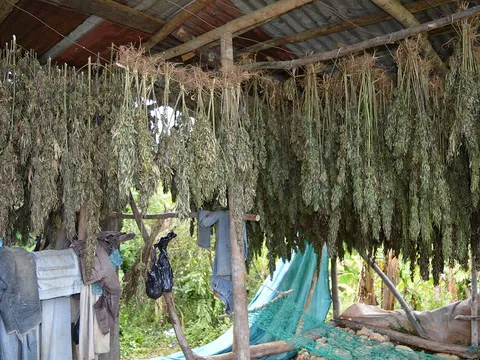 LanguageGanjaThe Hindi word for the flowering tops. Indian labourers carried it to the Caribbean, and it also became the usual word across South-East Asia.
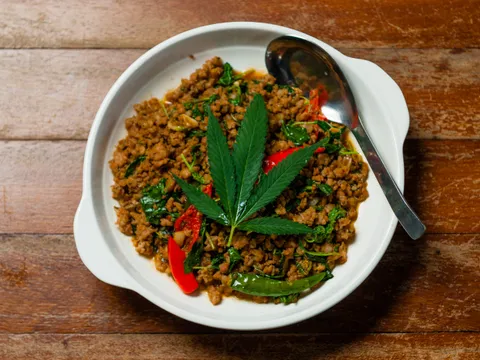 TraditionsCannabis in South-East Asian cookingIn Cambodia, Laos, Thailand and Vietnam the leaf was a seasoning and a household medicine long before it was a crime. The "happy" restaurants of the tourist towns are what is left in plain sight.
 TraditionsHmong hemp clothHmong women grew, spun and wove hemp for the family's clothes and decorated it with batik. Drug laws are one reason few still do.
Datasets not part of the score
What other organisations publish about Vietnam, and where it stands among the countries each one covers. Each dataset has a page of its own, with a world map and every country's figure.
Use
UNODC · 2002
Cannabis use
0.3%of people aged 15–64 (assumed)
survey 2002 · 210,000 people · earlier figure, not in UNODC 2026
Source Survey ages and years vary, and some surveys include children. Rates are not age-standardised; do not compare countries directly.WHO, Our World in Data · 2020
Alcohol drunk per person
8.04litres of pure alcohol a year
3.28 · 20003.28 · 20013.50 · 20023.92 · 20034.35 · 20044.81 · 20055.20 · 20065.73 · 20076.24 · 20086.83 · 20097.37 · 20107.81 · 20118.09 · 20128.28 · 20138.53 · 20148.85 · 20159.17 · 20169.31 · 20179.34 · 20189.34 · 20198.04 · 202020002020 Higher than 75% of 187 countriesLowestHighestper person aged 15 or over · 2020 · 3.28 in 2000 · 7.37 in 2010
Law
UNODC · 2024
Cannabis seized
2,580kg in 2024
4,500 · 2015480 · 20164,787 · 2017168 · 2018586 · 2019275 · 20201,756 · 2021467 · 2022727 · 20232,580 · 202420152024 Higher than 50% of 163 countriesLess seizedMore seized2,580 kg of herb · 4,500 kg in 2015 · 275 kg in 2020
Society
OpenAlex · 2025
Research on cannabis
0.0papers per million people
0.0 · 20070.0 · 20160.0 · 20180.0 · 20190.1 · 20200.1 · 20210.0 · 20220.0 · 20230.0 · 20240.0 · 202520072025 Higher than 1% of 176 countriesLowestHighest2 papers in 2025
Cato and Fraser Institutes · 2023
Human Freedom Index
5.29of 10
5.71 · 20005.64 · 20015.61 · 20025.34 · 20035.45 · 20045.63 · 20055.69 · 20065.61 · 20075.51 · 20085.63 · 20095.58 · 20105.38 · 20115.36 · 20125.37 · 20135.39 · 20145.43 · 20155.49 · 20165.49 · 20175.57 · 20185.56 · 20195.48 · 20205.47 · 20215.38 · 20225.29 · 202320002023 Higher than 18% of 164 countriesLess freeFreerrank #134 of 165 · personal freedom 4.64 · economic freedom 6.21
V-Dem, Our World in Data · 2025
Civil liberties
0.38of 1 in 2025
0.23 · 19760.23 · 19770.23 · 19780.23 · 19790.24 · 19800.24 · 19810.24 · 19820.24 · 19830.24 · 19840.24 · 19850.27 · 19860.29 · 19870.30 · 19880.30 · 19890.32 · 19900.34 · 19910.36 · 19920.36 · 19930.37 · 19940.37 · 19950.36 · 19960.36 · 19970.37 · 19980.39 · 19990.40 · 20000.40 · 20010.40 · 20020.40 · 20030.41 · 20040.41 · 20050.42 · 20060.42 · 20070.42 · 20080.42 · 20090.42 · 20100.42 · 20110.42 · 20120.45 · 20130.44 · 20140.44 · 20150.43 · 20160.42 · 20170.41 · 20180.38 · 20190.39 · 20200.36 · 20210.36 · 20220.35 · 20230.38 · 20240.38 · 202519762025 Higher than 22% of 175 countriesFewer libertiesMore liberties0.32 in 1990
Our World in Data, World Bank · 2025
Population
101,598,527people in 2025
11,800,814 · 190018,608,564 · 191018,390,657 · 192017,715,169 · 193019,114,980 · 194025,100,732 · 195032,531,929 · 196041,475,227 · 197052,490,098 · 198065,504,551 · 199077,154,016 · 200087,455,148 · 201098,079,196 · 2020101,598,527 · 202519002025 Higher than 92% of 196 countriesLowestHighest11,800,814 in 1900 · 25,100,732 in 1950 · 77,154,016 in 2000
CEPII
Former colonial rulers
Once ruled by France
World Bank · 2025
Government effectiveness
56of 100
40 · 199642 · 199838 · 200037 · 200238 · 200339 · 200443 · 200544 · 200643 · 200746 · 200847 · 200946 · 201047 · 201146 · 201247 · 201354 · 201454 · 201553 · 201653 · 201752 · 201852 · 201953 · 202052 · 202150 · 202249 · 202350 · 202456 · 202519962025 Higher than 56% of 195 countriesLowestHighestestimate 0.18 on a scale of −2.5 to 2.5 · 2025 · 38 in 2000 · 54 in 2015
Transparency International · 2024
Corruption Perceptions Index
40of 100
31 · 201231 · 201331 · 201431 · 201533 · 201635 · 201733 · 201837 · 201936 · 202039 · 202142 · 202241 · 202340 · 202420122024 Higher than 50% of 178 countriesLowestHighest0 highly corrupt, 100 very clean · 2024 · 31 in 2015 · 36 in 2020
Pew Research Center · 2020
Most common religion
Religiously Unaffiliated
the largest group · 2020
World Bank · 2025
Income per person
$15,457per person
2,468 · 19902,561 · 19912,726 · 19922,890 · 19933,090 · 19943,328 · 19953,584 · 19963,820 · 19973,983 · 19984,119 · 19994,349 · 20004,570 · 20014,810 · 20025,090 · 20035,421 · 20045,776 · 20056,098 · 20066,419 · 20076,659 · 20086,914 · 20097,275 · 20107,653 · 20117,980 · 20128,324 · 20138,752 · 20149,248 · 20159,743 · 201610,291 · 201710,937 · 201811,629 · 201911,851 · 202012,049 · 202112,980 · 202213,535 · 202314,396 · 202415,457 · 202519902025 Higher than 46% of 187 countriesLowestHighestat purchasing power parity, 2021 dollars · 2025 · $2,468 in 1990 · $7,275 in 2010
World Bank · 2024
Development indicators
84.2%use the internet
0% · 19900% · 19960% · 19970% · 19980.1% · 19990.3% · 20001.3% · 20011.9% · 20023.8% · 20037.6% · 200412.7% · 200517.3% · 200620.8% · 200723.9% · 200826.6% · 200930.6% · 201035.1% · 201136.8% · 201238.5% · 201341% · 201445% · 201553% · 201658.1% · 201769.8% · 201868.7% · 201970.3% · 202074.2% · 202178.6% · 202278.1% · 202384.2% · 202419902024 Higher than 57% of 195 countriesLowestHighest38.5% live in towns · 9% aged 65+ · life expectancy 74.7 · higher education 37.6% · 2024 · 0.3% in 2000 · 30.6% in 2010
GDELT · 2025
Cannabis in the news
0.002%of global news: cannabis articles from here
0.0017% · 20170.0024% · 20180.0027% · 20190.0024% · 20200.003% · 20210.0025% · 20220.0027% · 20230.0018% · 20240.002% · 202520172025 Higher than 85% of 147 countriesLowestHighest2025 average, 348 days · 0.0024% in 2018 · 0.003% in 2021
Plant and market
GBIF · 2025
Records of the cannabis plant
19dated records
2 · 18833 · 18844 · 19086 · 19137 · 19328 · 19379 · 201510 · 201914 · 202215 · 202318 · 202419 · 202518832025 Higher than 55% of 128 countriesLowestHighest6 more without a date · 1 in 2025
Enforcement 4 reports · the Cannabis Enforcement Tracker →
How the law above is applied: raids, seizures, fields destroyed, arrests and sentences, as recorded by the Cannabis Enforcement Tracker, our companion site.
- ArrestHo Chi Minh City arrests 151 in an inter-provincial cannabis ring
Ho Chi Minh City police said on 22 October 2026 that they had dismantled an inter-provincial cannabis ring led by Trần Huy Long, arresting 151 people and seizing 176.2 kg of cannabis and 178 e-cigarettes containing cannabis oil.
- SeizureVietnam reports 407 kg of cannabis seized in the first nine months of 2026
At a 7 September 2026 inter-agency conference, the drug police reported 17,600 cases and nearly 35,400 suspects since the start of the year.
- SentenceVietnam sentences two cannabis traffickers to death over 401 kg
On 12 June 2026, the Quảng Ninh provincial people's court sentenced 18 defendants in a cannabis ring that had used Telegram to take orders and arrange payment.
- SeizureVietnam breaks up a crypto-paid cannabis ring and seizes 550 kg
Anti-narcotics police announced on 20 December 2024 that they had broken up a cannabis ring that took payment through unverified bank accounts and cryptocurrency.
History 27 of 27 checked against a source
Score and entries per decade
3 today, from 100 before its first recorded change
This country's score Entries that moved the score Context only
20256 entries1 score change
Enforcement ✓
Vietnam reports nearly 1.3 tonnes of cannabis seized in 2025
At a 22 December 2025 inter-agency meeting, police reported 21,998 drug cases and 44,354 suspects for 2025. Seizures included 276 kg of heroin, nearly 1.3 tonnes of cannabis, and 4.4 tonnes plus nearly 2.1 million pills of synthetic drugs. The case and suspect figures cover all drugs; the cannabis figure is a seizure total. Police said synthetic-drug production and new psychoactive substances were multiplying, making control harder.
Other law ✓
Vietnam sets administrative fines for drug use and small cannabis plots
Decree 282/2025/NĐ-CP took effect on 15 December 2025, setting a warning or VND 1–2 million fine for drug use, VND 5–10 million for an individual growing fewer than 500 cannabis plants and VND 10–20 million for an organisation, with the plants destroyed. It also penalises teaching others to grow cannabis and allows deportation of foreigners. The decree restated administrative sanctions; it did not change the criminal thresholds.
Other law ✓
Vietnam raises the quantities for a death sentence for selling drugs
Law 86/2025/QH15 took effect on 1 July 2025. Illegal possession that is not for sale, transport or production is three to five years from 1 g of cannabis resin or 1 kg of the listed plant parts, and a prior penalty can make a smaller amount criminal. Illegal sale is three to seven years. Twenty years or life applies from 5 kg of resin or 75 kg of the listed plant parts. Life or death applies from 30 kg of resin or 150 kg of those plant parts. Death in that bracket is an alternative, not a required sentence. The same law removed death for illegal transport.
Tightening ✓ Article
Vietnam criminalises drug use in specified rehabilitation-related situations
From 1 July 2025, using drugs in specified rehabilitation or post-rehabilitation situations carries two to three years in prison, or three to five for recidivism of that offence. The rule includes people within two years after post-rehabilitation management ends only when they are also under illicit-user management. Ordinary first-detection monitoring alone does not meet these conditions.
43−1 point
Enforcement ✓
Vietnam reports nearly 2.3 tonnes of cannabis seized in 2024
At its 2024 review on 6 January 2025, the Ministry of Public Security reported 29,928 drug cases and 51,938 suspects for the year. Police seized 60 kg of opium, 680 kg of heroin, nearly 2.3 tonnes of cannabis, and 3.3 tonnes plus 3.3 million pills of synthetic drugs. The case and suspect counts cover all drugs; the cannabis figure is a seizure total, not a case count. The UN drugs office later recorded 2,580 kg of herbal cannabis for Vietnam in 2024, against 727 kg in 2023.
Tightening ✓
Vietnam raises drug-driving fines and suspends licences for up to two years
Decree 168/2024 took effect on 1 January 2025, setting administrative fines for driving with illicit drugs in the body: VND 30–40 million and a 22–24 month licence suspension for car drivers, and VND 8–10 million with the same suspension for motorcycle and moped riders. Refusing the drug test carries the same penalties. The rule has no quantified THC allowance.
20241 entry0 score changes
20221 entry0 score changes
20181 entry0 score changes
20092 entries1 score change
Easing ✓
Vietnam stops treating drug use as a crime
Resolution 33/2009/QH12 ended criminal liability for unlawful drug use under Penal Code Article 199 from promulgation of the amending law on 29 June 2009. Pending cases had to be discontinued and affected offenders received relief from unserved sentences and automatic expungement. The Supreme Court's July implementing letter confirmed the June date, ahead of the amending law's general 1 January 2010 commencement. Administrative measures and liability for other offences remained; cannabis possession and supply were not legalised.
34+1 point
Other law ✓
Vietnam adds harm reduction and mandatory post-treatment supervision
Law 16/2008/QH12 revised the drug-control framework. New Article 34a recognised harm-reduction interventions through programmes and projects. Revised Article 33 also required one to two years of supervision after compulsory institutional treatment, either at home or in a dedicated institution for people assessed as having a high risk of relapse. Revised Article 27 set family and community treatment at six to twelve months and allowed compulsory community treatment by local decision. The amendment was adopted on 3 June 2008 and took effect on 1 January 2009. These provisions concerned dependent drug users generally; they created no lawful cannabis-use exemption.
20011 entry0 score changes
20001 entry0 score changes
19972 entries1 score change
International ✓
Vietnam joins the 1988 UN convention against drug trafficking
Vietnam acceded to the United Nations Convention against Illicit Traffic in Narcotic Drugs and Psychotropic Substances of 1988 on 4 November 1997. Article 3 of the convention requires each party, subject to its constitutional principles, to make the possession, purchase and cultivation of drugs for personal consumption a criminal offence.
Tightening ✓ Article
Vietnam criminalises continued drug use after compulsory treatment
Continued illegal drug use after repeated education and administrative placement in compulsory treatment became punishable by three months to two years in prison; repeat offending carried two to five years. The expanded drug chapter also named cannabis in cultivation and quantity-based possession offences, retaining life or death for large quantities. The Supreme People’s Court confirmed commencement on 22 May and barred retrospective application of new offences or heavier penalties.
43−1 point
19911 entry0 score changes
19901 entry1 score change
19861 entry0 score changes
19701 entry0 score changes
19692 entries0 score changes
Enforcement ✓
South Vietnam: US forces test cannabis detection dogs
Two dog-handler teams arrived to help US forces detect cannabis in baggage and around barracks. The dogs had been retrained in Okinawa after the US command requested teams in May, drawing on US Customs experience at border stations. The command history reported finds of discarded cannabis before baggage inspections as the wider suppression campaign targeted both users and their supplies.
Enforcement ✓
South Vietnam begins destroying cannabis fields
US military aircraft began searching the Delta for cannabis fields so security forces could cut and burn the plants. The flights followed South Vietnam's 1968 directive against cultivation and formed part of a joint campaign against supplies reaching US troops. A later US health report estimated that half a million plants had been destroyed by 1971, mostly in the Delta.
19681 entry1 score change
19541 entry0 score changes
Sources hover a number in the text to see its source
- Cited
- 20
- Websites
- 13
- Last reviewed
- History checked
- 27/27
Most cited
- english.luatvietnam.vn4
- en.wikipedia.org3
- xaydungchinhsach.chinhphu.vn3
- azvlaw.vn1
- bocongan.gov.vn1
- data.unodc.org1
All 20 sources
- Chinhphu.vn — Article 249, illegal possession of narcotics, as amended by Law 86/2025/QH15 (14 July 2025)Article 249(1), (2) and (4). In force 1 July 2025.archived
- Vietnam — Penal Code 100/2015/QH13, consolidated text 11/VBHN-VPQH (24 February 2025, AZVLAW English)Articles 247–252; in force 1 January 2018.archived
- Vietnam — Decree 282/2025/NĐ-CP on administrative sanctions for security and public order violations (LuatVietnam English)Article 30; drug use, cultivation and guiding cultivation; effective 15 December 2025.archived
- Chinhphu.vn — Article 251, illegal sale of narcotics, as amended by Law 86/2025/QH15 (22 July 2025)Article 251(1), (4) and (5). In force 1 July 2025.archived
- Vietnam — Law 86/2025/QH15 amending the Penal Code (LuatVietnam English)Article 1(18)–(20), amending Articles 248–252; in force 1 July 2025.archived
- Vietnam State Audit Office — Law 86/2025/QH15 and Article 256a explanationArticle 256a(1)(a)–(d), (2); ordinary one-year monitoring versus rehabilitation/post-rehabilitation statuses; effective 1 July 2025archived
- Law No. 120/2025/QH15 on Drug Prevention and Control, 10 December 2025 (LuatVietnam English translation)Articles 2(5), 5(1), 13(1)(a), 24, 29 and 55; in force 1 July 2026.archived
- Vietnam — Decree 28/2026/NĐ-CP on the lists of narcotic substances and precursors (LuatVietnam English)Article 1 and List I; cannabis and its preparations; effective 19 January 2026.archived
- Ministry of Public Security — the Criminal Code amendment is in force from 1 July 2025Confirms commencement; Article 251 life-or-death bracket; death removed for illegal transport.archived
- Vietnam Ministry of Public Security via Tiếng Chuông — growing fibre hemp for cloth, fodder or fuel (26 March 2024)Fibre hemp not in the banned plant lists; extraction for drugs can be prosecuted.archived
- UNODC Data Portal — Drug seizures, reported seizures in kilogram equivalents (World Drug Report data)archived
- Vietnam Ministry of Public Security — 29,928 drug cases and 51,938 suspects in 2024 (6 January 2025)2024 summary conference; cases, suspects and cannabis seizures.archived
- Vietnam.vn — Nearly 22,000 drug-related crimes detected in 202521,998 cases, 44,354 suspects and nearly 1.3 tonnes of cannabis in 2025.archived
- Vietnam News — Inter-provincial cannabis trafficking ring dismantled, 151 suspects detained, 176 kg seized (October 2026)151 arrests and 176.2 kg of cannabis in Ho Chi Minh City.archived
- Government of Vietnam — Decree 168/2024/NĐ-CP, full textArticles 6(11)(c–d), 6(15)(c), 7(9)(e,g), 7(12)(c), 54archived
- VietnamNet — Vietnam busts maritime drug ring, seizes over 1.1 tons of narcotics (2026)More than 17,600 cases and nearly 35,400 suspects handled by September 2026.archived
- Wikipedia — Ganjaarchived
- Wikipedia — Hmong textile artarchived
- Wikipedia — Cannabis in Vietnamarchived
- International Narcotics Control Board — Travellers carrying medicines containing controlled substances