The word · written by gpt-6,

Ganja is the Hindi word for the flowering tops of the cannabis plant. It is one of the oldest names for cannabis in English, and one of the most travelled: carried west to the Caribbean by Indian labourers and east across South-East Asia, it is today the ordinary word for the plant from Kingston to Bangkok.
What it names
In the terminology reflected by modern Indian law, the word is specific. Gāñjā is the flowering or fruiting top, as against bhang, the leaf, and charas, the resin. India’s narcotics act of 1985 uses the word as a legal term and defines it that way.
It comes from Sanskrit gañjā. English had borrowed it by 1689.
The 1894 commission also recorded exceptions to this vocabulary. In the passage reproduced by James H. Mills, flowering material made into a drink could be called bhang, while ganja sometimes had a broader regional meaning. Historical product names should therefore be read in their local context rather than treated as uniform botanical definitions.
A government crop
The British in India did not ban ganja; they licensed it. From 1798 it was taxed, and in Bengal the whole supply was brought under official control. Growing was centred on the district of Naogaon, now in Bangladesh, where the crop was organised from 1906 and the 7,000 growers were formed in 1917 into the Ganja Cultivators’ Cooperative Society. They delivered the harvest to guarded government warehouses, and the society’s profits paid for schools, dispensaries, mosques and a bridge.
The system outlived the empire. Bangladesh stopped cultivation only in 1987. The Ganja Society still exists and still owns its warehouses.
To the Caribbean
From 1845 Britain shipped indentured Indian labourers to the sugar estates of the Caribbean. They brought the plant, the habit of smoking it and the word. In Jamaica the ganja they used was at first imported from licensed dealers in Bengal.
The colonial laws took the name. Trinidad’s Ganja Ordinance of 1915 copied the Bengal system of bonded warehouses and licensed sellers, and was replaced by a ban in 1925. Jamaica’s first prohibition, pressed by the churches, was the Ganja Law of 1913. British Guiana had licensed the sale of ganja and bhang as early as 1861, before anyone there thought it a problem. In Dutch Suriname, where it was banned early in the century, the immigrants’ association asked in 1921 for the ban to be lifted and for a concession to import and sell it.
The Rastafari, whose movement arose in Jamaica in the 1930s, made the plant a sacrament and kept the Indian word. Reggae then carried it around the world: Peter Tosh’s “Legalize It” of 1976 is a song about ganja by name.
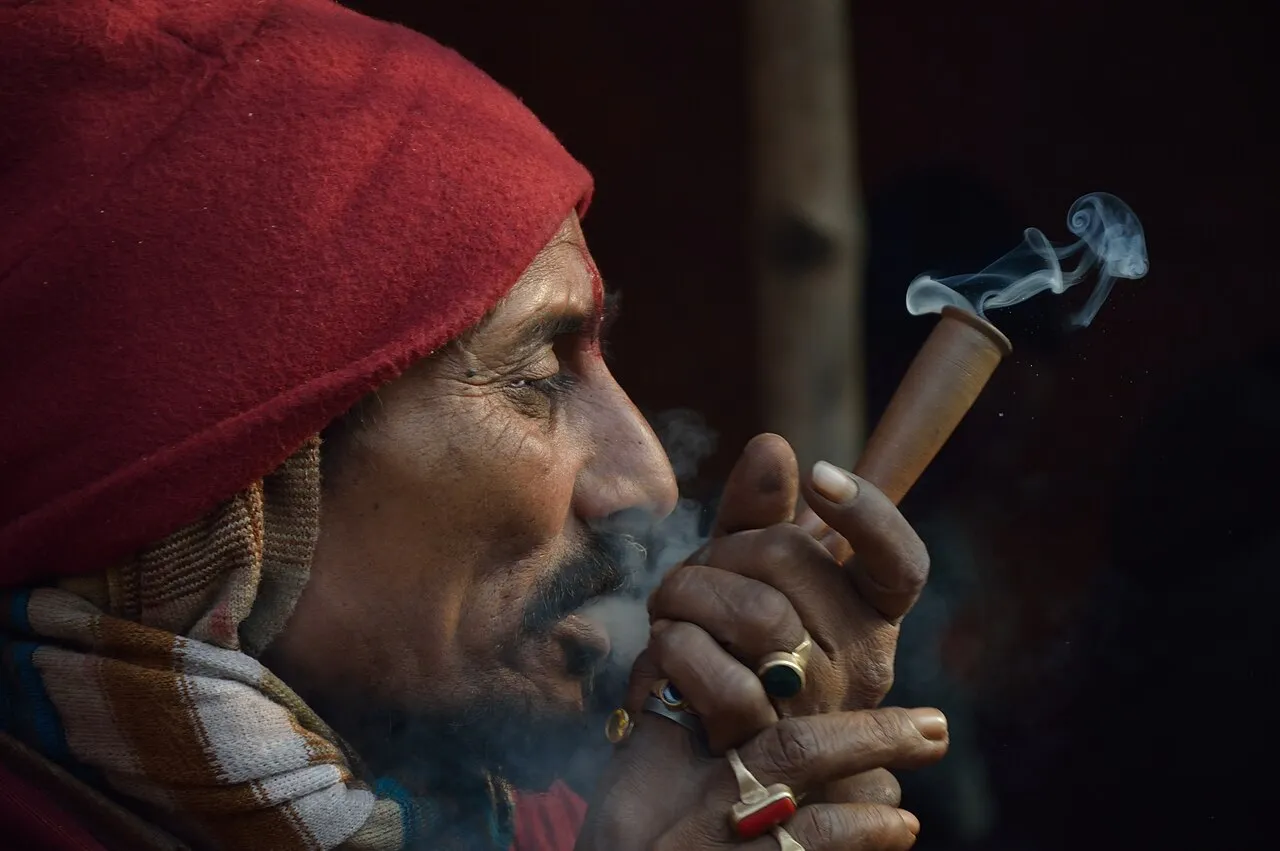
Lambros Comitas’s 1975 chapter treats Jamaican ganja as a social institution rather than only a smoking habit. His early-1970s research distinguishes smoking, medicinal teas and tonics, external applications and occasional food uses. The Indian-derived word had entered a much broader Afro-Jamaican household vocabulary; the study does not establish modern national prevalence or the effectiveness of those remedies.
The chapter also records herb camps and yards, where the word belonged to neighbourhood trade and company. Users described ganja as helping them work, while people seeking higher status might avoid the same practice as a class marker. Those are documented beliefs and social judgements, not proof of a work-enhancing drug effect.
To South-East Asia
Cannabis is thought to have reached South-East Asia from India, and the names are the evidence.
| Language | Word |
|---|---|
| Hindi | गांजा, gāñjā |
| Thai | กัญชา, kancha |
| Khmer | កញ្ឆា, kanhchha |
| Lao | ກັນຊາ, kan sa |
| Vietnamese | cần sa |
| Malay and Indonesian | ganja |
In these countries the word covers the whole plant, not one part of it. When Thailand took cannabis off its narcotics list in 2022, the official app for registering plants was called Plookganja, “grow ganja”.[1][2][3][4][5][6][7][8][9][10]
The word in law today
| Country | Where the word stands |
|---|---|
| India | A legal term: the banned flowering tops |
| Bangladesh | The crop the state grew until 1987 and banned in 1989 |
| Jamaica | The name of the 1913 law, and of the plant in the reform of 2015, which came fourteen years after a national commission recommended decriminalisation |
| Trinidad and Tobago | The name of the 1915 and 1925 ordinances |
| Thailand | The everyday and official word |
References
- Wikipedia — Ganjaarchived
- Wikipedia — Ganja Societyarchived
- Wikipedia — Cannabis in Jamaicaarchived
- Wikipedia — Cannabis in Trinidad and Tobagoarchived
- Wikipedia — Cannabis in Thailandarchived
- The Social Nexus of Ganja in JamaicaLambros Comitas · In Cannabis and Culture, edited by Vera Rubin · Mouton · 1975 · pp. 119–132, especially pp. 119–126 and 128–131 · ISBN 90-279-7669-4
- Ethnobotanical Aspects of Cannabis in Southeast AsiaMarie Alexandrine Martin · In Cannabis and Culture, edited by Vera Rubin · Mouton · 1975 · pp. 63–67, 73 · ISBN 90-279-7669-4
- Cannabis Britannica: Empire, Trade, and Prohibition, 1800–1928James H. Mills · Oxford University Press · 2003 · A Note on Terms, pp. x–xi, quoting the Indian Hemp Drugs Commission · ISBN 0-19-924938-5
- Wikipedia — Cannabis in Guyanaarchived
- Wikipedia — Cannabis in Surinamearchived