0/100
#191 of 196 worldwide
#44 of 48 in Asia
Class I narcotic. Since 2 January 2026, possessing plant material is up to twelve years and possessing dried cannabis over 5 g can bring life or twenty years. Aggravated sale or production can still be death. Medical use is prohibited.
In short all countries →
- Can I carry it?NoIt is a crime
- Can I grow it?NoIt is a crime
- Can I buy it?NoThere is no legal source
- Can I use it in public?NoUse itself is a crime
- What if I'm caught?Severe punishmentLong sentences or worse
A rough guide read from the scores and the rules below, not legal advice. The details and the exceptions are in each segment: select an answer to jump to it.
Cannabis in Indonesia not part of the score · all 20 datasets ↓
Who uses it
About 1 in 69
people aged 15–64 in Indonesia used cannabis in the past year: 2.8 million people.
- Past year
- 1.4%
- Asia median
- 2%
UNODC · survey 2019
Source Past-year cannabis use among people aged 15–64. People who used cannabis in the past year, from a 2019 survey, applied to today's population aged 15–64.Survey ages and years vary, and some surveys include children. Rates are not age-standardised; do not compare countries directly.
UNODC World Drug Report 2026, annex table 1.2. Population from the World Bank, aged 15–64. The whole dataset →
Use across Asia
24thhighest of 40 surveyed countries
- 🇱🇰 Sri Lanka2.0%
- 🇵🇭 Philippines1.5%
- 🇮🇩 Indonesia1.4%
- 🇲🇾 Malaysia1.4%
- 🇹🇷 Türkiye1.1%
Past-year use, latest survey of each. Survey years and ages differ. On the map →
What they think of it
“Is using marijuana morally acceptable?”
91% say it is morally unacceptable
- Acceptable 2%
- Not a moral issue 6%
- Depends or no answer 1%
- Unacceptable 91%
The most disapproving of the 25 countries surveyed, where the median is 52%. On the map →
Source Pew Research Center, surveyed January to May 2025, 1,022 adults (topline, question 17g).Cannabis in figures
- Police contact for drug use or possession6.5per 100,000 people · 2024
- Cannabis seized9,230kg in 2024 · 2024
- Cannabis shops on the map1shops mapped · 2026
- Research on cannabis0.2papers per million people · 2025
- Clinical trials of cannabis medicines2studies so far · 2026
The dot: where it stands among the countries each dataset covers, lowest to highest. All datasets ↓
Score breakdown 0/100 · how the scores are made
Cannabis is a Class I narcotic. Since 2 January 2026, planting or possessing it in plant form carries up to twelve years in prison and/or a category VI fine. More than 1 kg or at least six plants raises the penalty to life imprisonment or up to twenty years, and/or a higher fine. Possession under Article 111 has no death penalty or special minimum prison term.[1][2] Dried cannabis and resin are not "plant form": the new Criminal Code's Article 609 covers them, with up to twelve years for the basic offence and life or up to twenty years above 5 g.[3][2] Personal use under Article 127 carries up to four years; a person proved to be a victim of drug abuse must receive rehabilitation.[1]
| Amount | What happens | Punishment | Fine |
| Planting or possessing plant formUp to twelve years and/or a category VI fine; no minimum term | CriminalArticle 111 | Up to 12 years | Up to IDR 2,000,000,000 |
| Over 1 kg or at least six plantsLife imprisonment or up to twenty years and/or a higher fine | CriminalArticle 111 | — | — |
| Dried cannabis or resin, Article 609Above 5 g: life or up to twenty years | CriminalArticle 609 | Up to 12 years | Up to IDR 2,000,000,000 |
| Personal use, Article 127Up to four years; proven abuse victims must receive rehabilitation | CriminalArticle 127 | Up to 4 years | — |
Planting cannabis is punished under Article 111. Since 2 January 2026, the basic penalty is up to twelve years and/or a category VI fine. More than 1 kg or at least six plants carries life imprisonment or up to twenty years and/or a higher fine. The special minimum prison terms have been removed; Article 111 does not provide a death sentence.[2][1]
| Amount | What happens | Punishment | Fine |
| Planting or possessing plant formUp to twelve years and/or a category VI fine; no minimum term | CriminalArticle 111 | Up to 12 years | Up to IDR 2,000,000,000 |
| Over 1 kg or at least six plantsLife imprisonment or up to twenty years and/or a higher fine | CriminalArticle 111 | Up to 20 years | — |
Selling, buying, brokering or delivering a Class I narcotic carries life imprisonment or up to twenty years and/or a category VI fine. For plant-form cannabis, more than 1 kg or at least six plants can bring death, life imprisonment or up to twenty years and/or a higher fine under Article 114.[2][1] Giving a Class I narcotic to another person to use carries up to fifteen years and/or a category VI fine under Article 116(1). If it causes death or permanent disability, Article 116(2) allows death, life imprisonment or up to twenty years and/or a higher fine. The 2026 law removed the special minimum prison terms.[2][1]
| Amount | What happens | Punishment | Fine |
| Sale, purchase, brokerage or deliveryLife imprisonment or up to twenty years and/or a category VI fine | CriminalArticle 114 | Up to 20 years | Up to IDR 2,000,000,000 |
| Over 1 kg, at least six plants, or over 5 g non-plantDeath, life or up to twenty years and/or a higher fine | CriminalArticle 114 | Death or Up to 20 years | — |
| Giving to another to use, Article 116(1)Up to fifteen years and/or a category VI fine | CriminalArticle 116(1) | Up to 15 years | Up to IDR 2,000,000,000 |
| Giving causing death or disability, Article 116(2)Death, life or up to twenty years and/or a higher fine | CriminalArticle 116(2) | Death or Up to 20 years | — |
Using a Class I narcotic for oneself is a crime with up to four years in prison under Article 127; a judge may order treatment and rehabilitation, which counts towards the sentence.[1] An adult addict who does not report for treatment faces up to six months' custody or a fine, and so does a parent who does not report an addicted child.[5]
| Amount | What happens | Punishment | Fine |
| Personal use, Article 127Treatment and rehabilitation may count towards the sentence | CriminalArticle 127 | Up to 4 years | — |
Context not part of the score · every country, by topic →
Since 2 January 2026, aggravated sale or delivery under Article 114 can bring death, life imprisonment or up to twenty years and/or a higher fine.[2] For cannabis in plant form, the threshold is more than 1 kg or at least six plants.[2] Possession and planting under Article 111 carry prison penalties only.[2][1] The new Criminal Code’s Article 610 replaces the former production, import, export and distribution offence in Article 113: the same plant-weight or plant-count threshold can bring death, life imprisonment or up to twenty years and/or a category VI fine. For non-plant Class I narcotics the threshold is more than 5 g.[2] Giving a Class I narcotic to another person to use can also bring death under Article 116(2) if it causes death or permanent disability.[2][1] Death is one of three options, not mandatory. No executions have been carried out since July 2016; 639 people were on death row in April 2026, 441 for drug offences, and no cannabis-specific death sentence was found in 2024–2026.[6]
All recreational use is prohibited. Planting or possessing plant-form cannabis carries up to twelve years, personal use up to four years with rehabilitation, and aggravated sale can bring death; tourists in Bali are regularly jailed for years over a few grams.[1][2][4][5]
Prohibited absolutely: Class I narcotics may not be used for health services, and CBD is treated as cannabis.[1] The Constitutional Court rejected a challenge brought by mothers of children with cerebral palsy, while urging the government to research therapeutic use; the 2025 BNN university programme is research only.[7][8]
No cannabis clubs are known, and the law leaves no room for them: growing cannabis and supplying it to another person are both prohibited, and the law provides for the death penalty for the most serious drug offences.[5][4]
The Class I list covers the cannabis plant and all its parts, including seeds, fruit and straw, and its products.[1] Since 2 January 2026, unauthorised planting, keeping or possessing a Class I narcotic in plant form carries up to twelve years and/or a category VI fine under Article 111(1), without a special minimum prison term.[2]
No industrial-hemp or CBD exception was found. The Class I list covers the cannabis plant and all its parts, including seeds, fruit and straw, and its products; Class I narcotics may not be used for health services.[1] CBD is treated as cannabis.[7][4]
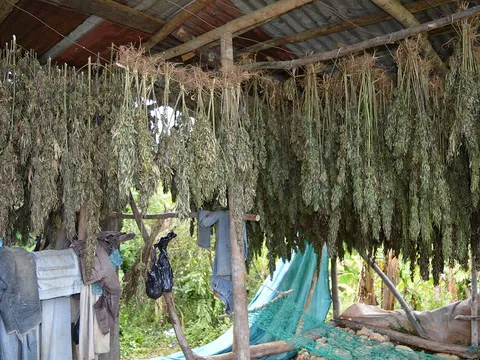
None. Cannabis has long been grown illicitly in Aceh, where the army burns fields each year.[5]
The illegal supply is domestic and centred on Aceh, in northern Sumatra, where the narcotics agency speaks of illicit cannabis production and destroys hill plantations every year.[9] In one operation in November 2025 it burned about 97,000 plants, some 69 tonnes wet weight, on six plots covering 6.5 hectares in North Aceh, with 151 officers from the agency, army, police and other bodies.[9] The village is one of four pilot sites of an alternative-development programme, with Aceh Besar, Bireuen and Gayo Lues, that trains growers to switch to legal crops.[9]
Bringing cannabis across the border is a separate offence: since 2 January 2026, unauthorised Class I importation carries up to fifteen years and/or a category V fine under Article 610.[2] For plant material over 1 kg or more than five plants, or for more than 5 g of non-plant cannabis, the aggravated offence can bring death, life imprisonment or up to twenty years and/or a category VI fine.[2] Travel advice warns that medicinal cannabis, oils, CBD, edibles and vapes are also illegal and screened at airports.[4] Domestic plant possession separately carries up to twelve years and/or a category VI fine; personal use under Article 127 carries up to four years, with rehabilitation required for a person proved to be a victim of abuse.[2][1]
Article 106(1) of Law 22/2009 requires proper driving with full concentration.[10] Its official explanation expressly includes alcohol or drugs affecting driving ability.[10] Article 283 punishes abnormal driving or a condition that disrupts concentration with up to three months' detention or a fine of up to Rp750,000.[10] This is a driving-ability rule, not a specified THC concentration in the provisions reviewed.[10] Article 314 also permits licence revocation or compensation as an additional penalty for traffic offences; licence loss is not automatic under article 283.[10]
Indonesia's prison figures cover all narcotics, not cannabis alone.[11] On 30 April 2026 prisons and detention centres held 271,602 people, 85% over capacity, and 146,376 of them, 53%, were there for narcotics offences.[11] In October 2026 the law minister said the government was preparing rehabilitation and re-education centres, mainly for drug users of working age, on the president's instruction.[11]
Long pre-trial detention, deportation and blacklisting for foreigners.[5]
Cannabis in Indonesia is known as ganja, and Aceh in northern Sumatra is the long-standing illicit growing region.[5] The plant is also part of older Acehnese and Malay medical and social traditions, but the modern narcotics law treats it as a Class I drug with no cultural exemption.[1]
In June 2025 the National Narcotics Board opened limited cannabis research to selected universities and began a pharmacy study with Udayana University, while insisting this was not legalisation.[8][12] No patient or commercial route exists, and medical use stays prohibited.[7][4]
Taking cannabis into or out of Indonesia is a separate offence from possessing it, normally charged as smuggling or trafficking, with far heavier penalties. That holds almost everywhere, including between two places where cannabis is legal.
In Indonesia the heaviest penalties, up to the death penalty, are aimed at trafficking, and bringing drugs across the border is treated as trafficking.
A prescription or medical card from another country is generally not recognised. Travellers who need a cannabis-based medicine should ask Indonesia's embassy before travelling.[13]
General guidance that applies to almost every country, not a check of Indonesia's customs rules.
Culture the atlas →
Did you know? all cases →
2017 · Indonesia
In Indonesia a man was jailed for eight months in 2017 for growing cannabis to treat his wife. She died while he was detained.
The full story →The floor
9 countries score exactly zero: Bahrain, Brunei, Comoros, Indonesia, Kuwait, Maldives, Nauru, Saudi Arabia and Singapore. In each, even a small amount means prison or corporal punishment.
Datasets not part of the score
What other organisations publish about Indonesia, and where it stands among the countries each one covers. Each dataset has a page of its own, with a world map and every country's figure.
Use
UNODC · 2019
Cannabis use
1.44%of people aged 15–64
0.44% · 20080.5% · 20100.91% · 20151.44% · 201920082019 ages 15–64 · survey 2019 · 2,800,000 people · UNODC 2026
Source Survey ages and years vary, and some surveys include children. Rates are not age-standardised; do not compare countries directly.WHO, Our World in Data · 2020
Alcohol drunk per person
0.07litres of pure alcohol a year
0.08 · 20000.08 · 20010.08 · 20020.07 · 20030.08 · 20040.08 · 20050.09 · 20060.09 · 20070.09 · 20080.10 · 20090.10 · 20100.11 · 20110.11 · 20120.11 · 20130.11 · 20140.11 · 20150.11 · 20160.11 · 20170.11 · 20180.11 · 20190.07 · 202020002020 Higher than 4% of 187 countriesLowestHighestper person aged 15 or over · 2020 · 0.08 in 2000 · 0.10 in 2010
Law
UNODC · 2024
Police contact for drug use or possession
6.5per 100,000 people
6.2 · 20204.2 · 20214.6 · 20225.6 · 20236.5 · 202420202024 Higher than 21% of 101 countriesFewerMore18,619 people in 2024 · all drugs together
UNODC · 2024
Cannabis seized
9,230kg in 2024
29,390 · 201513,892 · 2016151,671 · 201741,269 · 20182 · 201953,573 · 2020115,859 · 2021124,320 · 20229,891 · 20239,230 · 202420152024 Higher than 66% of 163 countriesLess seizedMore seized9,230 kg of herb · 29,390 kg in 2015 · 53,573 kg in 2020
Society
Pew Research Center · 2025
Is using marijuana morally wrong?
91%call it immoral
Higher than 96% of 25 countriesFewer disapproveMore disapprove2% acceptable · 6% not a moral issue · 1,022 people asked
OpenAlex · 2025
Research on cannabis
0.2papers per million people
0.0 · 20030.0 · 20040.0 · 20050.0 · 20060.0 · 20070.0 · 20100.0 · 20110.0 · 20120.0 · 20130.0 · 20140.0 · 20150.0 · 20160.0 · 20170.0 · 20180.1 · 20190.1 · 20200.1 · 20210.2 · 20220.2 · 20230.2 · 20240.2 · 202520032025 Higher than 30% of 176 countriesLowestHighest67 papers in 2025 · 2 in 2010
Cato and Fraser Institutes · 2023
Human Freedom Index
6.67of 10
6.61 · 20006.50 · 20016.71 · 20026.89 · 20036.88 · 20046.99 · 20057.07 · 20067.11 · 20077.05 · 20087.10 · 20097.22 · 20107.14 · 20117.10 · 20127.08 · 20137.11 · 20147.16 · 20157.20 · 20167.06 · 20177.05 · 20186.93 · 20196.68 · 20206.62 · 20216.81 · 20226.67 · 202320002023 Higher than 44% of 164 countriesLess freeFreerrank #92 of 165 · personal freedom 6.47 · economic freedom 6.96
V-Dem, Our World in Data · 2025
Civil liberties
0.63of 1 in 2025
0.14 · 19000.14 · 19010.14 · 19020.14 · 19030.14 · 19040.14 · 19050.15 · 19060.15 · 19070.16 · 19080.16 · 19090.16 · 19100.16 · 19110.16 · 19120.16 · 19130.16 · 19140.16 · 19150.16 · 19160.16 · 19170.16 · 19180.17 · 19190.17 · 19200.17 · 19210.17 · 19220.17 · 19230.17 · 19240.17 · 19250.16 · 19260.16 · 19270.16 · 19280.16 · 19290.16 · 19300.16 · 19310.16 · 19320.16 · 19330.16 · 19340.16 · 19350.16 · 19360.16 · 19370.16 · 19380.16 · 19390.15 · 19400.15 · 19410.10 · 19420.10 · 19430.10 · 19440.29 · 19450.52 · 19460.52 · 19470.52 · 19480.63 · 19490.63 · 19500.63 · 19510.63 · 19520.63 · 19530.64 · 19540.64 · 19550.63 · 19560.60 · 19570.54 · 19580.49 · 19590.43 · 19600.43 · 19610.43 · 19620.43 · 19630.43 · 19640.29 · 19650.24 · 19660.24 · 19670.22 · 19680.23 · 19690.23 · 19700.22 · 19710.22 · 19720.23 · 19730.25 · 19740.23 · 19750.23 · 19760.23 · 19770.23 · 19780.23 · 19790.22 · 19800.23 · 19810.23 · 19820.23 · 19830.23 · 19840.23 · 19850.23 · 19860.23 · 19870.23 · 19880.23 · 19890.23 · 19900.23 · 19910.20 · 19920.20 · 19930.20 · 19940.20 · 19950.19 · 19960.19 · 19970.33 · 19980.76 · 19990.77 · 20000.77 · 20010.79 · 20020.79 · 20030.78 · 20040.76 · 20050.76 · 20060.78 · 20070.78 · 20080.78 · 20090.79 · 20100.79 · 20110.78 · 20120.78 · 20130.78 · 20140.79 · 20150.78 · 20160.77 · 20170.75 · 20180.74 · 20190.70 · 20200.70 · 20210.75 · 20220.70 · 20230.70 · 20240.63 · 202519002025 Higher than 38% of 175 countriesFewer libertiesMore liberties0.17 in 1925 · 0.43 in 1961 · 0.23 in 1990
Our World in Data, World Bank · 2025
Population
285,721,236people in 2025
38,179,623 · 190042,820,498 · 191047,304,303 · 192053,422,386 · 193061,843,190 · 194068,799,031 · 195088,296,074 · 1960115,657,496 · 1970148,950,537 · 1980183,501,097 · 1990216,077,789 · 2000246,305,327 · 2010274,814,861 · 2020285,721,236 · 202519002025 Higher than 98% of 196 countriesLowestHighest38,179,623 in 1900 · 68,799,031 in 1950 · 216,077,789 in 2000
CEPII
Former colonial rulers
Once ruled by Netherlands
World Bank · 2025
Government effectiveness
58of 100
47 · 199637 · 199841 · 200035 · 200232 · 200336 · 200436 · 200542 · 200643 · 200747 · 200849 · 200951 · 201049 · 201151 · 201252 · 201360 · 201454 · 201557 · 201658 · 201760 · 201861 · 201960 · 202059 · 202160 · 202260 · 202358 · 202458 · 202519962025 Higher than 63% of 195 countriesLowestHighestestimate 0.26 on a scale of −2.5 to 2.5 · 2025 · 41 in 2000 · 54 in 2015
Transparency International · 2024
Corruption Perceptions Index
37of 100
32 · 201232 · 201334 · 201436 · 201537 · 201637 · 201738 · 201840 · 201937 · 202038 · 202134 · 202234 · 202337 · 202420122024 Higher than 43% of 178 countriesLowestHighest0 highly corrupt, 100 very clean · 2024 · 36 in 2015 · 37 in 2020
Pew Research Center · 2020
Most common religion
Muslims
the largest group · 2020
World Bank · 2025
Income per person
$15,091per person
4,873 · 19905,118 · 19915,357 · 19925,609 · 19935,931 · 19946,313 · 19956,695 · 19966,897 · 19975,898 · 19985,856 · 19996,056 · 20006,191 · 20016,382 · 20026,599 · 20036,844 · 20047,141 · 20057,434 · 20067,802 · 20078,165 · 20088,435 · 20098,848 · 20109,275 · 20119,709 · 201210,122 · 201310,504 · 201410,894 · 201511,320 · 201611,773 · 201712,262 · 201812,758 · 201912,389 · 202012,757 · 202113,334 · 202213,890 · 202314,471 · 202415,091 · 202519902025 Higher than 45% of 187 countriesLowestHighestat purchasing power parity, 2021 dollars · 2025 · $4,873 in 1990 · $8,848 in 2010
Wikimedia · 2026.792
Views of the cannabis article on Wikipedia
29page views in 2026–10
6,676 · 20158,487 · 20159,362 · 201511,586 · 201515,398 · 201513,825 · 201513,256 · 201613,067 · 201614,133 · 201614,750 · 201614,312 · 20167,849 · 20166,927 · 20169,973 · 201610,787 · 201612,305 · 201616,413 · 201611,099 · 201610,539 · 201710,503 · 201712,612 · 201714,209 · 201712,573 · 20178,582 · 20179,739 · 201711,837 · 201710,677 · 201712,633 · 201716,339 · 201710,617 · 201711,302 · 201810,637 · 201812,675 · 201810,646 · 201810,542 · 20186,339 · 20188,410 · 20189,803 · 201810,403 · 201813,454 · 201821,939 · 201813,934 · 201814,061 · 201916,808 · 201920,033 · 201918,075 · 201916,903 · 201912,834 · 201922,916 · 201917,256 · 201916,065 · 201918,108 · 201922,708 · 201912,880 · 201912,865 · 202019,333 · 202018,081 · 202017,480 · 202011,453 · 202018,964 · 20207,259 · 20206,831 · 20207,578 · 20208,459 · 202012,155 · 20209,086 · 20206,328 · 20216,062 · 20218,110 · 20217,203 · 20215,084 · 20218,795 · 20213,615 · 20213,432 · 20214,475 · 20214,537 · 20216,359 · 20214,692 · 20214,024 · 20223,709 · 20224,529 · 20224,423 · 20224,573 · 20227,197 · 20225,113 · 20225,311 · 20226,402 · 20227,622 · 20229,397 · 20225,060 · 20226,186 · 20237,436 · 20238,325 · 20235,645 · 20239,937 · 20237,234 · 20235,519 · 20236,744 · 20236,732 · 20236,980 · 20236,871 · 20235,581 · 20235,595 · 20244,767 · 20246,065 · 20245,815 · 20246,524 · 20244,694 · 202410,216 · 20247,217 · 20248,252 · 20248,022 · 20247,580 · 20245,770 · 202413,254 · 20255,259 · 202521,393 · 20256,869 · 20255,964 · 20253,979 · 20253,870 · 20254,012 · 20254,728 · 20254,624 · 20255,870 · 20252,846 · 20252,416 · 20261,755 · 20261,603 · 20261,860 · 20261,715 · 20261,662 · 20261,550 · 20261,322 · 20261,324 · 202629 · 202620152026 Higher than 65% of 26 countriesLowestHighestGanja · id Wikipedia
World Bank · 2024
Development indicators
72.8%use the internet
0% · 19900% · 19940% · 19950.1% · 19960.2% · 19970.3% · 19980.4% · 19990.9% · 20002% · 20012.1% · 20022.4% · 20032.6% · 20043.6% · 20054.8% · 20065.8% · 20077.9% · 20086.9% · 200910.9% · 201012.3% · 201114.5% · 201214.9% · 201317.1% · 201422.1% · 201525.4% · 201632.3% · 201739.9% · 201847.7% · 201953.7% · 202062.1% · 202166.5% · 202269.2% · 202372.8% · 202419902024 Higher than 41% of 195 countriesLowestHighest58.8% live in towns · 7.3% aged 65+ · life expectancy 71.3 · 2024 · 0.9% in 2000 · 10.9% in 2010
GDELT · 2025
Cannabis in the news
0.0037%of global news: cannabis articles from here
0.0045% · 20170.004% · 20180.0054% · 20190.0076% · 20200.0067% · 20210.0053% · 20220.005% · 20230.0036% · 20240.0037% · 202520172025 Higher than 89% of 147 countriesLowestHighest2025 average, 348 days · 0.004% in 2018 · 0.0067% in 2021
Plant and market
OpenStreetMap · 2026
Cannabis shops on the map
1shops mapped
Higher than 0% of 59 countriesFewer shopsMore shops0.0 per million people · 2026
GBIF · 1919
Records of the cannabis plant
1dated records
Higher than 0% of 128 countriesLowestHighest3 more without a date · 1 in 1919
ClinicalTrials.gov · 2026
Clinical trials of cannabis medicines
2studies so far
1 · 20171 · 20181 · 20191 · 20201 · 20212 · 20222 · 20232 · 20242 · 20252 · 202620172026 Higher than 14% of 50 countriesLowestHighest0 actual starts in 2026 · as of 2026–10–26 · 1 by 2020
Enforcement 8 reports · the Cannabis Enforcement Tracker →
How the law above is applied: raids, seizures, fields destroyed, arrests and sentences, as recorded by the Cannabis Enforcement Tracker, our companion site.
- ArrestAceh police find 18 hectares of cannabis and arrest four farmers
A 90-person joint team found about 18 hectares of cannabis in Teupin Reusep, North Aceh, on 27 October 2026 and handed four farmers to police. The plants were one to two metres tall and two to four months old.
- SeizureTwo-week Padangsidimpuan drive nets 36 kg of ganja, 11 held
Padangsidimpuan police reported on 24 October 2026 that case work and an 11-site drug-den operation between 9 and 22 October seized 36.23 kg of ganja and half a kilo of meth.
- SeizureIndonesia seizes 3.37 tonnes of Thai cannabis buds in East Java
A joint BNN, customs and East Java police operation from 29 June to 1 July 2026 found 3.37 tonnes of cannabis buds from Thailand in 500 suitcases and 80 cartons at a warehouse in Gresik.
- ProsecutionA Bali court gives a Dutch cannabis grower three years, not death
Police arrested a 31-year-old Dutchman and his Russian wife on 1 October 2025 after finding a hydroponic cannabis farm in their rented Denpasar house.
- Eradication97,000 cannabis plants destroyed in North Aceh
Indonesia's national narcotics agency led 151 officers into six fields near the village of Teupin Rusep and destroyed about 97,000 plants, some 69 tonnes by wet weight, on 6.5 hectares.
- SeizureBNN burns 69 tonnes of cannabis in North Aceh
Six plots covering 6.5 hectares in Teupin Reusep, North Aceh, held about 97,000 cannabis plants and 69 tonnes wet weight; 151 personnel destroyed them in place on 6 November 2025.
- SeizureIndonesia burns seven tonnes of ripe cannabis in Aceh
BNN destroyed about seven tonnes wet weight of mostly ready-to-harvest cannabis on four hectares in Aceh Besar, roughly 20,000 plants, on 6 March 2024.
- SentenceNearly 38,000 people are imprisoned in Indonesia for using cannabis in four years
Between 2009 and 2012, 37,923 people were imprisoned for using cannabis, according to figures cited by the Transnational Institute, even though the 2009 narcotics law and a Supreme Court circular were meant to send users to rehabilitation.
History 31 of 31 checked against a source
Score and entries per decade
0 today, from 100 before its first recorded change
This country's score Entries that moved the score Context only
20262 entries0 score changes
Debate ✓
Government sets an end-2026 target for a Narcotics Law rewrite
The government said on 9 October 2026 that it would speed up a revision of the Narcotics and Psychotropics laws, mainly to separate drug users from dealers and to expand rehabilitation. The bill was still with parliament and the government was preparing its response; no new narcotics law had been passed. The article described rehabilitation and the user/dealer distinction, not cannabis legalisation.
Easing ✓
Indonesia removes minimum prison terms for cannabis offences
People prosecuted for planting or possessing cannabis no longer face a special four-year minimum prison term: the basic maximum remains twelve years, with prison and/or a fine. The reform also removes minimum terms for sale and giving drugs to another person, while retaining life and death alternatives for specified serious offences. It took effect alongside the new Criminal Code on 2 January 2026: Article 112 was repealed and non-plant possession moved to Article 609, Article 113 became Article 610, and Article 114 was kept with its life and death alternatives.
20251 entry0 score changes
20241 entry0 score changes
20231 entry0 score changes
20221 entry0 score changes
20171 entry0 score changes
20161 entry0 score changes
20151 entry0 score changes
20142 entries0 score changes
Other law ✓
Aceh's Islamic criminal code sets 40 lashes for alcohol, not cannabis
Aceh adopted Qanun 6/2014 on Jinayat, which defines khamar as an intoxicating drink containing at least 2% alcohol and sets 40 lashes for drinking it, with up to 60 lashes, a 600-gram gold fine or 60 months in prison for making, importing or selling it. The qanun took effect a year later. Its text creates no cannabis offence, leaving cannabis to the national narcotics law.
Other law ✓
Indonesian agencies sign a joint regulation on rehabilitating drug users
The head of the Supreme Court, the ministers of justice, health and social affairs, the attorney general and the heads of the police and the National Narcotics Board signed a joint regulation on sending drug users, including suspects and convicts, to rehabilitation. Like the Supreme Court circular before it, which treats a person with no more than 5 g of cannabis as a user, it works inside the framework of punishment; the Transnational Institute describes both as de-penalisation, with a judge's decision resting on an assessment team whose advice police investigators often ignore.
20101 entry0 score changes
20092 entries0 score changes
Tightening ✓
Indonesia adopts its current Narcotics Law
Law 35 kept cannabis in the most restricted class and prohibited medical use. Personal use carries up to four years or rehabilitation, while possession or growing carries four to twelve years and large-scale supply can bring life imprisonment or death.
Easing ✓
Indonesia's Supreme Court issues initial guidance on rehabilitation for drug users
Supreme Court Circular 7/2009 addressed placing drug users in therapy and rehabilitation facilities. The court's archive dates it to 17 March 2009. A later Transnational Institute review describes conditions and procedures distinguishing users from dealers by quantities found at arrest, and records that a 2010 circular revised the guidance. This introduced a route within the criminal-law framework, not decriminalisation or an automatic entitlement to rehabilitation. The account relies on the official catalogue and the retrospective review; the original scanned circular has not been successfully read.
20072 entries0 score changes
Death penalty ✓
Indonesia's Constitutional Court upholds capital punishment under the narcotics law
In cases 2-3/PUU-V/2007, the Constitutional Court rejected Indonesian applicants' constitutional challenge to death-penalty provisions of the 1997 Narcotics Law. Foreign applicants' petitions were inadmissible for lack of standing. The judgment preserved existing capital sanctions within the broader drug-control framework; it did not introduce a new cannabis penalty or concern cannabis alone.
Other law ✓
Indonesia reorganises its national and regional narcotics boards
Presidential Regulation 83/2007 replaced the 2002 decree governing the National Narcotics Board. It set out separate national, provincial and district or city organisations, their executive staff, task forces, reporting and funding. Provincial boards answered to governors and district or city boards to regents or mayors, with national coordination through BNN. Regional boards had already been authorised in 2002; this was a more detailed organisational framework, not a new cannabis offence or the first regional enforcement presence. It took effect when signed on 23 July 2007.
20031 entry0 score changes
20021 entry0 score changes
19991 entry0 score changes
19971 entry1 score change
19801 entry0 score changes
19762 entries1 score change
International ✓
Indonesia joins the Single Convention on Narcotic Drugs
Indonesia ratified the Single Convention on Narcotic Drugs of 1961 on 3 September 1976. The convention lists cannabis and cannabis resin among its controlled drugs and obliges its parties to limit their production, trade, possession and use to medical and scientific purposes.
Tightening ✓ Article
Independent Indonesia passes its first narcotics law
Law 9 replaced the Dutch colonial ordinance while keeping cannabis restricted to medical and scientific purposes. It raised punishment to two years for personal use, six years for growing, possessing or small-scale supply, and as much as life imprisonment for trafficking.
123−9 points
19611 entry0 score changes
19581 entry0 score changes
19491 entry0 score changes
19351 entry0 score changes
19271 entry1 score change
19241 entry1 score change
19181 entry0 score changes
17411 entry0 score changes
Sources hover a number in the text to see its source
- Cited
- 13
- Websites
- 13
- Last reviewed
- History checked
- 31/31
Most cited
- bnn.go.id1
- en.tempo.co1
- ganjapreneur.com1
- incb.org1
- jdih.bnn.go.id1
- jdihdprd.bandungkab.go.id1
All 16 sources
- Indonesia National Narcotics Agency — Law 35 of 2009 on Narcotics, original official textAnnex I item 8; Articles 8, 111, 114, 116 and 127. Read penalties with Law 1/2026 Annex II; Article 113 repealed in 2026.
- Indonesia — Law 1 of 2026 on Penal Adjustments, official gazette textArticle VII point 51, amended Criminal Code Article 610(1)–(2), pp. 37–38; Annex II Articles 111, 114–116; commencement 2 January 2026archived
- Indonesia — Criminal Code (KUHP) Law 1/2023, articles 609–610Article 609 possession of non-plant cannabis; Article 610 production, import, export and distribution.archived
- The Sun (Malaysia) — Indonesian court rejects call to legalise medicinal marijuanaarchived
- Ganjapreneur — Indonesia high court rejects medical cannabis use and upholds drug lawsarchived
- Jakarta Post — Indonesia keeps death penalty despite execution hiatus (25 October 2026)No executions since July 2016; 639 on death row, 441 drug-related.archived
- Tempo — Indonesian Constitutional Court rejects medical cannabis appeal
- BNN — Research on cannabis is not legalisation (June 2025)archived
- Metro TV News — BNN musnahkan 69 ton ganja di Aceh Utara (6 November 2025)archived
- Indonesia — Law 22/2009 on Road Traffic and Transportation (JDIH BPK)Articles 106(1), 283 and 314; explanation of article 106(1)archived
- RRI — Indonesia prison population reaches 271,602 amid overcrowding (5 October 2026)archived
- Kompas — BNN and Udayana University study medical cannabis (15 July 2025)archived
- International Narcotics Control Board — Travellers carrying medicines containing controlled substances
Also consulted
- Supreme Court of Indonesia — Implikasi UU Penyesuaian Pidana terhadap perbuatan pidana narkotika (28 January 2026)Law 1 of 2026, issued 2 January 2026; Articles 111, 114 and 115 as adjusted; Articles 112, 113, 117, 118, 122 and 123 repealed
- Hukumonline — Bisakah dipidana jika menggunakan ganja untuk penyedap makanan? (quoting Annex I, item 8 of Law 35/2009)archived
- UK Foreign, Commonwealth & Development Office — Indonesia travel adviceIllegal drugs and prison sentences: cannabis products, medicinal preparations and airport screeningarchived