Trinidad and Tobago
39/100
#11 of 196 worldwide
#5 of 23 in North America
Adults may ordinarily hold up to 30 g and grow four plants, but possession around children at specified premises or on school buses can bring five years in prison. There is no legal market.
In short all countries →
- Can I carry it?LimitedUp to 30 g ordinarily; school buses and specified premises with children remain criminal
- Can I grow it?YesA few plants at home are legal
- Can I buy it?NoThere is no legal source
- Can I use it in public?NoIn private only
- What if I'm caught?Depends on the settingEven within the quantity allowance, possession on a school bus or at specified premises with children can bring five years
A rough guide read from the scores and the rules below, not legal advice. The details and the exceptions are in each segment: select an answer to jump to it.
Cannabis in Trinidad and Tobago not part of the score · all 15 datasets ↓
Who uses it
About 1 in 21
people aged 15–64 in Trinidad and Tobago used cannabis in the past year: 46,000 people.
- Past year
- 4.8%
- North America median
- 6.9%
UNODC · survey 2017
Source Past-year cannabis use among people aged 15–64. People who used cannabis in the past year, from a 2017 survey, applied to today's population aged 15–64.Survey ages and years vary, and some surveys include children. Rates are not age-standardised; do not compare countries directly.
UNODC World Drug Report 2026, annex table 1.2. Population from the World Bank, aged 15–64. The whole dataset →
Use across North America
13thhighest of 22 surveyed countries
- 🇻🇨 Saint Vincent and the Grenadines7.1%
- 🇨🇷 Costa Rica6.8%
- 🇹🇹 Trinidad and Tobago4.8%
- 🇬🇹 Guatemala3.5%
- 🇧🇸 Bahamas3.1%
Past-year use, latest survey of each. Survey years and ages differ. On the map →
Cannabis in figures
- Police contact for drug use or possession107per 100,000 people · 2022
- Cannabis seized4kg in 2024 · 2024
- Research on cannabis2.9papers per million people · 2025
- Cannabis in the news0.0004%of global news: cannabis articles from here · 2025
The dot: where it stands among the countries each dataset covers, lowest to highest. All datasets ↓
Score breakdown 39/100 · how the scores are made
Similar scores in North America
- 🇬🇩 Grenada39
- 🇱🇨 Saint Lucia39
- 🇹🇹 Trinidad and Tobago39
- 🇦🇬 Antigua and Barbuda37
- 🇯🇲 Jamaica35
The ordinary exemption is 30 g of cannabis or 5 g of resin.[3] It does not override section 5C(b): possession on a school bus, or at premises where children are present for education, sport or cultural activities, carries TT$250,000 and five years on summary conviction.[3] The separate school-vicinity trafficking presumption in section 5(7) expressly excludes people covered by section 5(2).[3] Moderate overages have a ticket scheme; larger amounts remain criminal.[3]
| Amount | What happens | Punishment | Fine |
| Up to 30 gCannabis flower; 5 g for resin. Does not apply on school buses or at specified children's-activity premises | LegalExempt personal quantity | — | — |
| Over 30 g, up to 60 gCannabis flower; 5–10 g for resin. A TT$2,000 fixed-penalty notice may be offered instead; an unpaid court fine can become 30 hours' community service | CriminalTT$50,000 fine on summary conviction | — | Up to TTD 50,000 |
| Over 60 g, up to 100 gCannabis flower; 10–14 g for resin. An unpaid court fine can become 50 hours' community service | CriminalTT$75,000 fine on summary conviction | — | Up to TTD 75,000 |
| Over 100 gCannabis flower; over 14 g for resin. On indictment, TT$1 million and up to fifteen years | CriminalTT$250,000 and five years on summary conviction | — | — |
| Any amount on a school bus or at specified children's-activity premisesSection 5C(b) overrides the personal-quantity exemption in these settings | CriminalTT$250,000 and five years on summary conviction | — | — |
Each adult may grow up to four plants at home.[3][1][4] More than four is an offence, punished far more harshly than an over-limit possession.[3][5]
| Amount | What happens | Punishment | Fine |
| Up to 4 plantsPer adult, at home | LegalHome growing | — | — |
| Over 4 plantsOn indictment, TT$2 million or ten times the street value, and up to life imprisonment | CriminalTT$750,000 and ten years on summary conviction | — | — |
None in operation. The Cannabis Control Act, Act No. 10 of 2022, was assented to on 17 June 2022 and published in the Gazette on 23 June 2022.[6][7] Section 2 brings it into operation only on a date the President fixes by proclamation.[6] Parliament's record of the 2020 bill, which became that Act, still says assent is awaiting proclamation.[8] The only lawful source today is an adult's own four plants.
Context not part of the score · every country, by topic →
Adults get cannabis from their own four home-grown plants: possession of 30 g of home-grown flower or 5 g of resin is ordinarily exempt, and private use is generally lawful.[3][1] Nothing is lawfully sold — there are no shops, because the 2022 licensing Act was never proclaimed — and supply stays criminal.[6][1] Smoking in public brings a TT$2,000 ticket, and school buses and children's-activity premises carry five-year sentences even for small amounts.[3] The 2019 reform is traced in the decriminalisation decision.
The 2022 Act provides for medicinal-cannabis licences, including a dispensary licence, but those licences do not operate until the President proclaims a commencement date.[6] There is no working medical programme.[8]
No cannabis clubs are known, and no law provides for them: the 2019 amendment removed penalties for possession and home growing but not for supply, and selling remains a crime.[1][4]
The 2019 amendment defines cannabis to include the plant's seeds, other than sterilised seed that cannot germinate.[3] Seeds therefore count towards the thirty grammes an adult may hold, and a person may grow or have up to four growing plants.[3] Because seeds and plants are cannabis in law, supplying them falls under the trafficking offences.[3]
Trinidad and Tobago has no industrial-hemp or low-THC exemption: cannabis grown for fibre counts as cultivation like any other.[3] The 2019 definition only carves out stalk fibre, seed oil, sterile seed and products combined with other ingredients.[5] The unproclaimed 2022 licensing Act contains no hemp regime either.[6]
The 2022 Act would create a Cannabis Licensing Authority and licences for cultivation, processing and sale, once the President proclaims a commencement date.[6] No proclamation is recorded, so commercial cultivation is not licensed.[8]
With no legal market, all cannabis beyond home growing changes hands illegally, and the islands sit on a transit route: in back-to-back operations around 1 October 2025 police seized 1,177 kg of Colombian "creepy" marijuana and 117 kg of cocaine at Palo Seco, days after 202 kg of Colombian marijuana was taken off Point Fortin, with a combined street value over TT$314 million.[9] Smuggling from Venezuela is an old pattern — producers grew across the gulf and ran it back in the 1890s (see the Venezuela smuggling entry).
There is no legal recreational market for visitors or residents.[6] The ordinary personal quantity allowance does not permit possession on school buses or at premises where children attend education, sport or cultural activities; section 5C(b) carries TT$250,000 and five years on summary conviction.[3]
Motor Vehicles and Road Traffic Act section 70 prohibits driving, attempting to drive or being in charge on a road while drug influence prevents proper vehicle control.[10] The Transport Ministry's published text gives a first-conviction penalty of TT$12,000 and three years' imprisonment, rising to TT$22,500 and five years on a subsequent conviction.[10] Two consecutive offences normally bring three years' disqualification, subject to special reasons and the court's power to impose a longer ban; a third conviction brings permanent disqualification.[10] Police may arrest without a warrant.[10] Section 70A separately concerns alcohol concentrations: the Finance Act 2025 doubled its fines, without amending section 70's drug-impairment penalty.[11] Separately, Dangerous Drugs Act section 5C(c) covers control of a motor vehicle, aircraft or ship while under cannabis influence, carrying TT$250,000 and five years on summary conviction.[3] No numeric THC allowance was established in the sources reviewed.[3][10]
Before the 2019 reform, police arrested thousands a year for cannabis: 3,128 men and 265 women in 2012, 3,220 men and 270 women in 2015, and 3,022 men and 201 women in 2017.[12]
Section 5D provides discharge and expungement routes for earlier small-possession cases; a pardon may follow expungement.[3][5] New offences can still create a criminal record, including section 5C(b) possession in specified settings involving children.[3]
Ganja came to Trinidad with indentured labourers from India, who grew it for their own use from the mid-19th century; the Hindi word ganja came with them.[1] The colonial state first licensed the trade — Trinidad's Ganja Ordinance of 1915 copied Bengal's warehouse system — then banned it in the 1925 ban.[1] The 1890s smuggling trade across the Gulf of Paria, with growers working Venezuelan soil and running the crop back, is traced in the Venezuela smuggling entry.
Taking cannabis into or out of Trinidad and Tobago is a separate offence from possessing it, normally charged as smuggling or trafficking, with far heavier penalties. That holds almost everywhere, including between two places where cannabis is legal.
The rules that allow or tolerate small amounts inside Trinidad and Tobago do not cover the border, an airport or the post.
A prescription or medical card from another country is generally not recognised. Travellers who need a cannabis-based medicine should ask Trinidad and Tobago's embassy before travelling.[13]
General guidance that applies to almost every country, not a check of Trinidad and Tobago's customs rules.
Culture the atlas →
Did you know? all cases →
1915 · Trinidad
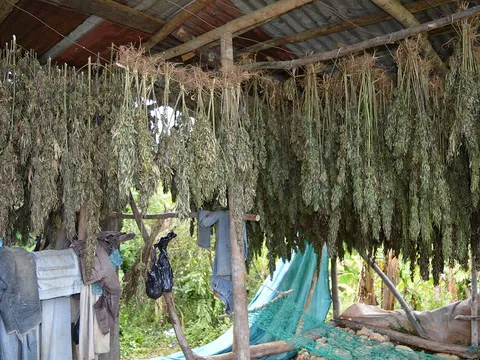
Trinidad and Tobago set up licensed ganja sellers in 1915. Ten years later it banned the plant outright.
The full story →
Datasets not part of the score
What other organisations publish about Trinidad and Tobago, and where it stands among the countries each one covers. Each dataset has a page of its own, with a world map and every country's figure.
Use
UNODC · 2017
Cannabis use
4.79%of people aged 15–64
3.7% · 20024.66% · 20064.03% · 20104.79% · 201720022017 ages 15–64 · survey 2017 · 46,000 people · UNODC 2026
Source Survey ages and years vary, and some surveys include children. Rates are not age-standardised; do not compare countries directly.WHO, Our World in Data · 2020
Alcohol drunk per person
6.03litres of pure alcohol a year
5.01 · 20005.01 · 20015.22 · 20025.55 · 20035.76 · 20045.99 · 20056.15 · 20066.22 · 20076.19 · 20086.16 · 20096.15 · 20106.18 · 20116.20 · 20126.24 · 20136.27 · 20146.23 · 20156.12 · 20166.01 · 20176.06 · 20186.06 · 20196.03 · 202020002020 Higher than 61% of 187 countriesLowestHighestper person aged 15 or over · 2020 · 5.01 in 2000 · 6.15 in 2010
Law
UNODC · 2022
Police contact for drug use or possession
107per 100,000 people
69 · 2020107 · 202220202022 Higher than 65% of 101 countriesFewerMore1,462 people in 2022 · all drugs together
UNODC · 2024
Cannabis seized
4kg in 2024
2,541 · 20151,200 · 20162,890 · 20192,360 · 20203,488 · 2021584 · 20223 · 20234 · 202420152024 Higher than 2% of 163 countriesLess seizedMore seized4 kg of herb · 2,541 kg in 2015 · 2,360 kg in 2020
Society
OpenAlex · 2025
Research on cannabis
2.9papers per million people
0.7 · 19760.7 · 19910.7 · 19980.7 · 20040.7 · 20060.7 · 20081.5 · 20090.7 · 20100.7 · 20111.5 · 20120.7 · 20140.7 · 20152.2 · 20171.5 · 20185.8 · 20190.7 · 20203.7 · 20225.8 · 20230.7 · 20242.9 · 202519762025 Higher than 74% of 176 countriesLowestHighest4 papers in 2025 · 1 in 2010
Cato and Fraser Institutes · 2023
Human Freedom Index
7.37of 10
7.83 · 20007.79 · 20017.80 · 20027.72 · 20037.71 · 20047.48 · 20057.54 · 20067.59 · 20077.39 · 20087.39 · 20097.36 · 20107.39 · 20117.48 · 20127.35 · 20137.44 · 20147.42 · 20157.51 · 20167.55 · 20177.81 · 20187.78 · 20197.64 · 20207.48 · 20217.54 · 20227.37 · 202320002023 Higher than 59% of 164 countriesLess freeFreerrank #67 of 165 · personal freedom 7.89 · economic freedom 6.65
V-Dem, Our World in Data · 2025
Civil liberties
0.89of 1 in 2025
0.56 · 19000.56 · 19010.56 · 19020.56 · 19030.56 · 19040.56 · 19050.56 · 19060.56 · 19070.56 · 19080.56 · 19090.56 · 19100.56 · 19110.56 · 19120.56 · 19130.56 · 19140.56 · 19150.56 · 19160.64 · 19170.64 · 19180.66 · 19190.66 · 19200.66 · 19210.66 · 19220.66 · 19230.66 · 19240.66 · 19250.66 · 19260.66 · 19270.66 · 19280.66 · 19290.66 · 19300.66 · 19310.66 · 19320.66 · 19330.66 · 19340.66 · 19350.66 · 19360.67 · 19370.67 · 19380.67 · 19390.68 · 19400.68 · 19410.68 · 19420.68 · 19430.68 · 19440.69 · 19450.70 · 19460.70 · 19470.71 · 19480.70 · 19490.70 · 19500.71 · 19510.72 · 19520.72 · 19530.72 · 19540.72 · 19550.73 · 19560.74 · 19570.74 · 19580.74 · 19590.75 · 19600.76 · 19610.83 · 19620.83 · 19630.83 · 19640.83 · 19650.83 · 19660.83 · 19670.83 · 19680.84 · 19690.85 · 19700.85 · 19710.85 · 19720.86 · 19730.86 · 19740.86 · 19750.86 · 19760.88 · 19770.88 · 19780.88 · 19790.88 · 19800.88 · 19810.88 · 19820.88 · 19830.88 · 19840.88 · 19850.88 · 19860.89 · 19870.89 · 19880.89 · 19890.89 · 19900.90 · 19910.90 · 19920.90 · 19930.90 · 19940.89 · 19950.90 · 19960.90 · 19970.90 · 19980.90 · 19990.91 · 20000.91 · 20010.91 · 20020.91 · 20030.91 · 20040.91 · 20050.91 · 20060.91 · 20070.91 · 20080.91 · 20090.91 · 20100.91 · 20110.91 · 20120.91 · 20130.91 · 20140.91 · 20150.91 · 20160.90 · 20170.91 · 20180.91 · 20190.89 · 20200.90 · 20210.89 · 20220.89 · 20230.89 · 20240.89 · 202519002025 Higher than 78% of 175 countriesFewer libertiesMore liberties0.66 in 1925 · 0.76 in 1961 · 0.89 in 1990
Our World in Data, World Bank · 2025
Population
1,367,764people in 2025
273,257 · 1900337,613 · 1910396,002 · 1920418,330 · 1930491,882 · 1940648,778 · 1950844,952 · 1960991,480 · 19701,121,750 · 19801,252,215 · 19901,319,781 · 20001,386,657 · 20101,481,026 · 20201,367,764 · 202519002025 Higher than 21% of 196 countriesLowestHighest273,257 in 1900 · 648,778 in 1950 · 1,319,781 in 2000
CEPII
Former colonial rulers
Once ruled by United Kingdom
World Bank · 2025
Government effectiveness
57of 100
52 · 199657 · 199864 · 200061 · 200261 · 200358 · 200452 · 200553 · 200654 · 200758 · 200861 · 200961 · 201062 · 201162 · 201262 · 201363 · 201462 · 201562 · 201662 · 201763 · 201862 · 201963 · 202063 · 202158 · 202258 · 202357 · 202457 · 202519962025 Higher than 60% of 195 countriesLowestHighestestimate 0.23 on a scale of −2.5 to 2.5 · 2025 · 64 in 2000 · 62 in 2015
Transparency International · 2024
Corruption Perceptions Index
41of 100
39 · 201238 · 201338 · 201439 · 201535 · 201641 · 201741 · 201840 · 201940 · 202041 · 202142 · 202242 · 202341 · 202420122024 Higher than 52% of 178 countriesLowestHighest0 highly corrupt, 100 very clean · 2024 · 39 in 2015 · 40 in 2020
Pew Research Center · 2020
Most common religion
Christians
the largest group · 2020
World Bank · 2025
Income per person
$31,722per person
11,870 · 199012,142 · 199113,268 · 199213,089 · 199313,473 · 199413,912 · 199514,839 · 199615,895 · 199717,129 · 199818,441 · 199919,638 · 200020,367 · 200121,877 · 200224,911 · 200326,758 · 200429,536 · 200533,349 · 200634,794 · 200735,825 · 200834,212 · 200935,145 · 201034,770 · 201136,904 · 201237,994 · 201339,249 · 201438,964 · 201535,915 · 201634,096 · 201733,710 · 201833,749 · 201930,721 · 202030,482 · 202130,784 · 202231,197 · 202331,960 · 202431,722 · 202519902025 Higher than 70% of 187 countriesLowestHighestat purchasing power parity, 2021 dollars · 2025 · $11,870 in 1990 · $35,145 in 2010
World Bank · 2024
Development indicators
82.2%use the internet
0% · 19900.2% · 19950.4% · 19961.2% · 19972.7% · 19985.8% · 19997.7% · 200015.4% · 200122% · 200226% · 200327% · 200429% · 200530% · 200632.3% · 200734.8% · 200844.3% · 200948.5% · 201055.2% · 201157.5% · 201259.9% · 201362.4% · 201465.1% · 201567.8% · 201670.6% · 201772.8% · 201875% · 201977.3% · 202084.4% · 202181.7% · 202282% · 202382.2% · 202419902024 Higher than 53% of 195 countriesLowestHighest54% live in towns · 12.4% aged 65+ · life expectancy 73.6 · higher education 23.8% · 2024 · 7.7% in 2000 · 48.5% in 2010
GDELT · 2025
Cannabis in the news
0.0004%of global news: cannabis articles from here
0.0004% · 20170.0006% · 20180.0005% · 20190.0004% · 20200.0004% · 20210.0003% · 20220.0003% · 20230.0002% · 20240.0004% · 202520172025 Higher than 59% of 147 countriesLowestHighest2025 average, 348 days · 0.0006% in 2018 · 0.0004% in 2021
History 12 of 12 checked against a source
Score and entries per decade
39 today, from 100 before its first recorded change
This country's score Entries that moved the score Context only
20261 entry0 score changes
20221 entry0 score changes
20191 entry1 score change
19951 entry0 score changes
19791 entry0 score changes
19641 entry0 score changes
19251 entry1 score change
19151 entry1 score change
18991 entry1 score change
18951 entry0 score changes
18941 entry0 score changes
18851 entry1 score change
Sources hover a number in the text to see its source
- Cited
- 13
- Websites
- 9
- Last reviewed
- History checked
- 12/12
Most cited
- ttparliament.org4
- ungassondrugs.org2
- en.wikipedia.org1
- en.wiktionary.org1
- incb.org1
- laaa.org.tt1
All 14 sources
- Wikipedia — Cannabis in Trinidad and Tobagoarchived
- Wiktionary — herbarchived
- Dangerous Drugs (Amendment) Act, 2019 (Act No. 24 of 2019), Parliament of Trinidad and Tobagoarchived
- TNI — Trinidad and Tobago lawmakers approve marijuana decriminalization billarchived
- Legal Aid and Advisory Authority — marijuana reform guidance (12 August 2024; statutory text controls)Public use and record-clearing guidance; its school-vicinity summary omits the section 5(2) exception and its section 5C dollar amount has a typographical error.archived
- Parliament of Trinidad and Tobago — Cannabis Control Act, 2022 (Act No. 10 of 2022, PDF)Sections 1, 2, 4 and 29; assented 17 June 2022archived
- Parliament of Trinidad and Tobago — The Cannabis Control Act, 2022Assent 17 June 2022; Gazette 23 June 2022archived
- Parliament of Trinidad and Tobago — The Cannabis Control Bill, 2020Status: Assent awaiting proclamation; Act 10 of 2022archived
- Oipol quoting TTPS/Ministry of Homeland Security — over TT$314M in narcotics seized in back-to-back operations (2 October 2025)archived
- Trinidad and Tobago Ministry of Works and Transport — driving while impaired by alcohol or other drugs (20 December 2019)Motor Vehicles and Road Traffic Act, sections 70 and 70Aarchived
- Trinidad and Tobago Government Printery — Finance Act 2025, Act No. 14 (PDF)Section 10(f), amendment to section 70A(2)archived
- Economic Analysis of the Potential Liberalization of Marijuana Laws in CARICOM — report commissioned by the CARICOM Commission on Marijuana (2018)archived
- International Narcotics Control Board — Travellers carrying medicines containing controlled substances