Antigua and Barbuda
37/100
#12 of 196 worldwide
#6 of 23 in North America
Adults may hold up to 15 g and a household may grow four plants; Rastafari sacramental use is recognised. Dispensaries serve patients only.
In short all countries →
- Can I carry it?YesUp to 15 g is not an offence; more is a crime
- Can I grow it?YesA few plants at home are legal
- Can I buy it?LimitedOn prescription only
- Can I use it in public?NoIn private only
- What if I'm caught?NothingIf you stay within the limits
A rough guide read from the scores and the rules below, not legal advice. The details and the exceptions are in each segment: select an answer to jump to it.
Cannabis in Antigua and Barbuda not part of the score · all 10 datasets ↓
Who uses it
About 1 in 9
people aged 15–64 (assumed) in Antigua and Barbuda used cannabis in the past year: about 7,000 people.
- Past year
- 10.6%
- North America median
- 6.9%
UNODC · survey 2005
Source Past-year cannabis use among people aged 15–64 (assumed). People who used cannabis in the past year, from a 2005 survey, applied to today's population aged 15–64. The population is approximate: the survey ages cut through an age group, or were not recorded and ages 15–64 are used. An earlier figure: UNODC's 2026 table has none for this country.Survey ages and years vary, and some surveys include children. Rates are not age-standardised; do not compare countries directly.
An earlier UNODC figure, as collected in Wikipedia's list of annual cannabis use by country. Population from the World Bank, aged 15–64. The whole dataset →
Use across North America
7thhighest of 22 surveyed countries
- 🇩🇲 Dominica10.8%
- 🇬🇩 Grenada10.8%
- 🇦🇬 Antigua and Barbuda10.6%
- 🇱🇨 Saint Lucia8.9%
- 🇧🇿 Belize8.4%
Past-year use, latest survey of each. Survey years and ages differ. On the map →
Cannabis in figures
- Cannabis seized220kg in 2024 · 2024
- Research on cannabis11papers per million people · 2025
- Cannabis in the news0%of global news: cannabis articles from here · 2025
The dot: where it stands among the countries each dataset covers, lowest to highest. All datasets ↓
Score breakdown 37/100 · how the scores are made
Similar scores in North America
- 🇱🇨 Saint Lucia39
- 🇹🇹 Trinidad and Tobago39
- 🇦🇬 Antigua and Barbuda37
- 🇯🇲 Jamaica35
- 🇺🇸 United States34
Since March 2018 a person holding up to 15 g of cannabis or resin 'is not guilty of an offence' — the lower house voted the reform that February with the prime minister calling cannabis part of the country's culture.[1][2] Above 15 g remains criminal. Registered members of religious bodies such as Rastafari may hold more.[3]
| Amount | What happens | Punishment | Fine |
| Up to 15 gCannabis or resin; registered religious members may hold more | LegalNot an offence | — | — |
| Over 15 gAmounts and sentences not stated in the retained sources | CriminalOrdinary criminal offence | — | — |
Up to four plants per household for personal use.[1] Registered religious adherents may grow more for sacramental purposes — the 2018 Cannabis Bill let them register to exceed both the plant and possession thresholds.[3]
| Amount | What happens | Punishment | Fine |
| Up to 4 plantsPer household for personal use | LegalHome growing allowance | — | — |
| Sacramental growingSacramental purposes within a registered religious body | LegalRegistered religious adherents may grow more | — | — |
Context not part of the score · every country, by topic →
Adults get cannabis from their own four home-grown plants: since March 2018 holding up to 15 g is not an offence, and use at home is lawful, while public smoking is banned as with tobacco. Registered religious adherents may hold and grow more for sacramental use. There are no general adult-use shops; supply stays criminal outside registered religious dispensing.[1][2][3]
Medical cannabis is legal under the Cannabis Act 2018, on a practitioner's recommendation, through licensed dispensaries;[1][3] licensed medical products move through dispensaries, otherwise only what you grow yourself.[3] In 2023 the Authority issued sacramental authorizations to three Rastafari communities for religious cultivation and use.(/history/antigua-rastafari-sacramental-authorizations-2023/)
There are no cannabis clubs as such. Giving or selling cannabis remains an offence, with one collective exception: sacramental dispensing within a registered religious body.[1][3]
The 2018 amendment makes it lawful for a household to cultivate up to four plants on its property. It does not mention seeds or say where plants may be obtained.[4]
Cultivation, processing and dispensary licences are issued by the Medicinal Cannabis Authority for medical supply only.[3]
Figures reported by the government to the UN drugs office record 196 kg of herbal cannabis seized in 2024, against 734 kg in 2023, and 24.1 kg of cannabis resin seized in 2024, against 35.8 kg in 2023. The UN publishes them as kilogram equivalents, and countries count seizures differently, so the figures are not comparable across borders.[5]
There is no legal recreational supply for anyone. British travel advice says it is illegal to possess drugs and that there are severe penalties for all drug offences; smoking in public places is also illegal and can lead to arrest.[3][1][6]
Vehicles and Road Traffic Act section 54 prohibits driving, attempting to drive or being in charge on a road when a drug prevents proper vehicle control. Both the government's older Cap. 460 text and the published 2018 replacement retain that impairment limb. The replacement changes fine, prison and repeat-licence provisions and authorises ministerial approval of drug-detection devices, but Act 18/2018 requires a Gazette commencement notice. That notice and an approved drug-device order were not retrieved here, so neither the old nor replacement penalty table is presented as a verified current tariff. The 2018 prescribed concentration definition concerns alcohol; it establishes no numerical THC allowance. The 2025 amendment deals with transport administration, fees and the fee for applications to remove permanent disqualification, and also has a separate commencement clause. The statutory possibility of applying to remove a permanent ban means that wording should not be described as necessarily irreversible. Current sanctions and testing procedure remain follow-up questions.[7][8][9]
Convictions for small amounts were to be expunged as part of the reform, and the government formally apologised to the Rastafari community for past persecution.[2][1]
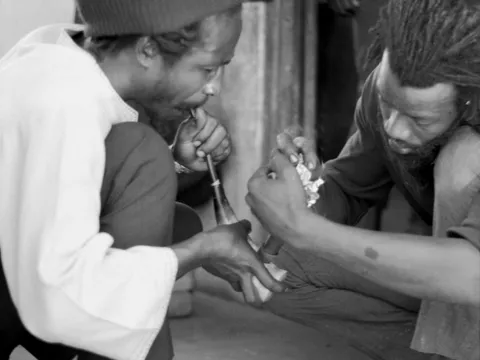
For Rastafari cannabis is a sacrament the law now accommodates: registered adherents may exceed the possession and growing thresholds, dispense at sacramental dispensaries, and three communities hold 2023 authorizations.[3](/history/antigua-rastafari-sacramental-authorizations-2023/) The country's drug law descends from the Leeward Islands' 1937 Act.(/history/leeward-islands-dangerous-drugs-act-1937-antigua/) A 2025 plan would pardon sub-15 g possession convictions and expunge records.(/history/antigua-pardons-plan-2025/)
Taking cannabis into or out of Antigua and Barbuda is a separate offence from possessing it, normally charged as smuggling or trafficking, with far heavier penalties. That holds almost everywhere, including between two places where cannabis is legal.
The rules that allow or tolerate small amounts inside Antigua and Barbuda do not cover the border, an airport or the post.
A prescription or medical card from another country is generally not recognised. Travellers who need a cannabis-based medicine should ask Antigua and Barbuda's embassy before travelling.[10]
General guidance that applies to almost every country, not a check of Antigua and Barbuda's customs rules.
Culture the atlas →
Datasets not part of the score
What other organisations publish about Antigua and Barbuda, and where it stands among the countries each one covers. Each dataset has a page of its own, with a world map and every country's figure.
Use
UNODC · 2005
Cannabis use
10.6%of people aged 15–64 (assumed)
survey 2005 · 7,000 people · earlier figure, not in UNODC 2026
Source Survey ages and years vary, and some surveys include children. Rates are not age-standardised; do not compare countries directly.WHO, Our World in Data · 2020
Alcohol drunk per person
6.66litres of pure alcohol a year
5.29 · 20005.29 · 20015.21 · 20025.10 · 20035.43 · 20045.95 · 20056.43 · 20066.50 · 20076.25 · 20085.97 · 20095.74 · 20105.91 · 20116.44 · 20127.00 · 20137.24 · 20147.39 · 20157.73 · 20168.26 · 20178.51 · 20188.51 · 20196.66 · 202020002020 Higher than 65% of 187 countriesLowestHighestper person aged 15 or over · 2020 · 5.29 in 2000 · 5.74 in 2010
Law
UNODC · 2024
Cannabis seized
220kg in 2024
835 · 2022769 · 2023220 · 202420222024 Higher than 18% of 163 countriesLess seizedMore seized196 kg of herb · 24 kg of resin
Society
OpenAlex · 2025
Research on cannabis
11papers per million people
32 · 201811 · 201911 · 202011 · 202111 · 202211 · 202311 · 202520182025 Higher than 94% of 176 countriesLowestHighest1 papers in 2025
Our World in Data, World Bank · 2025
Population
94,209people in 2025
34,575 · 190031,659 · 191029,765 · 192031,089 · 193040,909 · 194045,462 · 195055,621 · 196064,549 · 197064,531 · 198063,087 · 199074,929 · 200085,337 · 201091,864 · 202094,209 · 202519002025 Higher than 5% of 196 countriesLowestHighest34,575 in 1900 · 45,462 in 1950 · 74,929 in 2000
CEPII
Former colonial rulers
Once ruled by United Kingdom
World Bank · 2025
Government effectiveness
61of 100
67 · 199667 · 199867 · 200067 · 200267 · 200362 · 200464 · 200564 · 200664 · 200764 · 200864 · 200967 · 201067 · 201167 · 201267 · 201354 · 201461 · 201561 · 201647 · 201747 · 201847 · 201939 · 202039 · 202151 · 202261 · 202361 · 202461 · 202519962025 Higher than 68% of 195 countriesLowestHighestestimate 0.44 on a scale of −2.5 to 2.5 · 2025 · 67 in 2000 · 61 in 2015
World Bank · 2025
Income per person
$30,620per person
21,075 · 199021,424 · 199121,330 · 199222,051 · 199323,082 · 199421,640 · 199522,597 · 199623,350 · 199723,996 · 199824,462 · 199925,548 · 200024,015 · 200123,958 · 200225,136 · 200326,304 · 200427,693 · 200530,827 · 200633,245 · 200732,756 · 200828,406 · 200925,827 · 201025,024 · 201125,593 · 201225,207 · 201325,558 · 201425,734 · 201526,628 · 201627,199 · 201728,879 · 201829,652 · 201923,931 · 202025,745 · 202127,786 · 202228,712 · 202329,299 · 202430,620 · 202519902025 Higher than 67% of 187 countriesLowestHighestat purchasing power parity, 2021 dollars · 2025 · $21,075 in 1990 · $25,827 in 2010
World Bank · 2024
Development indicators
72.7%use the internet
0% · 19902.2% · 19952.9% · 19963.5% · 19974.1% · 19985.3% · 19996.5% · 20008.9% · 200112.5% · 200217.2% · 200324.3% · 200427% · 200530% · 200634% · 200738% · 200842% · 200947% · 201052% · 201158% · 201263.4% · 201367.8% · 201470% · 201570.3% · 201670.5% · 201770.8% · 201871.1% · 201971.4% · 202071.6% · 202171.9% · 202272.1% · 202372.7% · 202419902024 Higher than 40% of 195 countriesLowestHighest24.4% live in towns · 11.8% aged 65+ · life expectancy 77.8 · 2024 · 6.5% in 2000 · 47% in 2010
GDELT · 2025
Cannabis in the news
0%of global news: cannabis articles from here
0% · 20170% · 20180% · 20190% · 20200% · 20210% · 20220% · 20230% · 20240% · 202520172025 Higher than 0% of 147 countriesLowestHighest2025 average, 348 days · 0% in 2018 · 0% in 2021
History 6 of 6 checked against a source
Score and entries per decade
37 today, from 100 before its first recorded change
This country's score Entries that moved the score Context only
Sources hover a number in the text to see its source
- Cited
- 10
- Websites
- 7
- Last reviewed
- History checked
- 6/6
Most cited
- laws.gov.ag3
- idpc.net2
- copolad.eu1
- data.unodc.org1
- en.wikipedia.org1
- gov.uk1
All 10 sources
- Wikipedia — Cannabis in Antigua and Barbudaarchived
- IDPC — Antigua and Barbuda set to decriminalise cannabisarchived
- IDPC — Antigua and Barbuda set to pass inclusive cannabis regulation lawarchived
- Misuse of Drugs (Amendment) Act, 2018 (No. 3 of 2018)archived
- UNODC Data Portal — Drug seizures, reported seizures in kilogram equivalents (World Drug Report data)archived
- GOV.UK (FCDO) — Foreign travel advice: Antigua and Barbuda, safety and securityarchived
- Antigua and Barbuda Ministry of Legal Affairs — Vehicles and Road Traffic Act, Cap. 460, older published text (PDF)Sections 54 and 73; older penalty table not treated as verified currentarchived
- Antigua and Barbuda Ministry of Legal Affairs — Vehicles and Road Traffic (Amendment) Act 18/2018 (PDF)Sections 1(2) and 4; replacement sections 54–54F; Gazette commencement notice and drug-device approval not retrievedarchived
- Antigua and Barbuda Ministry of Legal Affairs — Vehicles and Road Traffic (Amendment) Act 1/2025 (PDF)Sections 1 and 8; separate commencement clause and amendment of section 73(6) application feearchived
- International Narcotics Control Board — Travellers carrying medicines containing controlled substances