Jamaica
35/100
#15 of 196 worldwide
#7 of 23 in North America
Since 2015 up to 2 oz is a petty offence with no record, five plants per household are allowed, and Rastafari sacramental use is legal. Licensed herb houses serve patients and visitors.
In short all countries →
- Can I carry it?LimitedUsually no criminal charge for a small amount, but it can still be seized or penalised
- Can I grow it?YesA few plants at home are legal
- Can I buy it?LimitedFrom licensed sellers, with a doctor's recommendation; visitors can apply for a permit
- Can I use it in public?NoIn private only
- What if I'm caught?A light penaltyFor a small amount, usually a fine, a referral to treatment or nothing at all; prison is rare
A rough guide read from the scores and the rules below, not legal advice. The details and the exceptions are in each segment: select an answer to jump to it.
Cannabis in Jamaica not part of the score · all 17 datasets ↓
Who uses it
About 1 in 5
people aged 15–64 in Jamaica used cannabis in the past year: 400,000 people.
- Past year
- 19.2%
- North America median
- 6.9%
UNODC · survey 2023
Source Past-year cannabis use among people aged 15–64. People who used cannabis in the past year, from a 2023 survey, applied to today's population aged 15–64.Survey ages and years vary, and some surveys include children. Rates are not age-standardised; do not compare countries directly.
UNODC World Drug Report 2026, annex table 1.2. Population from the World Bank, aged 15–64. The whole dataset →
Use across North America
3rdhighest of 22 surveyed countries
- 🇨🇦 Canada32.4%
- 🇺🇸 United States26.4%
- 🇯🇲 Jamaica19.2%
- 🇰🇳 Saint Kitts and Nevis11.7%
- 🇩🇲 Dominica10.8%
Past-year use, latest survey of each. Survey years and ages differ. On the map →
Cannabis in figures
- Police contact for drug use or possession54per 100,000 people · 2021
- Cannabis seized34,842kg in 2024 · 2024
- Cannabis shops on the map1shops mapped · 2026
- Research on cannabis0.7papers per million people · 2025
- Clinical trials of cannabis medicines3studies so far · 2026
The dot: where it stands among the countries each dataset covers, lowest to highest. All datasets ↓
What they call it
- Ganja[1]Jamaican EnglishThe standard Jamaican word for cannabis, brought by indentured labourers from India in the 19th century
- Spliff[2]Jamaican EnglishA cannabis cigarette; the standard Jamaican term for a joint
- Herb[3]Jamaican EnglishCannabis, especially in Rastafari and reggae usage — "the herb" as sacrament and medicine
Score breakdown 35/100 · how the scores are made
Similar scores in North America
Not actually legal: possessing up to 2 oz (56 g) is a ticketable infraction with a fixed J$500 penalty — no arrest, no court, no criminal record.[4][5] Above 2 oz it is still a criminal offence.[4] Rastafari adherents and holders of a medical permit may possess lawfully.[4]
| Amount | What happens | Punishment | Fine |
| Up to 2 oz (57 g)No arrest, court or criminal record; under-18s and dependent users are also sent for counselling. Rastafari and medical patients are exempt | AdministrativeTicket (fixed penalty notice) | — | Up to JMD 500 |
| Over 2 oz (57 g)A fine, prison or both, and a criminal record | CriminalCriminal offence | — | — |
Each household may legally grow up to five ganja plants on its premises; where several households share a property, each gets five.[4][5] More than that is an offence unless licensed.[4]
| Amount | What happens | Punishment | Fine |
| Up to 5 plantsPer household, on its own premises | Legal | — | — |
| Over 5 plantsUnless licensed, or authorised for Rastafari sacramental or research purposes | CriminalCriminal offence | — | — |
A recommendation or prescription from a registered medical doctor takes medical or therapeutic possession outside the ticket rules.[4] The Cannabis Licensing Authority licences sale for those purposes.[4] A visitor who does not ordinarily live in Jamaica may apply to the Ministry of Health for a permit to buy and possess up to 2 ounces at a time for medical or therapeutic purposes.[4] The applicant produces evidence that a licensed doctor in their home country recommended or prescribed ganja, or signs a voluntary declaration confirming that, and pays a fee.[4]
Context not part of the score · every country, by topic →
Ganja is part of everyday Jamaican life, but there is still no legal recreational market. Since 2015 an adult with up to 2 ounces gets a J$500 ticket instead of an arrest, and a household may grow five plants.[4] Licensed herb houses sell flower, oils and edibles, but only for medical or therapeutic use, on a doctor's recommendation or, for visitors, a permit; the first, Kaya Herbhouse, opened in March 2018.[7][5] Most ganja is still grown and sold outside the licensed system, and tourists and locals alike buy it on the street.[8][9]
Any registered medical practitioner can recommend ganja for medical or therapeutic purposes, with no fixed list of conditions.[5] Patients buy from licensed herb houses.[7]
There are no members' growing clubs.[10] Supplying ganja to another person outside the licensed medical system or sacramental use remains dealing;[6] the collective settings the law does allow are licensed dispensaries, where smoking on the premises is permitted, and Rastafari sacramental use.[5][10]
The justice ministry's fact sheet on the 2015 amendment says each household may legally grow up to five ganja plants.[5] It does not mention seeds or say where a household may obtain plants.
The law defines hemp as a ganja plant with less than 1% THC and takes it out of the ganja rules; growing, processing and trading it need a licence from the Cannabis Licensing Authority.[4] Hemp can be made into cloth, paper and rope, and into medicines, drinks and cosmetics.[4]
The Cannabis Licensing Authority issues cultivator, processor, transporter, retail and research licences in tiers by size.[7] The legal industry is small but growing: the regulator put its value at US$63.5 million in 2025, up from US$38.9 million in 2024, on 15.4 hectares of licensed land, and the first four exports of ganja products, oils, balms and lotions, left the island that year.[9] Fees, security rules and banking problems kept many traditional small growers outside the legal industry; in 2026 the authority widened fee-free routes in for them, with two-year transition periods and collective cultivation of up to ten acres for community groups.[7][11]
Most ganja in Jamaica is still grown and sold outside the licensed system: enforcement is patchy and tourists and locals buy on the street.[8][9] The licensed sector is small, with 15.4 hectares under legal cultivation and about 13 tonnes produced in 2025, valued by the regulator at 63.5 million US dollars, a figure that leaves out illegal cannabis and home growing.[9] Police tie the export trade to guns: by July 2025 they had seized more than 40,000 pounds of ganja that year, and described the seizures as part of a clampdown on a guns-for-drugs trade in which ganja is the currency, with Haitians among those arrested.[12]
A visitor who does not ordinarily live in Jamaica, including a tourist or a Jamaican who lives abroad, may apply to the Ministry of Health for a permit to buy and possess up to 2 ounces of ganja at a time for medical or therapeutic purposes.[4] The applicant produces evidence that a licensed doctor in the country where they live recommended or prescribed it, or signs a voluntary declaration confirming that, and pays a fee.[4] Without that permit, up to 2 ounces brings a J$500 ticket, with no arrest and no criminal record.[4] More than 2 ounces remains a criminal offence.[4] Smoking in a public place brings the same J$500 ticket.[4]
The Road Traffic Act 2018 makes drug influence that prevents proper vehicle control an offence when driving, attempting to drive or being in charge on a road or public place.[13] Its court penalty table lists a maximum J$50,000 fine, with fourteen days' imprisonment in default of payment, and fourteen demerit points.[13] Conviction normally brings twelve months' licence disqualification; the court can depart for special reasons or impose a longer ban.[13] Separately, section 123(j) prohibits smoking ganja while driving, attempting to drive or being in charge on a road, without requiring proof of impairment.[13] Police list a J$10,000 fixed penalty and two points for that offence; the Act's court maximum is J$20,000, with seven days in default of payment.[14][13] These are distinct penalties. No quantified THC limit was verified in the Act and 2022 Regulations reviewed.[13][15]
Before the reform of April 2015, Jamaican police arrested about 15,000 people a year for possessing cannabis, a quarter of all court cases concerned cannabis, and arrests and prosecutions were estimated to cost 64 million US dollars a year, according to a case study by Harm Reduction International.[16] After possession of small amounts became a ticketable matter, court cases for possessing or smoking cannabis fell by more than 90 per cent, and criminal cases referred to the courts in 2016 were 25 per cent fewer than in 2014.[16]
Tickets leave no criminal record, and earlier convictions for small quantities can be expunged.[5] Unpaid tickets can lead to a court order for community service.[6]
Ganja came to Jamaica with indentured labourers from India in the mid-19th century, and the Hindi word ganja came with it.[1] By the early 1970s it was drunk as tea and tonic in rural households far more than it was smoked, as the anthropologists Vera Rubin and Lambros Comitas found in the national study they published in 1972.[17] For Rastafari it became a sacrament, smoked in shared reasoning; the early preacher Leonard Howell founded Pinnacle, a community that grew it with its food until colonial police broke it up.[18][19] Reggae carried the herb to the world through singers such as Bob Marley and Peter Tosh, whose 1976 album Legalize It made legalisation a song.[20]
Jamaican doctors turned folk knowledge into medicine. The pharmacologist Manley West and the eye surgeon Albert Lockhart of the University of the West Indies noticed that fishermen who drank ganja tea saw better at night, and after years of work produced Canasol, an eye drop for glaucoma, and later Asmasol for asthma; both men received the Order of Merit.[21] Today accredited universities and bodies approved by the Scientific Research Council may grow ganja for research under a licence.[4] Earlier, the 1969–1972 Research Institute for the Study of Man project with the University of the West Indies produced the island’s landmark cannabis ethnography, recording ganja as a work stimulant in adult work circles and a class marker shed by the upwardly mobile — see the work-enhancement findings.[22]
Taking cannabis into or out of Jamaica is a separate offence from possessing it, normally charged as smuggling or trafficking, with far heavier penalties. That holds almost everywhere, including between two places where cannabis is legal.
The rules that allow or tolerate small amounts inside Jamaica do not cover the border, an airport or the post.
A prescription or medical card from another country is generally not recognised. Travellers who need a cannabis-based medicine should ask Jamaica's embassy before travelling.[23]
General guidance that applies to almost every country, not a check of Jamaica's customs rules.
A sacrament in law
Jamaica's 2015 reform wrote the Rastafari sacrament into law. Adherents aged 18 and over may possess ganja for religious purposes, smoke it at registered places of worship, and apply to grow it, and Rastafari organisations may hold events where it is used.[4]
Ganja's farmers, outside the ganja industry
The growers who supplied Jamaica for generations mostly stayed outside the licensed industry, kept out by fees, security rules and banks; in 2021 the island even ran short of ganja after drought and lockdowns.[8][7] The legal sector covers just 15.4 hectares, and the regulator's figures leave out the far larger illegal crop.[9] The 2026 fee-free routes are meant to bring the traditional growers in.[11]
Culture the atlas →
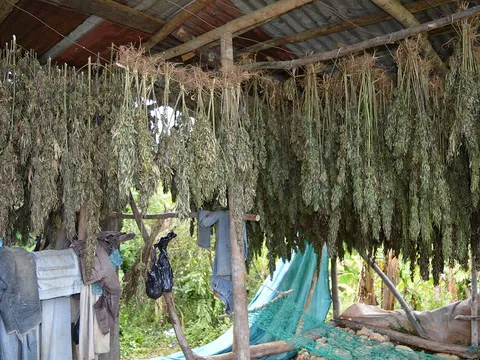 LanguageGanjaThe Hindi word for the flowering tops. Indian labourers carried it to the Caribbean, and it also became the usual word across South-East Asia.
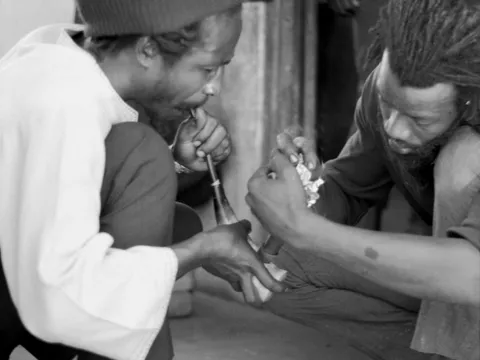 TraditionsThe Rastafari sacramentFor Rastafari, ganja is a holy herb smoked in shared reasoning. Several Caribbean countries have now written that into law.
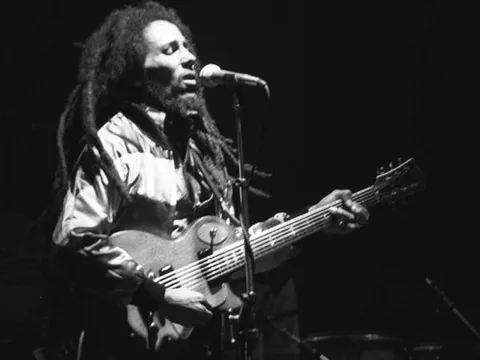 PeopleBob MarleyThe Jamaican singer who carried reggae, Rastafari and its sacramental herb to the world. He was jailed for ganja in Jamaica in 1968 and fined for it in London in 1977, and is remembered as cannabis's best-known ambassador.
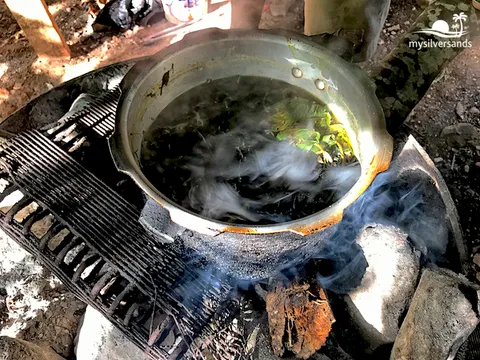 TraditionsGanja tea in JamaicaIn rural Jamaica in the early 1970s ganja was drunk far more widely than it was smoked. Households boiled it as tea and bottled it in rum as a tonic, gave it to children to make them "strong and smart", and washed newborns in its leaves.
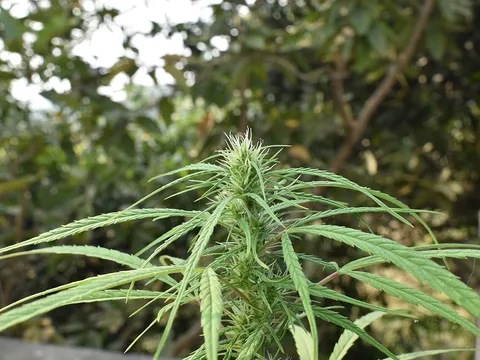 LanguageIndian hempThe name under which the British Empire, and then the world, first brought cannabis under control. It survives in the statute books of dozens of countries that have nothing to do with India.
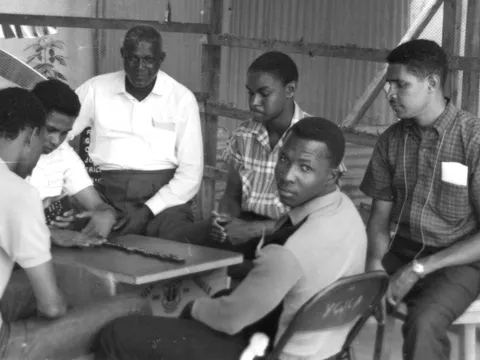 TraditionsJamaican herb camps and yardsInformal Jamaican cannabis venues offered company as well as ganja. An early-1970s account distinguishes herb camps with dominoes and music from simpler herb yards where people gathered to smoke.
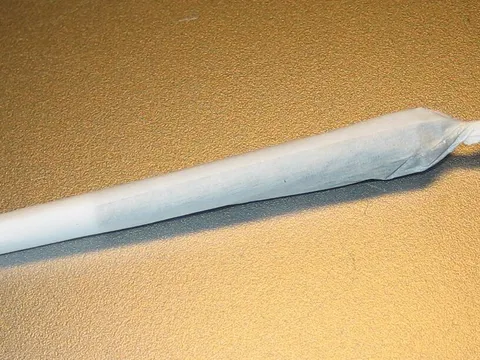 LanguageJointA hand-rolled cannabis cigarette. The word passed from "side room" to "opium den" before it reached its present meaning in the 1930s.
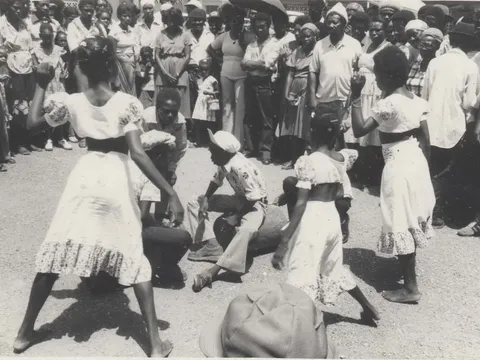 TraditionsKuminaA Jamaican religion of Central African origin, centred on drumming, dance and possession by ancestral spirits, in which ganja was smoked. It may be one of the roots of the Rastafari sacrament.
Show all 12
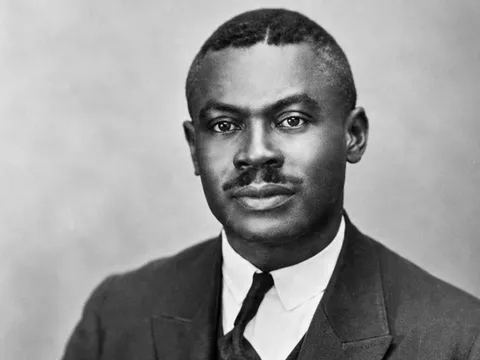 PeopleLeonard HowellAn early Rastafari preacher and founder of Pinnacle, a Jamaican farming and religious community that grew ganja alongside food crops. Colonial raids repeatedly disrupted the settlement and dispersed its residents.
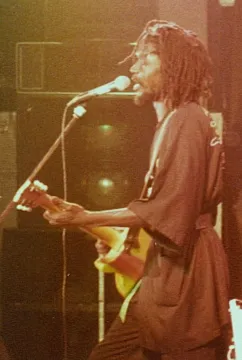 PeoplePeter ToshThe Jamaican reggae singer whose 1976 album Legalize It made legalisation a song. Two years later he lit a spliff on stage in front of Michael Manley and Edward Seaga and told them to change the law; months later he was beaten in police custody.
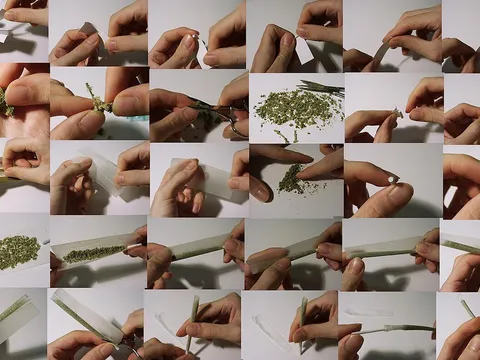 LanguageSpliffA Jamaican word of unknown origin for a cannabis cigarette. In Europe it came to mean one rolled with tobacco.
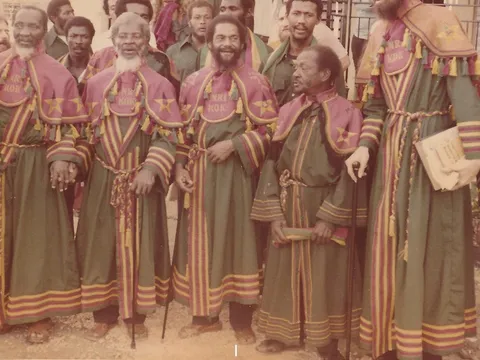 TraditionsThe Ethiopian Zion Coptic ChurchA Jamaican church close to Rastafari that held ganja to be its sacrament, and shipping it to America to be its duty.
Did you know? all cases →
Customs · Jamaica
In one rural community in Jamaica studied in the early 1970s, nearly 70 per cent of households used ganja, almost all of them as tea; only about half had a smoker. Tea was given to children to make them “strong and smart”, and older women advised washing newborns in ganja leaves.
Read the entry →
Datasets not part of the score
What other organisations publish about Jamaica, and where it stands among the countries each one covers. Each dataset has a page of its own, with a world map and every country's figure.
Use
UNODC · 2023
Cannabis use
19.2%of people aged 15–64
10.7% · 20019.86% · 20067.21% · 201018% · 201619.2% · 202320012023 ages 15–64 · survey 2023 · 400,000 people · UNODC 2026
Source Survey ages and years vary, and some surveys include children. Rates are not age-standardised; do not compare countries directly.WHO, Our World in Data · 2020
Alcohol drunk per person
3.10litres of pure alcohol a year
3.34 · 20003.34 · 20013.15 · 20023.10 · 20033.10 · 20043.13 · 20053.08 · 20063.02 · 20072.96 · 20082.99 · 20093.04 · 20103.13 · 20113.20 · 20123.27 · 20133.35 · 20143.39 · 20153.47 · 20163.55 · 20173.60 · 20183.60 · 20193.10 · 202020002020 Higher than 39% of 187 countriesLowestHighestper person aged 15 or over · 2020 · 3.34 in 2000 · 3.04 in 2010
Law
UNODC · 2021
Police contact for drug use or possession
54per 100,000 people
Higher than 50% of 101 countriesFewerMore1,539 people in 2021 · all drugs together
UNODC · 2024
Cannabis seized
34,842kg in 2024
21,208 · 201524,000 · 201926,000 · 202032,000 · 202134,842 · 202420152024 Higher than 85% of 163 countriesLess seizedMore seized34,840 kg of herb · 2 kg of resin · 21,208 kg in 2015 · 26,000 kg in 2020
Society
OpenAlex · 2025
Research on cannabis
0.7papers per million people
0.4 · 19670.4 · 19680.4 · 19690.4 · 19740.4 · 19760.4 · 19780.4 · 19830.4 · 19910.7 · 19940.4 · 19950.4 · 19960.4 · 19981.1 · 19990.4 · 20000.4 · 20010.7 · 20040.7 · 20050.7 · 20060.4 · 20070.7 · 20080.4 · 20090.7 · 20100.4 · 20111.1 · 20122.1 · 20130.4 · 20141.1 · 20150.4 · 20164.2 · 20172.5 · 20183.5 · 20191.8 · 20203.2 · 20214.2 · 20222.5 · 20232.8 · 20240.7 · 202519672025 Higher than 43% of 176 countriesLowestHighest2 papers in 2025 · 2 in 2010
Cato and Fraser Institutes · 2023
Human Freedom Index
7.89of 10
7.74 · 20007.76 · 20017.74 · 20027.71 · 20037.60 · 20047.65 · 20057.68 · 20067.63 · 20077.48 · 20087.56 · 20097.53 · 20107.56 · 20117.63 · 20127.80 · 20137.72 · 20147.92 · 20157.91 · 20167.88 · 20177.87 · 20187.87 · 20197.53 · 20207.58 · 20217.82 · 20227.89 · 202320002023 Higher than 74% of 164 countriesLess freeFreerrank #42 of 165 · personal freedom 8.19 · economic freedom 7.46
V-Dem, Our World in Data · 2025
Civil liberties
0.88of 1 in 2025
0.56 · 19000.56 · 19010.56 · 19020.56 · 19030.56 · 19040.56 · 19050.56 · 19060.56 · 19070.56 · 19080.56 · 19090.56 · 19100.56 · 19110.56 · 19120.56 · 19130.56 · 19140.56 · 19150.56 · 19160.56 · 19170.56 · 19180.56 · 19190.56 · 19200.56 · 19210.56 · 19220.56 · 19230.56 · 19240.56 · 19250.56 · 19260.56 · 19270.56 · 19280.56 · 19290.61 · 19300.61 · 19310.61 · 19320.61 · 19330.61 · 19340.61 · 19350.60 · 19360.60 · 19370.60 · 19380.59 · 19390.59 · 19400.59 · 19410.59 · 19420.59 · 19430.66 · 19440.68 · 19450.69 · 19460.70 · 19470.70 · 19480.70 · 19490.73 · 19500.73 · 19510.73 · 19520.73 · 19530.73 · 19540.73 · 19550.73 · 19560.73 · 19570.73 · 19580.73 · 19590.80 · 19600.80 · 19610.80 · 19620.80 · 19630.80 · 19640.79 · 19650.79 · 19660.76 · 19670.76 · 19680.76 · 19690.78 · 19700.78 · 19710.77 · 19720.80 · 19730.80 · 19740.81 · 19750.81 · 19760.81 · 19770.81 · 19780.81 · 19790.82 · 19800.84 · 19810.84 · 19820.84 · 19830.84 · 19840.84 · 19850.84 · 19860.84 · 19870.87 · 19880.87 · 19890.88 · 19900.88 · 19910.88 · 19920.88 · 19930.88 · 19940.88 · 19950.88 · 19960.88 · 19970.88 · 19980.88 · 19990.89 · 20000.89 · 20010.89 · 20020.89 · 20030.89 · 20040.89 · 20050.88 · 20060.88 · 20070.88 · 20080.88 · 20090.89 · 20100.89 · 20110.89 · 20120.90 · 20130.90 · 20140.90 · 20150.90 · 20160.90 · 20170.90 · 20180.91 · 20190.91 · 20200.90 · 20210.90 · 20220.88 · 20230.88 · 20240.88 · 202519002025 Higher than 73% of 175 countriesFewer libertiesMore liberties0.56 in 1925 · 0.80 in 1961 · 0.88 in 1990
Our World in Data, World Bank · 2025
Population
2,837,077people in 2025
727,676 · 1900815,621 · 1910873,146 · 19201,024,958 · 19301,226,097 · 19401,407,214 · 19501,650,009 · 19601,878,191 · 19702,145,661 · 19802,379,880 · 19902,607,827 · 20002,748,573 · 20102,830,745 · 20202,837,077 · 202519002025 Higher than 29% of 196 countriesLowestHighest727,676 in 1900 · 1,407,214 in 1950 · 2,607,827 in 2000
CEPII
Former colonial rulers
Once ruled by United Kingdom
World Bank · 2025
Government effectiveness
56of 100
49 · 199649 · 199849 · 200049 · 200249 · 200350 · 200445 · 200555 · 200654 · 200757 · 200858 · 200958 · 201057 · 201157 · 201258 · 201363 · 201463 · 201563 · 201663 · 201764 · 201864 · 201962 · 202061 · 202156 · 202256 · 202356 · 202456 · 202519962025 Higher than 56% of 195 countriesLowestHighestestimate 0.19 on a scale of −2.5 to 2.5 · 2025 · 49 in 2000 · 63 in 2015
Transparency International · 2024
Corruption Perceptions Index
44of 100
38 · 201238 · 201338 · 201441 · 201539 · 201644 · 201744 · 201843 · 201944 · 202044 · 202144 · 202244 · 202344 · 202420122024 Higher than 59% of 178 countriesLowestHighest0 highly corrupt, 100 very clean · 2024 · 41 in 2015 · 44 in 2020
Pew Research Center · 2020
Most common religion
Christians
the largest group · 2020
World Bank · 2025
Income per person
$11,358per person
8,880 · 19909,228 · 19919,316 · 199210,088 · 199310,123 · 199410,258 · 199510,147 · 19969,940 · 19979,625 · 19989,650 · 19999,668 · 20009,736 · 20019,870 · 200210,170 · 200310,244 · 200410,279 · 200510,522 · 200610,622 · 200710,490 · 20089,993 · 20099,806 · 20109,932 · 20119,829 · 20129,840 · 20139,872 · 20149,932 · 201510,179 · 201610,391 · 201710,636 · 201810,816 · 20199,892 · 202010,431 · 202111,097 · 202211,399 · 202311,340 · 202411,358 · 202519902025 Higher than 38% of 187 countriesLowestHighestat purchasing power parity, 2021 dollars · 2025 · $8,880 in 1990 · $9,806 in 2010
World Bank · 2024
Development indicators
90.1%use the internet
0% · 19900% · 19940.1% · 19950.6% · 19960.8% · 19972% · 19982.4% · 19993.1% · 20003.9% · 20016.1% · 20027.8% · 200310% · 200412.8% · 200516.4% · 200621.1% · 200723.6% · 200824.3% · 200927.7% · 201037.4% · 201133.8% · 201237.1% · 201340.4% · 201442.2% · 201544.4% · 201655.1% · 201768.2% · 201870.8% · 201976.4% · 202082.4% · 202185.8% · 202289.5% · 202390.1% · 202419902024 Higher than 72% of 195 countriesLowestHighest58.9% live in towns · 8.2% aged 65+ · life expectancy 71.6 · 2024 · 3.1% in 2000 · 27.7% in 2010
Plant and market
OpenStreetMap · 2026
Cannabis shops on the map
1shops mapped
Higher than 0% of 59 countriesFewer shopsMore shops0.4 per million people · 2026
GBIF · 2026
Records of the cannabis plant
9dated records
1 · 18922 · 19813 · 20186 · 20217 · 20238 · 20249 · 202618922026 Higher than 45% of 128 countriesLowestHighest1 more without a date · 1 in 2026
ClinicalTrials.gov · 2026
Clinical trials of cannabis medicines
3studies so far
2 · 20182 · 20192 · 20202 · 20212 · 20223 · 20233 · 20243 · 20253 · 202620182026 Higher than 28% of 50 countriesLowestHighest0 actual starts in 2026 · as of 2026–10–26 · 2 by 2020
Enforcement 1 report · the Cannabis Enforcement Tracker →
How the law above is applied: raids, seizures, fields destroyed, arrests and sentences, as recorded by the Cannabis Enforcement Tracker, our companion site.
- ProsecutionJamaica's courts see far fewer cannabis cases after decriminalisation
According to Harm Reduction International, court cases for possessing or smoking cannabis fell by more than 90 per cent after the reform of April 2015, and criminal cases referred to the courts in 2016 were 25 per cent fewer than in 2014.
History 33 of 33 checked against a source
Score and entries per decade
35 today, from 100 before its first recorded change
This country's score Entries that moved the score Context only
20261 entry0 score changes
20211 entry0 score changes
20181 entry1 score change
20152 entries1 score change
Easing ✓ Article
Jamaica decriminalises ganja
Possessing up to 2 oz became a ticket with a small fixed penalty: no arrest and no criminal record. Each household may grow five plants, Rastafari may use ganja as a sacrament, and a licensed medical industry was set up.
1131+20 points
Other law ✓
Jamaica plants its first legal cannabis
Two months after parliament voted to reduce possession of up to two ounces to a petty offence, the first legal plant was put in the ground at the Mona campus of the University of the West Indies. The reform also allowed growing up to five plants and use by Rastafari for religious purposes.
20141 entry0 score changes
20011 entry0 score changes
19951 entry0 score changes
19891 entry0 score changes
19781 entry0 score changes
19761 entry0 score changes
19751 entry0 score changes
19741 entry0 score changes
19722 entries1 score change
Easing ✓ Article
Jamaica drops mandatory prison for ganja
After three decades, an amendment to the Dangerous Drugs Law passed on 11 August 1972 removed the compulsory prison sentence and gave courts discretion: a first possession offence carried a fine of up to $1,000 or three years, or both. Four days later about 200 prisoners serving mandatory sentences, most of them for ganja, were pardoned and released.
211+9 points
Culture & science ✓
Jamaica's newspaper publishes the national ganja study
The health minister, Kenneth McNeill, gave the final report of the Rubin and Comitas field study of chronic ganja smokers to the Daily Gleaner, which printed it in 50 daily instalments. The study found no significant relationship between ganja and crime. McNeill cited it in August when parliament abolished mandatory sentences, while saying ganja would stay on the list of dangerous drugs.
19701 entry0 score changes
19681 entry0 score changes
19642 entries1 score change
Tightening ✓ Article
Jamaica sets an 18-month minimum for ganja possession
The Jamaica Labour Party government, which had promised early laws on rape and ganja, raised the penalty for a first possession offence to a minimum of 18 months and a maximum of three years in prison without the option of a fine. Police sergeants could authorise searches without a magistrate's warrant, vehicles suspected of carrying ganja could be seized, and allowing premises to be used for ganja became an offence. Norman Manley, for the opposition, called the penalties fit only for fascist countries.
92−7 points
International ✓
Jamaica joins the Single Convention on Narcotic Drugs
Jamaica acceded to the Single Convention on Narcotic Drugs of 1961 on 29 April 1964. The convention lists cannabis and cannabis resin among its controlled drugs and obliges its parties to limit their production, trade, possession and use to medical and scientific purposes.
19611 entry0 score changes
19581 entry0 score changes
19541 entry0 score changes
19501 entry0 score changes
19412 entries1 score change
Tightening ✓
Colonial police raid Pinnacle and arrest residents
Government forces raid the early Rastafari community and arrest followers of Leonard Howell. The raid is distinct from the same year’s national ganja-penalty amendment; no separate change to statutory penalties is recorded here.
Tightening ✓ Article
Jamaica makes prison mandatory for ganja
Amid the economic distress and mass demonstrations of 1938 and the rise of Rastafari, Jamaica made prison compulsory for possessing, selling or growing ganja: one year with no option of a fine, aimed chiefly at Rastafari cultivators and users. A 1972 amendment removed mandatory imprisonment and restored judicial discretion.
139−4 points
19401 entry0 score changes
19341 entry0 score changes
19241 entry1 score change
19131 entry1 score change
19121 entry0 score changes
18621 entry0 score changes
18551 entry0 score changes
18451 entry0 score changes
Sources hover a number in the text to see its source
- Cited
- 23
- Websites
- 18
- 1
- Last reviewed
- History checked
- 33/33
Most cited
- en.wikipedia.org3
- en.wiktionary.org2
- jamaica-gleaner.com2
- cifas.us1
- cla.org.jm1
- courthousenews.com1
All 23 sources
- Wikipedia — Cannabis in Jamaicaarchived
- Wiktionary — spliffarchived
- Wiktionary — herbarchived
- Ministry of Justice — Fact sheet on the Dangerous Drugs (Amendment) Act 2015Paragraphs 6–14 and 28–29archived
- Ministry of Justice — Dangerous Drugs (Amendment) Act 2015 fact sheetarchived
- The facts about ganja in Jamaica (Jamaica Observer, via TNI)archived
- Cannabis Licensing Authorityarchived
- Associated Press via Courthouse News — Jamaica faces marijuana shortage as farmers struggle (5 February 2021)archived
- Jamaica Gleaner — Cannabis industry on a $10b high despite Melissa (22 April 2026)archived
- Lonely Planet — Everything you need to know to legally enjoy marijuana in Jamaica (9 April 2026)archived
- The Marijuana Herald — Daily cannabis news brief, 29 September 2026archived
- Jamaica Gleaner — Three men charged in $9.3 million ganja bust in Toms River (22 July 2025)archived
- Jamaica Parliament — Road Traffic Act 2018 (PDF)Section 123(j); Third Schedule, Part B; Fifth Schedule, paragraphs 1–2; Sixth Schedulearchived
- Jamaica Constabulary Force — offence codes and fines 2023 (PDF)Item 126, smoking ganja while driving or being in chargearchived
- Jamaica Information Service — Road Traffic Regulations 2022 (PDF)archived
- Harm Reduction International — Jamaica case study: Divesting from Prohibition, Investing in the HIV Response (2025)archived
- Ganja in Jamaica: A Medical Anthropological Study of Chronic Marihuana UseVera Rubin, Lambros Comitas · Mouton · 1975
- Comitas Institute for Anthropological Study — Lighting the Chalice, JA–RT 004 (5 August 1969)archived
- Michael Barnett — The Legacy of Charismatic Leadership in the Rastafari Movement, IDEAZ 15 (2020), pp. 56–79archived
- Wikipedia — Peter Tosharchived
- Wikipedia — Manley Westarchived
- The Social Nexus of Ganja in JamaicaLambros Comitas · In Cannabis and Culture, edited by Vera Rubin · Mouton · 1975 · pp. 119–132 · ISBN 9789027976699
- International Narcotics Control Board — Travellers carrying medicines containing controlled substances