The story
For most of the twentieth century ganja was grown under licence around the town of Naogaon, in northern Bengal, and from 1917 its growers were organised in a cooperative of their own. The Ganja Cultivators Cooperative Society of Naogaon outlived the British Raj and Pakistan. It did not outlive the ban of 1987, but it still exists, without a crop, and it is still rich.
A crop under guard
Legend says the first seed came to Naogaon from Jessore. In 1906 the colonial government began commercial cultivation there and appointed a registrar to collect the revenue. Seedlings went into the ground in June and July; the crop was ready in February and was carried to warehouses under armed police guard.
The cooperative was founded in 1917 for the welfare of about 7,000 growers, who bought shares at ten rupees each. A warehouse was opened in 1921 by a provincial minister.
The trade in numbers
| Growers | more than 7,000 |
| Land | about 10,000 hectares |
| Harvest, 1918–1947 | 55,000 maunds a year on average |
| Government revenue | about 66 lakh a year |
| Markets | Assam, Orissa, the United Provinces, Madras, London |
The society’s funds paid for eleven high schools, three charitable dispensaries, mosques and a temple, a bridge over the Choto Jamuna, scholarships and a veterinary service. In 1975 it built a cold store of a thousand tonnes.
1987
Bangladesh signed an international drug agreement in 1974, three years after independence, and the ban on growing ganja that came in 1987 is attributed to it. About 50,000 people from 7,000 families lost their living. Many turned to rice, mustard and vegetables. The government sealed the warehouses; four of them still hold more than 226 maunds of ganja.
A cooperative without a crop
The society kept its property: by its own count 26 acres, 28 buildings, the cold store, ponds and a lake, and by some accounts land in Assam, Kolkata and Dhaka. Estimates of its worth run from a hundred crore taka to thousands. It has about 6,500 members, who once received a yearly allowance.
Since a disputed election in 2006 it has been run by an interim committee appointed by the ministry. Former officers say the property is being occupied by politicians and officials; the committee says it is working to recover it. The cold store, let out for potatoes after the ban, closed in 2022.
Why the index did not move
The founding of the cooperative organised a trade that was already licensed, so it changed no score. The scores for what is now Bangladesh fall when the licensed system itself was abolished, with the ban on sales in 1989.[1][2]
In the cultural atlas
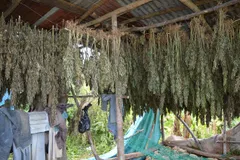
Listed for context. No score change is recorded for Bangladesh here.
References
Checked. The date and the event were compared with a source that was read.