Nepal
12/100
#75 of 196 worldwide
#11 of 48 in Asia
Illegal since 1976 but widely tolerated, notably during Maha Shivaratri. Legalisation bills resurface regularly.
In short all countries →
- Can I carry it?NoIt is a crime
- Can I grow it?NoIt is a crime
- Can I buy it?NoNo patient or adult-use purchase route verified
- Can I use it in public?NoNot in public, and even at home the law does not protect it
- What if I'm caught?Fine or prisonUsually a fine; prison is possible
A rough guide read from the scores and the rules below, not legal advice. The details and the exceptions are in each segment: select an answer to jump to it.
Cannabis in Nepal not part of the score · all 15 datasets ↓
Who uses it
About 1 in 141
people aged 15–50 in Nepal used cannabis in the past year: about 120,000 people.
- Past year
- 0.7%
- Asia median
- 2%
UNODC · survey 2019
Source Past-year cannabis use among people aged 15–50. People who used cannabis in the past year, from a 2019 survey, applied to today's population aged 15–50. The population is approximate: the survey ages cut through an age group, or were not recorded and ages 15–64 are used.Survey ages and years vary, and some surveys include children. Rates are not age-standardised; do not compare countries directly.
UNODC World Drug Report 2026, annex table 1.2. Population from the World Bank, aged 15–50. The whole dataset →
Use across Asia
30thhighest of 40 surveyed countries
- 🇱🇦 Laos0.9%
- 🇸🇬 Singapore0.8%
- 🇳🇵 Nepal0.7%
- 🇮🇷 Iran0.6%
- 🇸🇦 Saudi Arabia0.3%
Past-year use, latest survey of each. Survey years and ages differ. On the map →
Cannabis in figures
- Cannabis seized12,943kg in 2019 · 2019
- Research on cannabis0.2papers per million people · 2025
- Cannabis in the news0.0007%of global news: cannabis articles from here · 2025
The dot: where it stands among the countries each dataset covers, lowest to highest. All datasets ↓
Score breakdown 12/100 · how the scores are made
The Narcotic Drugs (Control) Act of 1976 treats use and storage as different offences.[1] Use can bring up to one month in prison or a fine of up to 2,000 rupees.[1] Storing, buying or selling up to 50 grams can bring up to three months or a fine of up to 3,000 rupees.[1] From 50 grams to 500 grams the sentence is one month to one year and a fine of 1,000 to 5,000 rupees; from 500 grams to 2 kilograms it is six months to two years and a fine of 2,000 to 10,000 rupees; from 2 to 10 kilograms it is one to three years and a fine of 5,000 to 25,000 rupees; and 10 kilograms or more is two to ten years and a fine of 15,000 to 100,000 rupees.[1] The Act writes the 50-gram and 500-gram points into the neighbouring bands.[1] Enforcement is relaxed in much of the country, where the plant grows wild.[2]
| Amount | What happens | Punishment | Fine |
| Up to 50 g stored or possessed | CriminalStorage | Up to 3 months | Up to NPR 3,000 |
| 50 g to 500 g | CriminalStorage or sale | 1 month – 1 year | NPR 1,000 – NPR 5,000 |
| 500 g to 2 kg | CriminalStorage or sale | 6 months – 2 years | NPR 2,000 – NPR 10,000 |
| 2 kg to 10 kg | CriminalStorage or sale | 1–3 years | NPR 5,000 – NPR 25,000 |
| 10 kg or more | CriminalStorage or sale | 2–10 years | NPR 15,000 – NPR 100,000 |
Cultivation is prohibited. Up to 25 plants can bring up to three months or a fine of up to 3,000 rupees; more than 25 plants can bring up to three years or a fine of 5,000 to 25,000 rupees.[1] In August 2026 Gandaki authenticated a law for licensed medicinal and industrial farming. Section 1(2) of the gazetted Act starts it on a later notice, and a review on 13 October had not found that notice.[3] No licence can be issued until the province makes the rules.[4]
| Amount | What happens | Punishment | Fine |
| Up to 25 plants | CriminalCultivation | Up to 3 months | Up to NPR 3,000 |
| More than 25 plantsThe Act sets the 25-plant line | CriminalCultivation | Up to 3 years | NPR 5,000 – NPR 25,000 |
Use can bring up to a month in prison or a fine of up to 2,000 rupees.[1] Storage and sale follow quantity bands that reach two to ten years for 10 kilograms or more.[1] Enforcement is uneven: the plant grows wild, and police have tolerated open smoking at Shivaratri while announcing arrests in other years.[2]
Sale and distribution sit in the same quantity bands as storage: up to three months or a fine of up to 3,000 rupees for up to 50 grams, and two to ten years plus a fine for 10 kilograms or more.[1] From 50 g upward prison and fine are cumulative, not alternatives.[1]
| Amount | What happens | Punishment | Fine |
| Up to 50 g | CriminalSale | Up to 3 months | Up to NPR 3,000 |
| 50 g to 500 g | CriminalSale | 1 month – 1 year | NPR 1,000 – NPR 5,000 |
| 500 g to 2 kg | CriminalSale | 6 months – 2 years | NPR 2,000 – NPR 10,000 |
| 2 kg to 10 kg | CriminalSale | 1–3 years | NPR 5,000 – NPR 25,000 |
| 10 kg or more | CriminalSale | 2–10 years | NPR 15,000 – NPR 100,000 |
Use can bring up to one month in prison or a fine of up to 2,000 rupees.[1] During Maha Shivaratri devotees smoke openly at Shiva temples such as Pashupatinath and police have often looked the other way, though arrests were announced in 2018.[2] A person who undertakes in writing to enter treatment for up to a month, with fortnightly reports, may receive no punishment.[1]
| Amount | What happens | Punishment | Fine |
| UsePrison or fine; a written treatment undertaking can avoid punishment | CriminalUse | Up to 1 month | Up to NPR 2,000 |
Context not part of the score · every country, by topic →
Illegal since 1976 but widely tolerated: the plant grows wild, enforcement is relaxed in much of the country, and devotees smoke openly at Shiva temples during Maha Shivaratri while police look the other way. Legalisation bills resurface regularly; no legal source exists.[5][2][6]
Medical use appears in federal plans.[8] The 1976 Act has a paper route: a doctor's recommendation and a licensed shop under section 5, or a special government licence for medicine or research under section 6, but no cannabis medicine or shop exists.[1] Gandaki's 2026 Act is a cultivation framework for medicinal and industrial cannabis, and a patient still has no lawful supply under it.[7] A review on 13 October had not found the commencement notice that section 1(2) requires.[3] No legal consumer products exist.[5]
No cannabis clubs are known, and the law leaves no room for them: growing cannabis and supplying it to another person are both prohibited.[2][9]
The 1976 definition covers leaves, flowers, resin, fibre and extracts but not seeds; bhang seeds are sold openly as food, while sowing them is cultivation punished under section 14.[1] Clones are plants, so keeping or trading them falls under the same offence.[1] Seed trade for planting remains unclear.[1]
No industrial-hemp exemption was found: the 1976 Act controls cannabis and cultivation is prohibited.[1] A 2011 fair-trade project linked Himalayan hemp craft with Italian textile buyers, but it created no cultivation licence.[10] Gandaki's 2026 framework covers medicinal and industrial cannabis; it sets a THC ceiling but has not commenced.[4][3]
The federal budget for 2024/25 announced legal arrangements for commercial cultivation for medicinal purposes.[8] Gandaki authenticated a cultivation law on 3 August 2026. No grower may start until the Act commences and the province writes the rules.[4][3] A national framework is still pending.
Cannabis is grown illegally across Nepal, in 23 districts: the eastern hills supply herbal cannabis to Bihar, while the central and western hills produce charas for Delhi and overseas markets.[11] Police seized 51,439 kg of herbal cannabis in fiscal 2024/25, and 3,332 kg in a single Saptari case in July 2026.[12][13] Thai cannabis has also made Kathmandu airport a transit route to India.[14] One campaigner quoted by Nepali Times called the trade an open secret.[6]
There is no legal recreational supply for anyone.[5] Use can bring up to one month in prison or a fine of up to 2,000 rupees. Storing up to 50 grams can bring up to three months or a fine of up to 3,000 rupees, and from 50 grams to 500 grams the sentence is one month to one year and a fine.[1]
The Narcotic Drugs (Control) Act contains no driving offence, and the sources read did not identify a cannabis-specific traffic rule or THC limit.[1] Traffic police use SoToxa oral-fluid kits and THC urine tests and have booked drivers, but the Motor Vehicles Act trigger was not verified; the status stays unverified rather than treating a general careless-driving rule as a drug-driving offence.[15]
Police-wide figures for fiscal 2024/25 show 5,110 drug cases and 7,943 arrests, with 51,439 kg of herbal cannabis seized, a record.[12] The Narcotics Control Bureau's anti-trafficking operations for 2025/26 recorded 993 cases, 1,768 arrests and 1,325 people charged, with 1,603 kg of cannabis, 204 kg of Thai cannabis and 41.5 kg of hashish; those figures cover all drugs and are not comparable with the police-wide series.[16] In June 2025, 6,126 of 29,012 prisoners were held on drug-trafficking charges.[17]
A drug conviction carries a criminal record.[2]
Nepal's cannabis culture is bound up with Shaiva devotion.[18] Sadhus smoke charas and hashish in clay chillums, especially at Pashupatinath, where the Shivaratri festival draws holy men and open smoking.[18] Householders in Kathmandu's bhajan circles shared hymns and sometimes a pipe.[18] Freak Street became the travellers' quarter where licensed hashish shops traded until 1973.[5] The plant grows wild in the hills, and charas is rubbed by hand from the living plant.[18]
Taking cannabis into or out of Nepal is a separate offence from possessing it, normally charged as smuggling or trafficking, with far heavier penalties. That holds almost everywhere, including between two places where cannabis is legal.
A prescription or medical card from another country is generally not recognised. Travellers who need a cannabis-based medicine should ask Nepal's embassy before travelling.[19]
General guidance that applies to almost every country, not a check of Nepal's customs rules.
Culture the atlas →
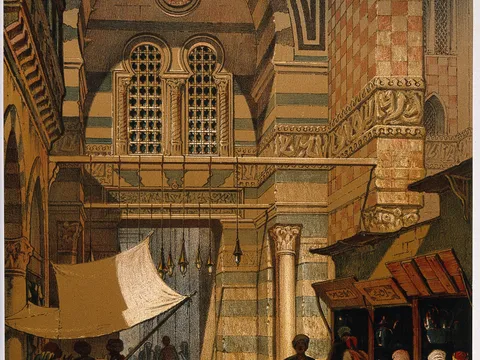 LanguageHashishArabic for dried grass. The word for cannabis resin from Morocco to Afghanistan.
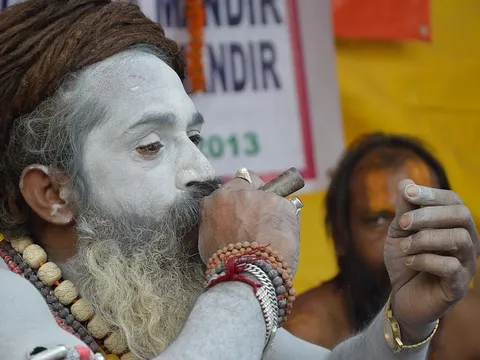 TraditionsSadhus and the chillumHindu ascetics devoted to Shiva smoke cannabis as part of their worship. At Nepal's greatest Shiva temple the police arrest visitors who smoke, but not the holy men.
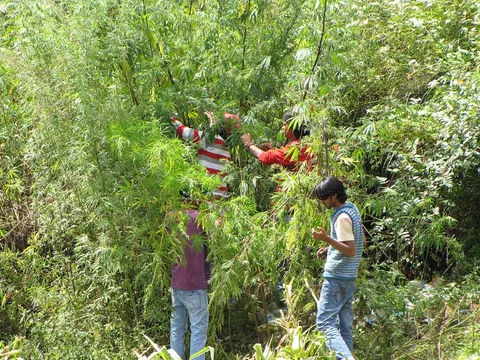 LanguageCharasResin rubbed by hand from the living plant, the hashish of the Himalaya. Indian law names it in its definition of cannabis.
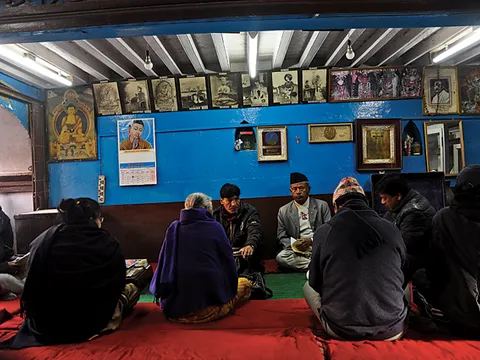 TraditionsBhajan circles in KathmanduIn Kathmandu's devotional singing circles, householders shared hymns and sometimes a cannabis pipe. James Fisher's 1975 account describes fellowship, optional smoking and the social limits of sharing.
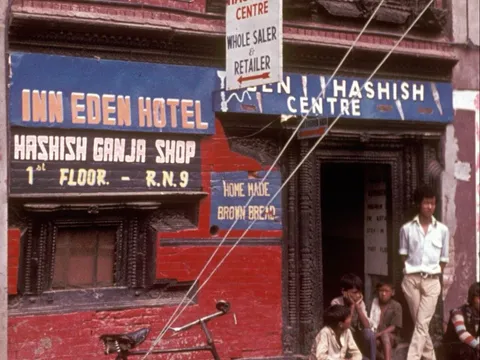 TraditionsFreak StreetKathmandu's Jhochhen became a meeting place for overland travellers, licensed hashish shops and café life. The shops lost their licences in 1973; the neighbourhood outlived the trade.
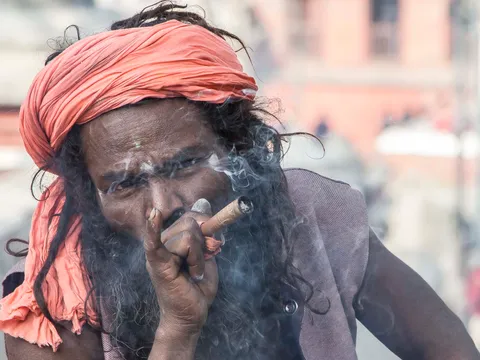 TraditionsShivaratri at PashupatinathCannabis accompanies some holy men's observance of Shiva's great night in Kathmandu. Festival tolerance has survived alongside Nepal's prohibition, but has also been restricted.
Did you know? all cases →
1973 · Nepal
Kathmandu had licensed cannabis shops until 16 July 1973, when Nepal cancelled every licence under pressure from the United States and the United Nations.
The full story →Religion · Nepal
Until 1995 the trust that runs Nepal's Pashupatinath temple handed holy men marijuana at the Shivaratri festival — taken from the Home Ministry's confiscated stock.
Read the entry →
Datasets not part of the score
What other organisations publish about Nepal, and where it stands among the countries each one covers. Each dataset has a page of its own, with a world map and every country's figure.
Use
UNODC · 2019
Cannabis use
0.71%of people aged 15–50
ages 15–50 · survey 2019 · 120,000 people · UNODC 2026
Source Survey ages and years vary, and some surveys include children. Rates are not age-standardised; do not compare countries directly.WHO, Our World in Data · 2020
Alcohol drunk per person
1.06litres of pure alcohol a year
0.20 · 20000.20 · 20010.25 · 20020.31 · 20030.31 · 20040.31 · 20050.30 · 20060.30 · 20070.31 · 20080.64 · 20090.95 · 20101.24 · 20111.26 · 20121.15 · 20131.18 · 20141.22 · 20151.35 · 20161.34 · 20171.36 · 20181.36 · 20191.06 · 202020002020 Higher than 19% of 187 countriesLowestHighestper person aged 15 or over · 2020 · 0.20 in 2000 · 0.95 in 2010
Law
UNODC · 2019
Cannabis seized
12,943kg in 2019
5,727 · 201812,943 · 201920182019 Higher than 74% of 163 countriesLess seizedMore seized10,320 kg of herb · 2,622 kg of resin
Society
OpenAlex · 2025
Research on cannabis
0.2papers per million people
0.1 · 19700.0 · 19750.0 · 20000.0 · 20030.0 · 20070.0 · 20100.0 · 20130.1 · 20140.1 · 20150.1 · 20160.1 · 20170.1 · 20180.2 · 20190.2 · 20200.5 · 20210.3 · 20220.4 · 20230.3 · 20240.2 · 202519702025 Higher than 27% of 176 countriesLowestHighest6 papers in 2025 · 2 in 1970 · 1 in 2010
Cato and Fraser Institutes · 2023
Human Freedom Index
6.97of 10
5.98 · 20005.92 · 20015.83 · 20025.92 · 20035.83 · 20045.70 · 20055.93 · 20066.77 · 20076.67 · 20086.66 · 20096.77 · 20106.88 · 20116.88 · 20126.89 · 20136.95 · 20146.96 · 20156.94 · 20166.97 · 20176.91 · 20186.94 · 20196.71 · 20206.71 · 20216.96 · 20226.97 · 202320002023 Higher than 52% of 164 countriesLess freeFreerrank #80 of 165 · personal freedom 7.27 · economic freedom 6.54
V-Dem, Our World in Data · 2025
Civil liberties
0.74of 1 in 2025
0.03 · 19000.03 · 19010.03 · 19020.03 · 19030.03 · 19040.03 · 19050.03 · 19060.03 · 19070.03 · 19080.03 · 19090.03 · 19100.03 · 19110.03 · 19120.03 · 19130.03 · 19140.03 · 19150.03 · 19160.03 · 19170.03 · 19180.03 · 19190.03 · 19200.03 · 19210.03 · 19220.03 · 19230.03 · 19240.03 · 19250.03 · 19260.03 · 19270.03 · 19280.03 · 19290.03 · 19300.03 · 19310.03 · 19320.03 · 19330.03 · 19340.03 · 19350.03 · 19360.03 · 19370.03 · 19380.03 · 19390.03 · 19400.03 · 19410.03 · 19420.03 · 19430.03 · 19440.04 · 19450.04 · 19460.04 · 19470.04 · 19480.04 · 19490.09 · 19500.32 · 19510.40 · 19520.40 · 19530.40 · 19540.40 · 19550.40 · 19560.40 · 19570.40 · 19580.44 · 19590.35 · 19600.24 · 19610.20 · 19620.21 · 19630.20 · 19640.21 · 19650.21 · 19660.21 · 19670.21 · 19680.21 · 19690.21 · 19700.21 · 19710.21 · 19720.22 · 19730.22 · 19740.21 · 19750.22 · 19760.22 · 19770.21 · 19780.20 · 19790.24 · 19800.24 · 19810.24 · 19820.24 · 19830.24 · 19840.24 · 19850.24 · 19860.24 · 19870.24 · 19880.24 · 19890.56 · 19900.71 · 19910.70 · 19920.71 · 19930.71 · 19940.69 · 19950.65 · 19960.64 · 19970.64 · 19980.64 · 19990.62 · 20000.59 · 20010.53 · 20020.54 · 20030.54 · 20040.56 · 20050.64 · 20060.79 · 20070.80 · 20080.84 · 20090.83 · 20100.83 · 20110.84 · 20120.77 · 20130.78 · 20140.79 · 20150.80 · 20160.82 · 20170.80 · 20180.77 · 20190.76 · 20200.76 · 20210.77 · 20220.78 · 20230.77 · 20240.74 · 202519002025 Higher than 49% of 175 countriesFewer libertiesMore liberties0.03 in 1925 · 0.24 in 1961 · 0.56 in 1990
Our World in Data, World Bank · 2025
Population
29,618,118people in 2025
5,116,267 · 19005,384,368 · 19105,360,778 · 19205,343,320 · 19305,500,086 · 19408,396,610 · 195010,123,664 · 196012,436,191 · 197015,553,106 · 198019,524,579 · 199024,546,509 · 200027,341,955 · 201028,966,580 · 202029,618,118 · 202519002025 Higher than 73% of 196 countriesLowestHighest5,116,267 in 1900 · 8,396,610 in 1950 · 24,546,509 in 2000
CEPII
Former colonial rulers
Once ruled by
World Bank · 2025
Government effectiveness
37of 100
35 · 199635 · 199835 · 200030 · 200230 · 200336 · 200431 · 200531 · 200632 · 200740 · 200838 · 200940 · 201038 · 201133 · 201234 · 201337 · 201433 · 201536 · 201638 · 201738 · 201835 · 201935 · 202035 · 202135 · 202238 · 202338 · 202437 · 202519962025 Higher than 22% of 195 countriesLowestHighestestimate -0.77 on a scale of −2.5 to 2.5 · 2025 · 35 in 2000 · 33 in 2015
Transparency International · 2024
Corruption Perceptions Index
34of 100
27 · 201231 · 201329 · 201427 · 201529 · 201631 · 201731 · 201834 · 201933 · 202033 · 202134 · 202235 · 202334 · 202420122024 Higher than 38% of 178 countriesLowestHighest0 highly corrupt, 100 very clean · 2024 · 27 in 2015 · 33 in 2020
Pew Research Center · 2020
Most common religion
Hindus
the largest group · 2020
World Bank · 2025
Income per person
$5,277per person
1,808 · 19901,874 · 19911,897 · 19921,917 · 19932,023 · 19942,044 · 19952,106 · 19962,166 · 19972,188 · 19982,243 · 19992,341 · 20002,414 · 20012,380 · 20022,439 · 20032,522 · 20042,580 · 20052,641 · 20062,709 · 20072,853 · 20082,962 · 20093,085 · 20103,177 · 20113,317 · 20123,427 · 20133,622 · 20143,745 · 20153,744 · 20164,072 · 20174,371 · 20184,608 · 20194,413 · 20204,546 · 20214,763 · 20224,861 · 20235,047 · 20245,277 · 202519902025 Higher than 21% of 187 countriesLowestHighestat purchasing power parity, 2021 dollars · 2025 · $1,808 in 1990 · $3,085 in 2010
World Bank · 2024
Development indicators
46.3%use the internet
0% · 19900% · 19910% · 19920% · 19930% · 19940% · 19950% · 19960% · 19970.1% · 19980.1% · 19990.2% · 20000.2% · 20010.3% · 20020.4% · 20030.4% · 20040.8% · 20051.1% · 20061.4% · 20071.7% · 20082% · 20097.9% · 20109% · 201111.1% · 201213.3% · 201315.4% · 201417.6% · 201520.7% · 201624.3% · 201728.6% · 201833.3% · 201937% · 202041% · 202145.5% · 202245.8% · 202346.3% · 202419902024 Higher than 23% of 195 countriesLowestHighest66.8% live in towns · 6.5% aged 65+ · life expectancy 70.6 · higher education 21.3% · 2024 · 0.2% in 2000 · 7.9% in 2010
GDELT · 2025
Cannabis in the news
0.0007%of global news: cannabis articles from here
0.0001% · 20170.0002% · 20180.0002% · 20190.0002% · 20200.0001% · 20210.0003% · 20220.0005% · 20230.0006% · 20240.0007% · 202520172025 Higher than 70% of 147 countriesLowestHighest2025 average, 348 days · 0.0002% in 2018 · 0.0001% in 2021
Plant and market
GBIF · 2026
Records of the cannabis plant
202dated records
1 · 18212 · 18934 · 19545 · 19566 · 19728 · 197310 · 197412 · 197614 · 198115 · 198316 · 198917 · 199020 · 199322 · 199623 · 199724 · 199925 · 200026 · 200327 · 200428 · 201030 · 201232 · 201333 · 201434 · 201535 · 201641 · 201745 · 201854 · 201960 · 202064 · 202173 · 202291 · 2023148 · 2024187 · 2025202 · 202618212026 Higher than 81% of 128 countriesLowestHighest5 more without a date · 15 in 2026 · 25 by 2000
Enforcement 8 reports · the Cannabis Enforcement Tracker →
How the law above is applied: raids, seizures, fields destroyed, arrests and sentences, as recorded by the Cannabis Enforcement Tracker, our companion site.
- ArrestTwo Indian women held with 14 kg of Thai ganja at Kathmandu airport
Nepal's Narcotics Control Bureau arrested two women from Gujarat at Tribhuvan International Airport on 27 October 2026 with 14 kg of Thai ganja. They had flown in from Thailand via Malaysia on Batik Air flight OD-182.
- ArrestNepal's drug arrests rise again
Narcotics Control Bureau data for the 2025/26 fiscal year showed 1,768 people arrested in anti-trafficking operations and 993 cases registered, with 1,325 charged and 1,113 remanded in custody.
- SeizurePolice seize 3.3 tonnes of cannabis in Saptari
On the night of 23 July 2026 police in Saptari stopped three vehicles at Tilathi Koiladi-5 and found 3,332 kg of cannabis packed in 100 sacks. The drivers fled and no arrests were reported.
- SeizureNepal Police shoot more drug suspects as trafficking rises
A Kathmandu Post investigation counted 17 police shootings in drug operations in three years: six in 2023/24, two in 2024/25 and seven in 2025/26 by April.
- SeizureThai cannabis turns Kathmandu airport into a transit route
In the year to mid-April 2025, police seized 114.8 kg of cannabis at Tribhuvan International Airport, up from 540 grams the year before and 36 grams in 2022.
- SeizureA US cable details the cannabis trade and Maoist taxes
A confidential US embassy cable from June 2003 reported that Nepal was a source country for cannabis sold in India and for hashish sent to North America, Europe and South-East Asia.
- SeizureMaoists tax cannabis as police leave Makwanpur
In the Maoist-held villages of north-western Makwanpur, police had stopped patrolling and farmers turned to cannabis as their main cash crop.
- SeizureA Nepali Times investigation finds a Rs 6 billion ganja trade
A December 2000 investigation in Makwanpur, Bara, Parsa and Dhading found cannabis plantations worked openly, with Indian buyers supplying seed on credit and returning at harvest.
History 26 of 26 checked against a source
Score and entries per decade
12 today, from 100 before its first recorded change
This country's score Entries that moved the score Context only
20266 entries0 score changes
Hemp ✓
Hemp clothes and bags sell while cultivation stays illegal
Nepali Times reported in August 2026 that Thamel shops were selling hemp bags, shirts, socks and dresses made from fibre bought in Bajura, Bajhang and Rolpa. Manufacturers said demand was growing at home and abroad, but they said quality and supply were inconsistent because hemp cultivation was illegal. Gandaki was the only province with a cultivation law, and it had not been implemented.
Debate ✓
Nepal's finance minister backs regulated cannabis
Answering a question in the National Assembly on 21 August 2026, Finance Minister Swarnim Wagle said medicinal legalisation was reasonable and that the Finance Ministry would facilitate regulated cultivation if experts studied it and a law was passed. He said cannabis was not in the current budget and that the Home Ministry held the lead. No federal bill followed, and the 1976 Act remained in force.
Medical ✓ Article
Gandaki authenticates a cannabis cultivation law
On 3 August 2026 the province chief authenticated Gandaki's Medicinal and Industrial Cannabis Cultivation Act, after first sending the bill back over a conflict with federal law. The gazetted text, section 1(2), starts the Act on a date fixed by a further gazette notice. A review on 13 October had not found that notice. No licence can be issued until the province makes rules under section 31. Licensed growing would be for medicinal and industrial use in designated zones, with THC capped at 0.3%, and growing without a licence stays a crime under the national narcotics law.
Medical ✓
Gandaki's province chief sends the cannabis bill back
On 24 July 2026 Province Chief Dilliraj Bhatta returned Gandaki's cannabis bill without signing it, saying it conflicted with the Constitution, the 1976 Narcotic Drugs (Control) Act and Nepal's treaty obligations. He argued that only the federal government could permit medicinal cannabis production and that a province could not create its own licensing regime. The assembly rejected the message, re-passed the bill unchanged on 31 July and sent it back; Bhatta authenticated it on 3 August.
Medical ✓
Gandaki's assembly passes a cannabis cultivation bill
Gandaki's provincial assembly passed a bill to regulate cannabis cultivation for medicinal and industrial use on 9 July 2026. The bill set a 0.3% THC ceiling, a three-stage licensing system and five-year licences, and kept unlicensed growing under the 1976 narcotics law. It went to the province chief for authentication, setting up a constitutional fight over whether a province may regulate a crop the federal law treats as a narcotic.
20253 entries0 score changes
Hemp ✓
Ilam writes its own rules for fibre hemp
Ilam Municipality gazetted a Hemp Cultivation Promotion and Management Procedure on 25 November 2025 and invited farmers to apply in March 2026. The procedure allows cannabis only for fibre and yarn: farmers must notify the ward a week before flowers form so officials can destroy them, and the rest of the plant can be sold only to buyers the municipality approves. By April 2026 the municipality had 33 applications, while federal law still treated the crop as a narcotic.
Medical ✓
Gandaki moves a cannabis cultivation bill into committee
On 10 November 2025 the Gandaki government presented a bill to regulate cannabis cultivation for medicinal and industrial use. The assembly sent it to a thematic committee with amendment proposals five days later. The draft proposed nine kinds of licence, a cannabis regulation board and fees from Rs 5,000 for an application to Rs 15 million for import and export; it still had to pass the assembly and clear federal-law objections.
Hemp ✓
Nepali researchers estimate a national hemp economy
A study by Nepali researchers in Renewable and Sustainable Energy Reviews estimated that 1.8 million hectares of Nepal are suitable for hemp and that 0.28 million hectares could be grown commercially. It put the net return at about $7,273 per hectare and said the crop could produce 3.1-4.6 million tonnes of solid fuel and 126-174 million litres of biodiesel a year. Hemp remained illegal, and the authors said Nepal lacked the agronomic information and production guidelines needed to grow it.
20241 entry0 score changes
20231 entry0 score changes
20221 entry0 score changes
20203 entries0 score changes
International ✓
Nepal votes at the UN to ease the treaty status of cannabis
Nepal was among the countries on the UN Commission on Narcotic Drugs that voted to remove cannabis from Schedule IV of the 1961 Single Convention, the list of drugs considered most dangerous.
Debate ✓
A former law minister registers a bill to legalise cannabis farming in Nepal
Sher Bahadur Tamang's private bill would have licensed farmers to grow cannabis, let them export it, and allowed sale to patients on a doctor's prescription and to drug makers. The draft also let a household grow six plants without a licence. It was never put to a vote.
Debate ✓
Nepali lawmakers ask for cannabis to be legalised
A ruling-party MP and 47 other lawmakers filed a motion in parliament seeking legalisation. A private bill followed in March 2020, and in May 2024 the finance minister announced plans to allow medicinal cannabis; none has become law.
20181 entry0 score changes
20112 entries0 score changes
Hemp ✓ Article
An Italy–Nepal project links Himalayan hemp craft with fair-trade textiles
Parrella’s 2014 account dates the operational start of Italia-Nepal canapa solidale to 2011, after preparatory years. It describes support for Himalayan communities to maintain hemp-working knowledge and supply textiles through alternative trading channels. The account does not establish a cannabis-law reform or verified export volumes.
Medical ✓
Campaigners launch a medical cannabis society in Kathmandu
The Marijuana Medical Society held its first national conference at Shivaratri in 2011 and demanded that doctors be allowed to prescribe cannabis. Its members, including people living with HIV, argued that cannabis eased pain, nausea and appetite loss and could replace expensive imported medicines. They said the Drug Act 1975 already allowed prescription use but that no rules said who could prescribe it or how it would be supplied.
19951 entry0 score changes
19911 entry0 score changes
19871 entry0 score changes
19801 entry0 score changes
19761 entry1 score change
19731 entry1 score change
19611 entry1 score change
18191 entry0 score changes
Sources hover a number in the text to see its source
- Cited
- 19
- Websites
- 11
- 2
- Last reviewed
- History checked
- 26/26
Most cited
- kathmandupost.com5
- english.onlinekhabar.com2
- nepalnews.com2
- b360nepal.com1
- en.wikipedia.org1
- giwmscdnone.gov.np1
All 19 sources
- Nepal — Narcotic Drugs (Control) Act, 2033 (1976), government consolidation (PDF)Section 14(1). Use is up to one month or 2,000 rupees. Storage and sale: up to 50 g, up to three months or 3,000 rupees; 50 g to 500 g, one month to one year and a fine. The consolidation lists amendments through 2072.archived
- Onlinekhabar — Narcotics law in Nepal: everything you need to knowarchived
- Policy Nepal — Gandaki cannabis implementation review (updated 13 October 2026)archived
- Kathmandu Post — Gandaki passed the cannabis law. The harder one comes next (12 August 2026)archived
- Wikipedia — Cannabis in Nepalarchived
- Nepali Times — Nepal is moving to decriminalise cannabis (22 August 2026)archived
- Kathmandu Post — Inside Gandaki's new cannabis law (7 August 2026)archived
- B360 — FY 2024/25 budget: government to legalise marijuana for medicinal purposesarchived
- AP via WTOP — Nepal's Gandaki province legalizes medical cannabis farming and use (2026)archived
- Cannabis: non solo fumoBernardo Parrella · Stampa Alternativa · 2014 · Scenari per il nuovo millennio — Hemp for Victory — Italia-Nepal canapa solidale passage
- Nepalnews — The inside story of Nepal–Bihar marijuana smuggling (9 June 2026)23 cannabis-growing districts; eastern herb, western charas.archived
- Kathmandu Post — Nepal police is shooting drug suspects more often (14 April 2026)5,110 cases, 7,943 arrests and 51,439 kg cannabis in FY 2024/25.archived
- Nepalnews — Police seize 3,332 kg of marijuana in Saptari (23 July 2026)archived
- Onlinekhabar — Thai cannabis turns Kathmandu airport into a transit route (20 May 2025)archived
- Kathmandu Post — Traffic police to use SoToxa to check substance use by drivers (6 June 2023)archived
- myRepublica — 1,768 drug traffickers arrested in Nepal in one year, 1,325 chargedarchived
- Kathmandu Post — Drug trafficking surges despite police success claims (27 June 2025)6,126 of 29,012 prisoners held on drug-trafficking charges.archived
- Cannabis in Nepal: An OverviewJames Fisher · In Cannabis and Culture, edited by Vera Rubin · Mouton · 1975 · pp. 247–255, especially pp. 250–254 · ISBN 90-279-7669-4
- International Narcotics Control Board — Travellers carrying medicines containing controlled substances