The story
Until July 1973, Nepal taxed and licensed a legal cannabis trade. Farmers could cultivate commercially, dealers sold marijuana and hashish, and Kathmandu’s licensed shops became a famous destination on the overland “hippie trail.” Then the government revoked every cannabis licence.
A regulated trade
The Intoxicants Act of 1961 and rules adopted the next year established excise and sales taxes and licences for commercial cultivation and trade. This formal market sat alongside much older uses of cannabis for food, fibre, medicine, religious practice and recreation.
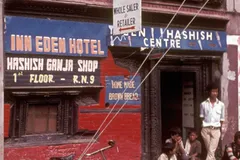
From the mid-1960s, growing numbers of foreign travellers arrived in Kathmandu. Demand raised the price of marijuana and hashish and encouraged exports to India. Licensed dealers operated on Jhochhen Tole, popularly known as Freak Street.
16 July 1973
The government revoked all licences to cultivate, buy and sell cannabis on 16 July. An account published two years later by anthropologist James Fisher identifies three pressures behind the crackdown: concern that local youth were adopting cannabis use, pressure from the United Nations and pressure from the United States for stronger narcotics control.
The decision closed the lawful commercial route and cost the state tax revenue. Later research also describes the loss of income for farmers, traders and communities where cannabis had been an important cash crop.
Because cultivation and sales had both required licences, cancelling them reached the production fields as well as the retail counters.
Closure before prohibition
The licence cancellation did not yet create the blanket criminal regime that exists in Nepal’s later history. Fisher’s contemporary account says buying, selling and cultivation became illegal while use itself was not prohibited at that stage.
The broader ban arrived in 1976 through the Narcotic Drugs (Control) Act. That law prohibited cultivation, sale and use, completing the transition from a taxed market to national prohibition.
What moved in the index
Closing the licensed shops cut Nepal’s access score from 6 to 0. Possession stayed at 6, cultivation at 3, enforcement at 6, sharing at 3 and consumption at 5 until the 1976 act. The single large score movement reflects exactly what the 1973 order did: it ended legal supply before the state criminalised the remaining personal conduct.[1][2]
In the cultural atlas
Score by segment 0 to 10
- Possession · 25%6 → 6
- Personal cultivation · 25%3 → 3
- Punishment & enforcement · 20%6 → 6
- Sharing & gifting · 10%3 → 3
- Consumption · 10%5 → 5
- Legal access · 10%6 → 0−6
The bar shows the score after the change; the tick marks where it stood before. Nepal's scores have changed again since.
References
- Journal of Cannabis Research — Revealed reality of cultivation and licit/illicit use of Cannabis in the western mid-hills of Nepal (2025)archived
- Cannabis in Nepal: An OverviewJames Fisher · In Cannabis and Culture, edited by Vera Rubin · Mouton · 1975 · pp. 247–255, especially pp. 249–254 · ISBN 90-279-7669-4
- Wikipedia — Cannabis in Nepalarchived
- Nepali Times — Nepal is moving to decriminalise cannabis (22 August 2026)archived
Checked. The date and the event were compared with a source that was read. The score before the change is an editorial estimate.