Austria
22/100
#34 of 196 worldwide
#12 of 45 in Europe
People caught with cannabis for personal use can have their case dropped after probation and any required health measures. Growing to obtain the drug is a crime. Patients can receive cannabinoid medicines, including dronabinol.
In short all countries →
- Can I carry it?NoEven a small amount can bring a fine or a charge
- Can I grow it?LimitedA few plants are treated far more leniently than dealing
- Can I buy it?LimitedOn prescription only
- Can I use it in public?NoNot in public, and even at home the law does not protect it
- What if I'm caught?A light penaltyFor a small amount, usually a fine, a referral to treatment or nothing at all; prison is rare
A rough guide read from the scores and the rules below, not legal advice. The details and the exceptions are in each segment: select an answer to jump to it.
Cannabis in Austria not part of the score · all 27 datasets ↓
Who uses it
About 1 in 16
people aged 15–64 in Austria used cannabis in the past year: 380,000 people.
- Past year
- 6.3%
- Europe median
- 5.8%
- Aged 15–16, 2024
- 15.1%
UNODC · survey 2020
Source Past-year cannabis use among people aged 15–64. People who used cannabis in the past year, from a 2020 survey, applied to today's population aged 15–64.Survey ages and years vary, and some surveys include children. Rates are not age-standardised; do not compare countries directly.
UNODC World Drug Report 2026, annex table 1.2. Population from the World Bank, aged 15–64. The whole dataset →
Use across Europe
20thhighest of 44 surveyed countries
- 🇲🇰 North Macedonia6.6%
- 🇬🇧 United Kingdom6.5%
- 🇦🇹 Austria6.3%
- 🇨🇾 Cyprus6.0%
- 🇮🇸 Iceland5.8%
Past-year use, latest survey of each. Survey years and ages differ. On the map →
Cannabis in figures
- Offences for cannabis use or possession214per 100,000 people · 2023
- Police contact for drug use or possession322per 100,000 people · 2024
- Cannabis seized2,545kg in 2024 · 2024
- THC in cannabis sold (Europe)12.67%THC in herb · 2024
- Street price of cannabis (Europe)€10.00a gram of herb · 2008
The dot: where it stands among the countries each dataset covers, lowest to highest. All datasets ↓
Score breakdown 22/100 · how the scores are made
Neighbours
- 🇨🇿 Czechia44
- 🇩🇪 Germany44
- 🇨🇭 Switzerland30
- 🇮🇹 Italy26
- 🇸🇮 Slovenia23
- 🇦🇹 Austria22
- 🇱🇮 Liechtenstein14
- 🇸🇰 Slovakia11
- 🇭🇺 Hungary10
Possessing cannabis for personal use remains a crime, with a basic maximum of six months in prison or 360 day-fines.[1] For cases that meet the law's conditions, prosecutors must put the case on hold for one to two years, with health measures such as treatment where needed.[1] Austria replaced its drug law and kept diversion in 1998.
| Amount | What happens | Punishment | Fine |
| Possession for personal useUp to six months in prison or 360 day-fines; qualifying cases must be put on hold for one to two years with health measures | CriminalPossession | Up to 6 months | — |
| Unpaid supply for another person's personal useCan be put on hold and later dropped under the same conditions as one's own personal use | CriminalSupply | — | — |
Growing cannabis with the purpose of obtaining the controlled drug is a crime.[1] The personal-use form carries up to six months in prison or 360 day-fines; the offence depends on that purpose, so plants can fall under it before flowering.[1] Growing cannabis to obtain narcotics became an explicit offence in 2008.
| Amount | What happens | Punishment | Fine |
| Growing to obtain the drug, personal use onlyOr 360 day-fines; case put on hold and later dropped if conditions met | CriminalCultivation | Up to 6 months | — |
| Growing to obtain the drug, basic offenceOr 360 day-fines; above the threshold, section 28 trafficking penalties apply | CriminalCultivation | Up to 1 year | — |
Police report personal-use cases to the prosecutor and notify the health authority.[1] Prosecutors must put qualifying cases on hold under the law's conditions; this also covers unpaid supply for another person's personal use.[1] Austria replaced its drug law and kept diversion in 1998.
Giving cannabis to another person is an offence.[1] Cases involving unpaid supply for that person's personal use can be put on hold and later dropped under the same conditions as one's own personal use.[1] Austria replaced its drug law and kept diversion in 1998.
The law punishes acquiring and possessing cannabis, including for personal consumption.[1] People caught with cannabis for personal use can have their case put on hold and later dropped, with health assessment or treatment where the legal conditions require it.[1] Austria revised small-quantity diversion in 1985.
Recreational supply remains prohibited.[1] Patients can receive prescription cannabinoid medicines: a parliamentary report names Sativex, Canemes and pharmacy-compounded dronabinol.[2] Current prescribing rules allow approved cannabis-extract medicines and highly purified THC for pharmacy preparations, while cannabis flower remains excluded.[3] Austria opened a narrow prescription-cannabinoid route in 2012.
Context not part of the score · every country, by topic →
There is no legal recreational supply. Possessing cannabis for personal use stays a crime with up to six months or 360 day-fines, but qualifying cases must be put on hold for one to two years with health measures, and unpaid supply for another person's personal use can be dropped the same way.[1] Police report users to the prosecutor and the health authority.[1] Austria replaced its drug law and kept diversion in 1998.
Patients can obtain cannabinoid medicines on prescription, including pharmacy-compounded dronabinol.[2] A parliamentary report describes reimbursement where medically justified and approved by the insurer's reviewing doctor.[2] The prescribing rules permit approved cannabis-extract medicines and highly purified THC preparations, while excluding flower.[3] Austria opened a narrow prescription-cannabinoid route in 2012.
A European survey conducted in 2018–19 received responses from four Austrian cannabis social clubs; its authors could not establish the full number operating in the country.[4] Supplying cannabis remains an offence, including through a club; qualifying unpaid personal-use cases can be put on hold and later dropped.[1]
Seeds unmixed with flowering or fruiting tops are excluded from the controlled-drug definition of cannabis.[3] Growing plants or cuttings becomes a criminal offence when the purpose is to obtain the controlled drug; flowering is not the only test.[1] The basic personal-use offence carries up to six months in prison or 360 day-fines.[1]
Hemp flowers with less than 0.3% THC fall under the tobacco monopoly: a 2025 court ruling put smokable CBD flower under the Tobacco Monopoly Act, so only licensed tobacconists may sell it, supplied by approved wholesalers.[5] Hemp and CBD shops may keep selling until the end of 2028; from 2029 low-THC cannabis goods fall fully under the monopoly.[6] The industry association announced it would challenge the law at the Constitutional Court.[6] Austria put hemp flowers under the tobacco monopoly in 2025.
Growing cannabis to obtain the drug for manufacturing medicines is reserved to AGES, the Austrian health and food-safety agency, or a subsidiary at least 75% owned by it.[1] The harvest may be supplied only to businesses authorised to manufacture and wholesale medicines and poisons.[1] Medicinal cultivation was reserved to AGES or its subsidiary in 2008.
The EU drugs agency records 2,370 kg of herbal cannabis and 1,745 kg of resin seized in Austria in 2024, against 2,470 kg and 183 kg in 2023.[7] Herbal cannabis was seized on 13,587 occasions and resin on 2,030.[7] Plant seizures totalled 40,101 plants.[7]
Visitors have no lawful recreational supply.[1] Possession remains a crime, while qualifying personal-use cases can be put on hold and later dropped, with health measures where needed.[1]
Driving while impaired by drugs is an offence; there is no numerical THC limit.[8] The government's penalty table lists an €800–3,700 fine, a one-month licence withdrawal and traffic coaching for a first offence.[9]
The EU drugs agency records 27,355 cannabis-related drug law offences in Austria in 2024, against 25,322 in 2023.[10] Of the 2023 total, 19,672 were for use or possession for use.[10] The total peaked at 37,751 in 2017.[10]
A case put on hold comes with a probation period and any required health measures.[1] Prosecution can resume if the conditions are breached.[1] Once probation ends successfully and the required measures are completed, the prosecutor finally drops the case.[1] Austria replaced its drug law and kept diversion in 1998.
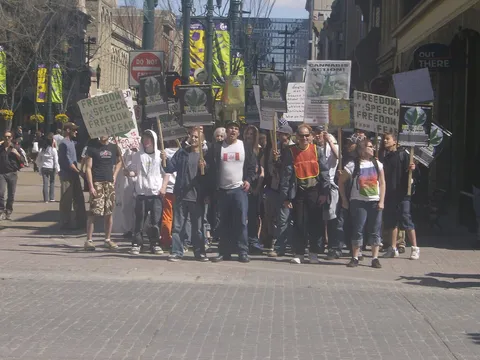
Vienna marches. The capital's Hanfwandertag joins the Global Marijuana March, held on the first Saturday of May in hundreds of cities, with a procession down the Mariahilfer Strasse shopping street.[11] People in hundreds of cities marched for legalisation in 1999. Austria's Constitutional Court refused to hear a challenge to the ban in 2022. Germany's plans reopened the debate in Austria in 2022.
Taking cannabis into or out of Austria is a separate offence from possessing it, normally charged as smuggling or trafficking, with far heavier penalties. That holds almost everywhere, including between two places where cannabis is legal.
The rules that allow or tolerate small amounts inside Austria do not cover the border, an airport or the post.
A prescription from another country is not recognised by itself. Within the Schengen area a patient can carry prescribed medicine for up to 30 days with a certificate issued by their home health authority; whether cannabis qualifies depends on both countries.[12]
General guidance that applies to almost every country, not a check of Austria's customs rules.
Culture the atlas →
Datasets not part of the score
What other organisations publish about Austria, and where it stands among the countries each one covers. Each dataset has a page of its own, with a world map and every country's figure.
Use
UNODC · 2020
Cannabis use
6.3%of people aged 15–64
7.5% · 20043.5% · 20086.4% · 20156.3% · 202020042020 ages 15–64 · survey 2020 · 380,000 people · UNODC 2026
Source Survey ages and years vary, and some surveys include children. Rates are not age-standardised; do not compare countries directly.UNODC · 2024
Cannabis use at 15 and 16
15.1%in the past year
16% · 201518.9% · 201915.1% · 202420152024 Higher than 76% of 49 countriesLowestHighest18.26% ever · 6.86% in the past month · 2024 · ages 15–16
ESPAD
Is cannabis easy to get? (students, Europe)
29.6%of students say it is easy to get
Higher than 58% of 36 countriesLowestHighest30.9% of boys · 27.7% of girls · aged 15–16 · 2024
EUDA · 2024
Cannabis in wastewater
73.90mg of THC-COOH a day per 1,000 people
74.30 · 201864.50 · 201951.70 · 202075.10 · 202173.30 · 202271.50 · 202373.90 · 202420182024 Higher than 52% of 33 countriesLowestHighestcities measured: 17 · 5,362,600 people served
ESPAD · 2024
Students who have tried cannabis (Europe)
17.3%of students have tried it
21% · 200316.9% · 200720.2% · 201521% · 201917.3% · 202420032024 Higher than 78% of 36 countriesLowestHighestaged 15–16 · 2024
WHO, Our World in Data · 2020
Alcohol drunk per person
11.51litres of pure alcohol a year
12.89 · 200012.89 · 200112.63 · 200212.53 · 200312.59 · 200412.61 · 200512.73 · 200612.66 · 200712.40 · 200812.27 · 200912.23 · 201012.35 · 201112.34 · 201212.49 · 201312.33 · 201412.19 · 201511.93 · 201611.92 · 201711.97 · 201811.97 · 201911.51 · 202020002020 Higher than 95% of 187 countriesLowestHighestper person aged 15 or over · 2020 · 12.89 in 2000 · 12.23 in 2010
EUDA · 2024
People entering treatment for cannabis
23.9%of people entering drug treatment came for cannabis
Higher than 34% of 29 countriesLowestHighest1,122 of 4,702 people · 2024
Law
EUDA · 2023
Offences for cannabis use or possession
214per 100,000 people
187 · 2007150 · 2008174 · 2009170 · 2010178 · 2011174 · 2012230 · 2013231 · 2014222 · 2015260 · 2016314 · 2017268 · 2018267 · 2019247 · 2020216 · 2021216 · 2022214 · 202320072023 Higher than 87% of 23 countriesFewerMore19,672 offences in 2023 · cannabis only · use or possession, not dealing · 15,612 in 2010 · 22,778 in 2020
UNODC · 2024
Police contact for drug use or possession
322per 100,000 people
396 · 2020304 · 2021305 · 2022308 · 2023322 · 202420202024 Higher than 89% of 101 countriesFewerMore29,638 people in 2024 · all drugs together
UNODC · 2024
Cannabis seized
2,545kg in 2024
1,138 · 20151,079 · 20161,657 · 20171,492 · 20181,364 · 20192,054 · 20202,106 · 20211,755 · 20222,653 · 20232,545 · 202420152024 Higher than 49% of 163 countriesLess seizedMore seized2,312 kg of herb · 233 kg of resin · 1,138 kg in 2015 · 2,054 kg in 2020
Society
OpenAlex · 2025
Research on cannabis
2.8papers per million people
0.1 · 19520.1 · 19680.1 · 19690.1 · 19700.2 · 19780.1 · 19810.1 · 19850.2 · 19860.1 · 19970.1 · 19980.3 · 19990.1 · 20000.4 · 20010.4 · 20030.8 · 20041.1 · 20051.2 · 20061.2 · 20072.0 · 20081.3 · 20091.6 · 20102.0 · 20112.0 · 20121.5 · 20132.5 · 20142.6 · 20151.7 · 20162.2 · 20173.0 · 20183.8 · 20193.3 · 20204.9 · 20213.1 · 20223.9 · 20234.1 · 20242.8 · 202519522025 Higher than 73% of 176 countriesLowestHighest26 papers in 2025 · 1 in 1970 · 15 in 2010
Cato and Fraser Institutes · 2023
Human Freedom Index
8.54of 10
8.72 · 20008.67 · 20018.67 · 20028.74 · 20038.72 · 20048.67 · 20058.70 · 20068.73 · 20078.70 · 20088.70 · 20098.62 · 20108.69 · 20118.74 · 20128.78 · 20138.83 · 20148.78 · 20158.83 · 20168.78 · 20178.69 · 20188.69 · 20198.26 · 20208.28 · 20218.51 · 20228.54 · 202320002023 Higher than 87% of 164 countriesLess freeFreerrank #22 of 165 · personal freedom 9.24 · economic freedom 7.57
V-Dem, Our World in Data · 2025
Civil liberties
0.91of 1 in 2025
0.66 · 19000.66 · 19010.66 · 19020.66 · 19030.66 · 19040.66 · 19050.66 · 19060.66 · 19070.66 · 19080.66 · 19090.66 · 19100.66 · 19110.66 · 19120.66 · 19130.68 · 19140.68 · 19150.68 · 19160.68 · 19170.69 · 19180.83 · 19190.84 · 19200.84 · 19210.84 · 19220.84 · 19230.84 · 19240.84 · 19250.84 · 19260.82 · 19270.83 · 19280.83 · 19290.82 · 19300.82 · 19310.82 · 19320.59 · 19330.38 · 19340.37 · 19350.37 · 19360.36 · 19370.37 · 19380.75 · 19450.80 · 19460.80 · 19470.80 · 19480.80 · 19490.82 · 19500.82 · 19510.82 · 19520.82 · 19530.82 · 19540.84 · 19550.91 · 19560.91 · 19570.91 · 19580.91 · 19590.91 · 19600.91 · 19610.91 · 19620.91 · 19630.91 · 19640.90 · 19650.91 · 19660.91 · 19670.91 · 19680.91 · 19690.92 · 19700.93 · 19710.93 · 19720.93 · 19730.93 · 19740.93 · 19750.94 · 19760.94 · 19770.94 · 19780.94 · 19790.93 · 19800.94 · 19810.94 · 19820.94 · 19830.94 · 19840.94 · 19850.94 · 19860.94 · 19870.94 · 19880.94 · 19890.95 · 19900.95 · 19910.95 · 19920.95 · 19930.95 · 19940.94 · 19950.95 · 19960.95 · 19970.95 · 19980.95 · 19990.95 · 20000.95 · 20010.95 · 20020.95 · 20030.95 · 20040.95 · 20050.95 · 20060.95 · 20070.94 · 20080.94 · 20090.94 · 20100.94 · 20110.94 · 20120.95 · 20130.95 · 20140.95 · 20150.95 · 20160.94 · 20170.93 · 20180.92 · 20190.92 · 20200.93 · 20210.92 · 20220.93 · 20230.91 · 20240.91 · 202519002025 Higher than 82% of 175 countriesFewer libertiesMore liberties0.84 in 1925 · 0.91 in 1961 · 0.95 in 1990
Our World in Data, World Bank · 2025
Population
9,208,163people in 2025
5,979,176 · 19006,571,587 · 19106,486,069 · 19206,679,644 · 19306,725,734 · 19406,936,455 · 19507,047,274 · 19607,466,320 · 19707,548,407 · 19807,679,627 · 19908,012,929 · 20008,365,087 · 20108,921,402 · 20209,208,163 · 202519002025 Higher than 50% of 196 countriesLowestHighest5,979,176 in 1900 · 6,936,455 in 1950 · 8,012,929 in 2000
CEPII
Former colonial rulers
Once ruled by
World Bank · 2025
Government effectiveness
84of 100
90 · 199689 · 199893 · 200093 · 200291 · 200390 · 200491 · 200588 · 200688 · 200787 · 200886 · 200986 · 201084 · 201184 · 201284 · 201387 · 201485 · 201586 · 201686 · 201785 · 201888 · 201988 · 202087 · 202186 · 202285 · 202383 · 202484 · 202519962025 Higher than 91% of 195 countriesLowestHighestestimate 1.54 on a scale of −2.5 to 2.5 · 2025 · 93 in 2000 · 85 in 2015
Transparency International · 2024
Corruption Perceptions Index
67of 100
69 · 201269 · 201372 · 201476 · 201575 · 201675 · 201776 · 201877 · 201976 · 202074 · 202171 · 202271 · 202367 · 202420122024 Higher than 86% of 178 countriesLowestHighest0 highly corrupt, 100 very clean · 2024 · 76 in 2015 · 76 in 2020
Pew Research Center · 2020
Most common religion
Christians
the largest group · 2020
World Bank · 2025
Income per person
$63,970per person
43,258 · 199044,302 · 199144,735 · 199244,601 · 199345,497 · 199446,639 · 199547,609 · 199648,575 · 199750,217 · 199852,004 · 199953,534 · 200054,032 · 200154,565 · 200254,920 · 200355,980 · 200456,890 · 200558,460 · 200660,471 · 200761,158 · 200858,810 · 200959,730 · 201061,272 · 201161,377 · 201260,863 · 201360,846 · 201460,952 · 201561,573 · 201662,536 · 201763,778 · 201864,609 · 201960,276 · 202062,969 · 202165,694 · 202264,536 · 202363,788 · 202463,970 · 202519902025 Higher than 91% of 187 countriesLowestHighestat purchasing power parity, 2021 dollars · 2025 · $43,258 in 1990 · $59,730 in 2010
World Bank · 2025
Development indicators
91.9%use the internet
0.1% · 19900.3% · 19910.6% · 19920.8% · 19931.4% · 19941.9% · 19956.9% · 19969.5% · 199715.4% · 199823% · 199933.7% · 200039.2% · 200136.6% · 200242.7% · 200354.3% · 200458% · 200563.6% · 200669.4% · 200772.9% · 200873.5% · 200975.2% · 201078.7% · 201180% · 201280.6% · 201381% · 201483.9% · 201584.3% · 201687.9% · 201787.5% · 201887.8% · 201987.5% · 202092.5% · 202193.6% · 202295.3% · 202394.9% · 202491.9% · 202519902025 Higher than 77% of 195 countriesLowestHighest69.7% live in towns · 21.1% aged 65+ · 2025 · 33.7% in 2000 · 75.2% in 2010
GDELT · 2025
Cannabis in the news
0.001%of global news: cannabis articles from here
0.002% · 20170.0018% · 20180.0014% · 20190.001% · 20200.0013% · 20210.0015% · 20220.0011% · 20230.0012% · 20240.001% · 202520172025 Higher than 78% of 147 countriesLowestHighest2025 average, 348 days · 0.0018% in 2018 · 0.0013% in 2021
Plant and market
EUDA · 2008
Street price of cannabis (Europe)
€10.00a gram of herb
3.00 · 20043.00 · 20054.00 · 20069.00 · 200710.00 · 200820042008 Higher than 50% of 28 countriesLowestHighest€9.00 a gram of resin · 2008
EUDA · 2024
THC in cannabis sold (Europe)
12.67%THC in herb
9% · 20024.8% · 20045.6% · 20057.2% · 20066.7% · 20077.2% · 20085.9% · 20097.5% · 20107.02% · 20119.71% · 20129.56% · 20138.94% · 20149.82% · 201510.75% · 20169.64% · 20179.64% · 20187.03% · 20196.11% · 20209.1% · 20219.15% · 202210.32% · 202312.67% · 202420022024 Higher than 56% of 27 countriesLowestHighest24.21% in resin · 2024 · 7.5% in 2010 · 9.82% in 2015
OpenStreetMap · 2026
Cannabis shops on the map
78shops mapped
Higher than 85% of 59 countriesFewer shopsMore shops8.5 per million people · 2026
GBIF · 2026
Records of the cannabis plant
605dated records
1 · 18324 · 18505 · 18538 · 18549 · 186110 · 186311 · 186512 · 186613 · 186815 · 187017 · 187318 · 187419 · 187520 · 187621 · 187822 · 187924 · 188025 · 188426 · 188727 · 188930 · 189031 · 189132 · 189333 · 189634 · 189738 · 189939 · 190040 · 190342 · 190443 · 190644 · 190945 · 191147 · 191548 · 191749 · 192050 · 192252 · 192653 · 192755 · 192958 · 193159 · 193260 · 194062 · 194165 · 194367 · 194773 · 194981 · 195082 · 195283 · 195484 · 195585 · 195687 · 195888 · 195989 · 196290 · 196392 · 196693 · 196895 · 196996 · 197097 · 197299 · 1973105 · 1975114 · 1976120 · 1977121 · 1978129 · 1979136 · 1980139 · 1981141 · 1982144 · 1983151 · 1984155 · 1985173 · 1987183 · 1988190 · 1989198 · 1990199 · 1991210 · 1992217 · 1993221 · 1994223 · 1995229 · 1996237 · 1997245 · 1998247 · 1999257 · 2000261 · 2001284 · 2002294 · 2003300 · 2004314 · 2005333 · 2006339 · 2007342 · 2008346 · 2009348 · 2010351 · 2011357 · 2012361 · 2013366 · 2015370 · 2016371 · 2017380 · 2018391 · 2019408 · 2020429 · 2021454 · 2022478 · 2023514 · 2024575 · 2025605 · 202618322026 Higher than 91% of 128 countriesLowestHighest13 more without a date · 30 in 2026 · 39 by 1900 · 257 by 2000
FAO · 2024
Hemp grown
550ha in 2024
10 · 196111 · 19620 · 19630 · 19640 · 19650 · 19660 · 19670 · 19680 · 19690 · 19700 · 19710 · 19720 · 19730 · 19740 · 19750 · 19760 · 19770 · 19780 · 19790 · 19800 · 19810 · 19820 · 19830 · 19840 · 19850 · 19860 · 19870 · 19880 · 19890 · 19900 · 19911 · 19920 · 19930 · 19940 · 19950 · 19960 · 19970 · 19980 · 19990 · 20000 · 2001294 · 2002364 · 2003401 · 2004346 · 2005562 · 2006449 · 2007296 · 2008356 · 2009540 · 2010512 · 2011472 · 2012566 · 2013906 · 2014774 · 2015646 · 2016717 · 20171,580 · 20182,010 · 20192,140 · 20201,880 · 20211,340 · 2022720 · 2023550 · 202419612024 Higher than 59% of 39 countriesLowestHighest2,140 t of fibre · 10 ha in 1961 · 0 ha in 1980 · 0 ha in 2000
ClinicalTrials.gov · 2026
Clinical trials of cannabis medicines
11studies so far
2 · 20174 · 20185 · 20197 · 20209 · 202110 · 202210 · 202310 · 202410 · 202511 · 202620172026 Higher than 68% of 50 countriesLowestHighest1 actual starts in 2026 · as of 2026–10–26 · 7 by 2020
History 20 of 20 checked against a source
Score and entries per decade
22 today, from 100 before its first recorded change
This country's score Entries that moved the score Context only
20251 entry0 score changes
20222 entries0 score changes
Debate ✓
Germany's plans reopen the debate in Austria
Germany's announcement that it would legalise cannabis set off a discussion in Austria, where almost half the public said it was open to legal cannabis.
Debate ✓
Austria's Constitutional Court refuses to hear a challenge to the cannabis ban
A man caught late in 2020 by two plain-clothes officers with a half-smoked joint asked the court to strike down the prohibition, arguing that cannabis carries less risk of dependence than nicotine or alcohol. The court had opened proceedings in February and asked the government to justify the ban. It then declined unanimously: cannabis, unlike alcohol and tobacco, is covered by international treaties, and how to regulate drugs is for parliament. The decision was made public on 18 July.
20161 entry1 score change
20121 entry1 score change
20082 entries0 score changes
Medical ✓
Austria reserves medicinal cannabis cultivation to AGES or its controlled subsidiary
New section 6a permitted cannabis cultivation for obtaining narcotics to manufacture medicines and for related scientific purposes only by the Austrian Agency for Health and Food Safety (AGES), or a subsidiary in which it held at least 75 percent. Harvested and dried plants or cannabis could be supplied only to licensed pharmaceutical manufacturers and wholesalers. This created an institutional production route, not a patient home-growing entitlement or general access to cannabis flower.
Tightening ✓
Austria explicitly criminalises growing cannabis to obtain narcotics
The 2007 amendment, effective in January 2008, added cultivation of cannabis, opium poppy or coca for obtaining narcotics to section 27's offences. The basic penalty was up to one year in prison or 360 day-fines; conduct exclusively for personal use carried up to six months or the same fine ceiling. Section 28 separately covered cultivation to obtain quantities above the statutory threshold. The change addressed growing before production of the drug; it did not ban every cannabis plant regardless of purpose or remove the law's diversion provisions.
19981 entry1 score change
19972 entries0 score changes
International ✓
Austria joins the 1988 UN convention against drug trafficking
Austria ratified the United Nations Convention against Illicit Traffic in Narcotic Drugs and Psychotropic Substances of 1988 on 11 July 1997. Article 3 of the convention requires each party, subject to its constitutional principles, to make the possession, purchase and cultivation of drugs for personal consumption a criminal offence.
Debate ✓
Austrian deputies ask for cannabis for personal use to go unpunished
After parliament passed the Narcotic Substances Act on 16 April 1997, the deputies Klara Motter, Schmidt and colleagues moved that the government prepare a law exempting the purchase, possession, use, import and export of cannabis for one's own use from punishment. They pointed to the Netherlands, Spain, Britain and the German Constitutional Court's ruling of 1994, and argued that cannabis was less harmful than alcohol or nicotine.
19851 entry0 score changes
19781 entry0 score changes
19681 entry0 score changes
19521 entry0 score changes
19501 entry0 score changes
19461 entry0 score changes
19281 entry1 score change
19071 entry0 score changes
19051 entry0 score changes
18821 entry0 score changes
Sources hover a number in the text to see its source
- Cited
- 12
- Websites
- 9
- Last reviewed
- History checked
- 20/20
Most cited
- euda.europa.eu3
- ris.bka.gv.at2
- cannabisfreedom.fyi1
- cdn.sanity.io1
- incb.org1
- oesterreich.gv.at1
All 12 sources
- Suchtmittelgesetz (SMG) — consolidated federal law (RIS)§§ 6a, 13(2b), 27, 35 and 38archived
- Austrian Parliament — Patients have access to Sativex, Canemes and prescribed dronabinol (22 January 2019)archived
- RIS — Suchtgiftverordnung, consolidated prescribing rules and controlled substances§ 14; annex I.1.a, Cannabisarchived
- Pardal, Decorte, Bone, Parés & Johansson — Mapping Cannabis Social Clubs in Europe, European Journal of Criminology (2020, PDF)archived
- The Germany Eye — CBD Flower Sales Now Subject to Tobacco Monopoly Regulations (17 April 2025)VwGH ruling puts CBD flowers under 0.3% THC under tobacco monopoly; tobacconists onlyarchived
- ORF — Neuregelung des Tabakmonopols beschlossen (10 December 2025)Low-THC cannabis goods under the tobacco monopoly from 2029; transition to end 2028; industry court challengearchived
- EUDA — Statistical Bulletin 2026, seizures of drugs: cannabis (quantity and number of seizures)archived
- EUDA — Legal approaches to drugs and driving, country table (last updated May 2025)archived
- Austrian Government — Driving licence withdrawal: offences and penaltiesFirst offence: drug-impaired drivingarchived
- EUDA — Statistical Bulletin 2026, drug law offences: cannabis (totals and use-related)archived
- Cannabis Freedom Index — Global Marijuana March (atlas)archived
- International Narcotics Control Board — Travellers carrying medicines containing controlled substances