New Zealand
20/100
#44 of 196 worldwide
#2 of 14 in Oceania
Illegal, but since 2019 police must consider a health-based response before prosecuting. A legalisation referendum narrowly failed in 2020; the medical scheme has operated since.
In short all countries →
- Can I carry it?NoEven a small amount can bring a fine or a charge
- Can I grow it?NoIt is a crime
- Can I buy it?LimitedOn prescription only
- Can I use it in public?NoNot in public, and even at home the law does not protect it
- What if I'm caught?A light penaltyFor a small amount, usually a fine, a referral to treatment or nothing at all; prison is rare
A rough guide read from the scores and the rules below, not legal advice. The details and the exceptions are in each segment: select an answer to jump to it.
Cannabis in New Zealand not part of the score · all 18 datasets ↓
Who uses it
About 1 in 7
people aged 15+ in New Zealand used cannabis in the past year: 620,000 people.
- Past year
- 14.1%
- Oceania median
- 11.5%
UNODC · survey 2024/25
Source Past-year cannabis use among people aged 15+. People who used cannabis in the past year, from a 2024/25 survey, applied to today's population aged 15+.Survey ages and years vary, and some surveys include children. Rates are not age-standardised; do not compare countries directly.
UNODC World Drug Report 2026, annex table 1.2. Population from the World Bank, aged 15+. The whole dataset →
Use across Oceania
3rdhighest of 7 surveyed countries
- 🇵🇬 Papua New Guinea29.5%
- 🇵🇼 Palau24.2%
- 🇳🇿 New Zealand14.1%
- 🇦🇺 Australia11.5%
- 🇲🇭 Marshall Islands5.5%
Past-year use, latest survey of each. Survey years and ages differ. On the map →
Cannabis in figures
- Police contact for drug use or possession126per 100,000 people · 2024
- Cannabis seized1,140kg in 2024 · 2024
- Cannabis shops on the map2shops mapped · 2026
- Research on cannabis8.5papers per million people · 2025
- Clinical trials of cannabis medicines6studies so far · 2026
The dot: where it stands among the countries each dataset covers, lowest to highest. All datasets ↓
Score breakdown 20/100 · how the scores are made
Similar scores in Oceania
- 🇦🇺 Australia22
- 🇳🇿 New Zealand20
- 🇫🇲 Micronesia18
- 🇵🇼 Palau17
- 🇫🇯 Fiji13
Possession is a criminal offence with a maximum of three months' prison or a NZ$500 fine. For a Class C plant or seed offence, there is a legal presumption against imprisonment unless there are previous convictions or exceptional circumstances; Class B preparations do not have that custody presumption.[1][2] Since August 2019 police must consider whether a health-based response would be more beneficial than prosecution, and many cases now end in a warning or referral — but thousands are still charged.[3] The 1975 Act that still governs cannabis is traced in the 1975 Act, and the 2019 discretion in its amendment.
| Amount | What happens | Punishment | Fine |
| Ordinary Class B/C personal possessionClass C only has the presumption against imprisonment; health response considered first | CriminalPossession | Up to 3 months | Up to NZ$500 |
Growing cannabis is a criminal offence, with up to seven years.[2] The one exception is low-THC hemp, at most 1% THC by dry weight: since 28 May 2026 it may be grown without a licence for specified purposes, such as breeding, making hemp products or supplying the medicinal scheme, after notifying both Police and the Ministry for Primary Industries, and a notification lasts a year.[4][5] It gives no right to grow cannabis to use.[4]
| Amount | What happens | Punishment | Fine |
| Growing cannabis | CriminalUnlicensed cultivation | Up to 7 years | — |
| Hemp growing with notification (from 28 May 2026)Notify Police and MPI; 1% THC max; one-year notification; no right to grow for use | LegalLicensed hemp | — | — |
Warnings and health referrals have reduced user prosecutions since 2019, although many people are still charged.[3][6] Ordinary Class B/C personal possession can carry up to three months and/or NZ$500. The Class C presumption against imprisonment does not apply to Class B preparations.[1] Supply accusations have different penalties: up to fourteen years for Class B preparations and eight years for Class C plant offences under section 6. The supply presumptions differ by form and can be rebutted.[7][1]
Unauthorised supply is an offence even below the presumption amounts. Possessing 28 g of Class C cannabis plant material, 5 g of a Class B cannabis preparation such as hashish or oil, or 250 mg of the separately scheduled THC creates a rebuttable presumption of supply; it is not an automatic conviction. The cannabis rows also specify 100 cigarettes containing the drug. Section 6 supply offences carry up to fourteen years for Class B and eight years for Class C; lower-level Class C supply can instead fall under section 7.[1][7]
| Amount | What happens | Punishment | Fine |
| Selling or supplying Class C cannabis | CriminalSupply | Up to 8 years | — |
| Supplying Class C cannabis to a person under 18 | CriminalSupply to a minor | Up to 8 years | — |
| Giving Class C cannabis without sale | CriminalGift | Up to 3 months | Up to NZ$500 |
| Supplying Class B cannabis | CriminalSupply | Up to 14 years | — |
| Possession for supply8 years for Class C plant, 14 for Class B preparations | CriminalPossession for supply | Up to 14 years | — |
No adult-use source. A 2020 referendum on a regulated legal market failed narrowly, 50.7% to 48.4%.[8] Medicinal cannabis is available on prescription from pharmacies.[2] The vote is traced in the 2020 referendum.
Context not part of the score · every country, by topic →
Recreational cannabis is fully illegal: possession is a crime even if police must now consider a health response first, and the only public vote on a legal market failed.[3][8] A tinny — a small foil-wrapped deal — remains the street-level unit, sold from ordinary-looking tinny houses; researchers found their young, often Maori buyers showed no wider drug escalation.[9]
Any doctor or nurse practitioner can prescribe a verified medicinal cannabis product for any condition; pharmacist prescribers are limited to CBD and some Class B1 dosage products.[2] Products are unsubsidised and costly.[2] Prescription flower and oils must meet the scheme's quality standard; CBD products meeting the legal definition are prescription-only medicines, and hemp flower or leaf is not a food.[2][10] The scheme's launch is traced in the 2020 scheme.
Clubs are illegal and the best-known one has been shut down repeatedly. The Daktory ran openly in Auckland from late 2008 to 2012 as a members' club where cannabis was sold over the counter and smoked on the premises; it drew more than 2,000 members before police raided and closed it.[11] Its founder reopened it in Wellington, where police raided it in August 2019, charging him and another man with offences including possession for supply, and again in December 2019, a month after it had reopened.[12]
Since 28 May 2026, qualifying hemp seeds, seedlings and cuttings may be held, procured, sold and supplied domestically for the permitted hemp purposes under regulation 14A.[4] Supply must be to a person legally entitled to possess hemp; growers notify Police and the Ministry for Primary Industries, with notifications valid for one year.[4] Hemp cultivars must contain no more than 1% THC by dry weight. Clones, tissue, seedlings and seeds of high-THC cultivars are not hemp, even when young material itself contains little THC.[10] Ordinary cannabis seed is a Class C controlled drug, so possessing or germinating it remains an offence; only qualifying hemp material is outside the licence requirement.[1][4] Importing or exporting whole hemp seed or plant material still needs a licence.[4][10]
Hemp at most 1% THC may be grown without a licence for specified purposes since May 2026, after notifying Police and the Ministry for Primary Industries.[4] It gives no right to grow cannabis to use, and importing or exporting hemp plants and seed still needs a licence.[4] CBD remains prescription-only, and hemp leaf or flower is not a food.[10]
Since April 2020 the Medicinal Cannabis Scheme has licensed commercial cultivation and manufacture of medicinal cannabis under the Misuse of Drugs Act and the 2019 regulations.[13] Since 28 May 2026 low-THC hemp (at most 1% THC) may be grown, processed and supplied within New Zealand without a licence for specified purposes, after the grower notifies Police and the Ministry for Primary Industries.[4] Importing and exporting hemp plants and seed still needs a licence.[4]
Figures reported by the government to the UN drugs office record 1,136 kg of herbal cannabis seized in 2024, against 812 kg in 2023, and 4.7 kg of cannabis resin seized in 2024, against 2.7 kg in 2023.[14] The UN publishes them as kilogram equivalents, and countries count seizures differently, so the figures are not comparable across borders.[14] Police plant-material seizures are larger and measured differently: Operation Beryl reported more than 10 tonnes in 2025 and Operation Blackout more than five tonnes in 2026, counted as cannabis material rather than dried herb.[15][16]
There is no legal recreational supply for anyone, so a visitor has no lawful way to buy cannabis.[8] Whatever legal supply exists is medical, for patients with a prescription or registration.[2] A visitor may bring a prescribed medicinal cannabis product for personal use with a copy of the prescription or a prescriber's letter; there is no recreational route.[17]
Police can stop any driver and screen saliva at the roadside for four drugs, THC among them.[18] Testing began in Wellington on 15 December 2025 and went nationwide on 1 July 2026.[19][20] The device reacts only at or above a built-in threshold, which police say is set to show recent use and to exclude past use and passive exposure.[18] A positive screen leads to a second one and a saliva sample for the laboratory; two positive screens mean a 12-hour driving ban on the spot.[21] A fine follows only if the laboratory confirms the drug at or above its threshold (5 ng/mL of THC in oral fluid): 200 dollars and 50 demerit points for one drug, 400 dollars and 75 points for two or more, and the same 400 dollars and 75 points for refusing the test.[22][21] In blood, a concentration within the tolerance level is an infringement and one at the high-risk level a crime.[22] Patients prescribed cannabis can still test positive; they must take the test and may apply afterwards for a medical defence if they took the medicine as prescribed.[23]
Ministry of Justice figures reported in March 2026 show 3,438 people charged with possessing cannabis in 2025, up from 2,881 in 2024 and 2,287 in 2023, the highest number since a 2019 law change told police to consider a health-based response first.[24] Charges had fallen from 3,719 in 2017 to a low of 2,055 in 2021.[24] Of all convictions for cannabis offences, 82% came alongside charges unrelated to cannabis; 506 people were convicted of cannabis offences alone in 2025, against 387 in 2023.[24] Police said the rise tracks higher use seen in wastewater testing, and that the charge figures leave out the warnings officers give for possession.[24] Official court finalisations for the year to 30 June 2026 show 5,690 cannabis charges and 3,543 people charged, down slightly from 5,854 and 3,606; 2,551 people were convicted, 558 received imprisonment as the most serious sentence, and 464 of 2,596 conviction instances were cannabis-only.[25]
A conviction is a criminal record affecting travel and work.[2] Roadside oral-fluid drug testing was introduced with penalties for THC.[6]
A tinny is a small foil-wrapped deal, and a tinny house the ordinary-looking home that sells it to anyone with cash — the country's street-level trade, which researchers found drew younger, often Maori buyers without spreading harder-drug use, deflating a 2000s panic that the houses pushed methamphetamine.[9] Its story is traced in tinny.[9]
Taking cannabis into or out of New Zealand is a separate offence from possessing it, normally charged as smuggling or trafficking, with far heavier penalties. That holds almost everywhere, including between two places where cannabis is legal.
A prescription or medical card from another country is generally not recognised. Travellers who need a cannabis-based medicine should ask New Zealand's embassy before travelling.[26]
General guidance that applies to almost every country, not a check of New Zealand's customs rules.
Culture the atlas →
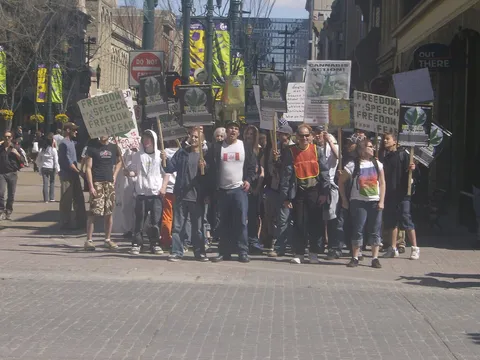 TraditionsThe Global Marijuana MarchOn the first Saturday of May, people in hundreds of cities march for legal cannabis. Brazil's supreme court had to rule that doing so is free speech.
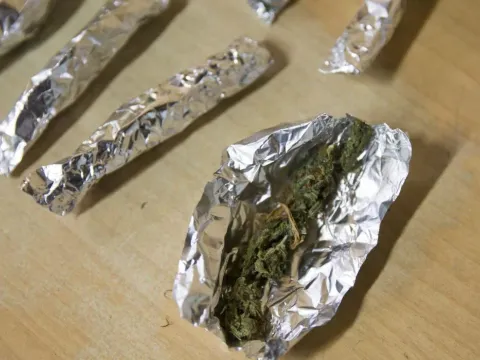 LanguageTinnyNew Zealand slang for a small deal of cannabis wrapped in tinfoil, and for the "tinny house", an ordinary-looking home where it is sold to anyone with cash.
Did you know? all cases →
Words · New Zealand
In New Zealand, a small cannabis deal wrapped in foil is a tinny. An ordinary-looking home selling it can become a ‘tinny house’: the name of the little package extends to the whole premises.
Read the entry →
Datasets not part of the score
What other organisations publish about New Zealand, and where it stands among the countries each one covers. Each dataset has a page of its own, with a world map and every country's figure.
Use
UNODC · 2025
Cannabis use
14.1%of people aged 15+
13.25% · 200614.6% · 200714.6% · 200811% · 201313.73% · 201614.03% · 201711.9% · 201815% · 201915% · 202015.3% · 202114.7% · 202214.2% · 202315.6% · 202414.1% · 202520062025 ages 15+ · survey 2024/25 · 620,000 people · UNODC 2026
Source Survey ages and years vary, and some surveys include children. Rates are not age-standardised; do not compare countries directly.WHO, Our World in Data · 2020
Alcohol drunk per person
10.02litres of pure alcohol a year
9.77 · 20009.77 · 20019.80 · 20029.95 · 200310.02 · 200410.15 · 200510.15 · 200610.20 · 200710.15 · 200810.29 · 200910.28 · 201010.25 · 201110.07 · 20129.91 · 20139.74 · 20149.69 · 20159.71 · 20169.85 · 20179.89 · 20189.89 · 201910.02 · 202020002020 Higher than 85% of 187 countriesLowestHighestper person aged 15 or over · 2020 · 9.77 in 2000 · 10.28 in 2010
Law
UNODC · 2024
Police contact for drug use or possession
126per 100,000 people
105 · 2022106 · 2023126 · 202420222024 Higher than 67% of 101 countriesFewerMore6,684 people in 2024 · all drugs together
UNODC · 2024
Cannabis seized
1,140kg in 2024
693 · 2015524 · 2016541 · 2017893 · 2018506 · 2019768 · 2020736 · 2021991 · 2022815 · 20231,140 · 202420152024 Higher than 39% of 163 countriesLess seizedMore seized1,136 kg of herb · 5 kg of resin · 693 kg in 2015 · 768 kg in 2020
Society
OpenAlex · 2025
Research on cannabis
8.5papers per million people
0.4 · 19730.4 · 19750.4 · 19760.2 · 19780.2 · 19790.2 · 19800.2 · 19810.2 · 19820.2 · 19900.2 · 19910.2 · 19920.8 · 19930.9 · 19940.6 · 19950.2 · 19960.9 · 19970.9 · 19980.6 · 19991.3 · 20001.9 · 20013.6 · 20023.2 · 20031.5 · 20043.2 · 20053.0 · 20063.0 · 20075.3 · 20083.4 · 20095.6 · 20104.7 · 20113.8 · 20125.4 · 20135.6 · 20147.7 · 20157.3 · 20165.1 · 20177.1 · 20189.2 · 201916 · 202012 · 202113 · 202210 · 20239.0 · 20248.5 · 202519732025 Higher than 91% of 176 countriesLowestHighest45 papers in 2025 · 1 in 1990 · 30 in 2010
Cato and Fraser Institutes · 2023
Human Freedom Index
9.02of 10
9.24 · 20009.19 · 20019.20 · 20029.20 · 20039.20 · 20049.17 · 20059.15 · 20069.17 · 20079.15 · 20089.13 · 20099.11 · 20109.13 · 20119.14 · 20129.16 · 20139.20 · 20149.21 · 20159.22 · 20169.18 · 20179.17 · 20189.04 · 20198.89 · 20208.83 · 20219.00 · 20229.02 · 202320002023 Higher than 98% of 164 countriesLess freeFreerrank #3 of 165 · personal freedom 9.51 · economic freedom 8.33
V-Dem, Our World in Data · 2025
Civil liberties
0.95of 1 in 2025
0.94 · 19000.94 · 19010.94 · 19020.94 · 19030.94 · 19040.94 · 19050.94 · 19060.94 · 19070.94 · 19080.94 · 19090.94 · 19100.94 · 19110.93 · 19120.93 · 19130.92 · 19140.92 · 19150.92 · 19160.92 · 19170.92 · 19180.94 · 19190.94 · 19200.94 · 19210.94 · 19220.94 · 19230.94 · 19240.94 · 19250.94 · 19260.94 · 19270.94 · 19280.94 · 19290.94 · 19300.94 · 19310.94 · 19320.94 · 19330.94 · 19340.94 · 19350.94 · 19360.94 · 19370.94 · 19380.93 · 19390.92 · 19400.92 · 19410.92 · 19420.92 · 19430.92 · 19440.92 · 19450.94 · 19460.94 · 19470.94 · 19480.94 · 19490.94 · 19500.93 · 19510.94 · 19520.94 · 19530.94 · 19540.94 · 19550.94 · 19560.94 · 19570.94 · 19580.94 · 19590.95 · 19600.95 · 19610.95 · 19620.95 · 19630.95 · 19640.95 · 19650.95 · 19660.95 · 19670.95 · 19680.95 · 19690.95 · 19700.95 · 19710.96 · 19720.96 · 19730.96 · 19740.96 · 19750.96 · 19760.96 · 19770.96 · 19780.96 · 19790.96 · 19800.96 · 19810.96 · 19820.96 · 19830.96 · 19840.97 · 19850.97 · 19860.97 · 19870.97 · 19880.97 · 19890.96 · 19900.96 · 19910.96 · 19920.96 · 19930.96 · 19940.96 · 19950.96 · 19960.96 · 19970.96 · 19980.96 · 19990.96 · 20000.96 · 20010.96 · 20020.96 · 20030.96 · 20040.96 · 20050.96 · 20060.96 · 20070.96 · 20080.96 · 20090.96 · 20100.96 · 20110.96 · 20120.96 · 20130.96 · 20140.96 · 20150.96 · 20160.96 · 20170.96 · 20180.96 · 20190.95 · 20200.94 · 20210.96 · 20220.96 · 20230.95 · 20240.95 · 202519002025 Higher than 95% of 175 countriesFewer libertiesMore liberties0.94 in 1925 · 0.95 in 1961 · 0.96 in 1990
Our World in Data, World Bank · 2025
Population
5,324,700people in 2025
809,099 · 19001,037,814 · 19101,239,349 · 19201,481,347 · 19301,638,415 · 19401,911,265 · 19502,379,482 · 19602,822,184 · 19703,146,325 · 19803,396,981 · 19903,857,576 · 20004,347,766 · 20105,069,895 · 20205,324,700 · 202519002025 Higher than 37% of 196 countriesLowestHighest809,099 in 1900 · 1,911,265 in 1950 · 3,857,576 in 2000
CEPII
Former colonial rulers
Once ruled by United Kingdom
World Bank · 2025
Government effectiveness
91of 100
93 · 199692 · 199888 · 200094 · 200294 · 200390 · 200492 · 200591 · 200690 · 200789 · 200892 · 200990 · 201092 · 201192 · 201292 · 201393 · 201492 · 201591 · 201690 · 201788 · 201888 · 201987 · 202085 · 202187 · 202289 · 202390 · 202491 · 202519962025 Higher than 96% of 195 countriesLowestHighestestimate 1.87 on a scale of −2.5 to 2.5 · 2025 · 88 in 2000 · 92 in 2015
Transparency International · 2024
Corruption Perceptions Index
83of 100
90 · 201291 · 201391 · 201491 · 201590 · 201689 · 201787 · 201887 · 201988 · 202088 · 202187 · 202285 · 202383 · 202420122024 Higher than 98% of 178 countriesLowestHighest0 highly corrupt, 100 very clean · 2024 · 91 in 2015 · 88 in 2020
Pew Research Center · 2020
Most common religion
Religiously Unaffiliated
the largest group · 2020
World Bank · 2025
Income per person
$48,233per person
30,786 · 199029,014 · 199129,030 · 199230,533 · 199331,670 · 199432,687 · 199533,330 · 199633,578 · 199733,566 · 199835,187 · 199935,985 · 200036,995 · 200138,072 · 200239,092 · 200340,091 · 200440,970 · 200541,597 · 200642,473 · 200741,682 · 200841,251 · 200941,395 · 201041,962 · 201142,693 · 201243,453 · 201344,370 · 201445,097 · 201545,746 · 201646,286 · 201746,975 · 201847,392 · 201946,326 · 202048,202 · 202149,843 · 202249,593 · 202348,325 · 202448,233 · 202519902025 Higher than 80% of 187 countriesLowestHighestat purchasing power parity, 2021 dollars · 2025 · $30,786 in 1990 · $41,395 in 2010
World Bank · 2024
Development indicators
93.5%use the internet
0% · 19900.3% · 19920.6% · 19933.2% · 19944.9% · 19958% · 199614.6% · 199731.6% · 199841.5% · 199947.4% · 200053.2% · 200159.1% · 200261% · 200361.8% · 200462.7% · 200569% · 200669.8% · 200772% · 200879.7% · 200980.5% · 201081.2% · 201181.6% · 201282.8% · 201384% · 201485.2% · 201586.5% · 201687.7% · 201789% · 201889.9% · 201990.9% · 202092% · 202193.1% · 202293.3% · 202393.5% · 202419902024 Higher than 81% of 195 countriesLowestHighest83.9% live in towns · 17.2% aged 65+ · life expectancy 82 · higher education 77.2% · 2024 · 47.4% in 2000 · 80.5% in 2010
Wikidata · 1996
Parties for legal cannabis
Aotearoa Legalise Cannabis Party
founded 1996
Plant and market
OpenStreetMap · 2026
Cannabis shops on the map
2shops mapped
Higher than 25% of 59 countriesFewer shopsMore shops0.4 per million people · 2026
GBIF · 2026
Records of the cannabis plant
57dated records
1 · 19672 · 19695 · 19716 · 19807 · 19828 · 19849 · 198912 · 199013 · 199214 · 199315 · 199416 · 199517 · 199618 · 199719 · 199920 · 200021 · 200622 · 200825 · 201333 · 201434 · 201735 · 201836 · 201938 · 202041 · 202144 · 202246 · 202351 · 202455 · 202557 · 202619672026 Higher than 69% of 128 countriesLowestHighest4 more without a date · 2 in 2026 · 20 by 2000
ClinicalTrials.gov · 2026
Clinical trials of cannabis medicines
6studies so far
2 · 20183 · 20193 · 20205 · 20216 · 20226 · 20236 · 20246 · 20256 · 202620182026 Higher than 52% of 50 countriesLowestHighest0 actual starts in 2026 · as of 2026–10–26 · 3 by 2020
Enforcement 6 reports · the Cannabis Enforcement Tracker →
How the law above is applied: raids, seizures, fields destroyed, arrests and sentences, as recorded by the Cannabis Enforcement Tracker, our companion site.
- ArrestSix arrested in Taranaki drug raids, cannabis seized
A three-month operation ended with search warrants at two New Plymouth properties, six arrests and the seizure of cash, cannabis, methamphetamine, a rifle and a homemade taser.
- SeizurePolice seize 270 kg of cannabis in a week-long trans-Tasman operation
A week-long Australia–New Zealand operation in September 2026 carried out 85 search warrants in New Zealand and arrested 34 people.
- ProsecutionCannabis charges fall slightly but imprisonments hold steady
The Ministry of Justice's cannabis offences tables for the year to 30 June 2026 show 5,690 finalised charges, down from 5,854 a year earlier, and 3,543 people charged, down from 3,606.
- SeizurePolice shut a cannabis grow-house syndicate and seize five tonnes
Police announced on 25 August 2026 that a 10-month investigation had shut down a Vietnamese-organised cannabis grow-house syndicate in Auckland.
- ProsecutionNew Zealand's cannabis possession charges reach an eight-year high
Ministry of Justice figures reported in March 2026 showed 3,438 people charged with possessing cannabis in 2025, up from 2,881 in 2024 and 2,287 in 2023, the highest number since a 2019 law change told police to consider a health-based response first.
- EradicationPolice destroy more than 10 tonnes of cannabis in Auckland grow-house raids
Police announced on 25 September 2025 that a month-long operation in Auckland had shut 120 cannabis grow houses, destroyed more than 11,000 plants and seized more than 10 tonnes of cannabis.
History 24 of 24 checked against a source
Score and entries per decade
20 today, from 100 before its first recorded change
This country's score Entries that moved the score Context only
20261 entry0 score changes
20251 entry0 score changes
20241 entry0 score changes
20202 entries1 score change
Debate ✓ Article
New Zealand votes against legalisation
A referendum on a detailed bill for a regulated market was lost by 50.7% to 48.4%. The proposal would have allowed adults to buy and grow limited amounts, but it did not become law.
Medical ✓ Article
New Zealand opens its medicinal cannabis scheme
Doctors may prescribe cannabis products that meet a national quality standard, dispensed by pharmacies. A referendum on full legalisation failed narrowly later the same year.
1820+2 points
20191 entry1 score change
20091 entry0 score changes
20031 entry0 score changes
19991 entry0 score changes
19982 entries0 score changes
International ✓
New Zealand joins the 1988 UN convention against drug trafficking
New Zealand ratified the United Nations Convention against Illicit Traffic in Narcotic Drugs and Psychotropic Substances of 1988 on 16 December 1998. Article 3 of the convention requires each party, subject to its constitutional principles, to make the possession, purchase and cultivation of drugs for personal consumption a criminal offence.
Debate ✓
A New Zealand parliamentary committee finds the harms of cannabis overstated
The ten-member health select committee, chaired by Brian Neeson, reported that the mental health effects of cannabis appeared to have been overstated and that moderate use did not seem to harm most people who tried it. It recommended that the government review its cannabis policy; Neeson worried that illegality kept people from seeking treatment. It was described as the first such inquiry since 1973.
19961 entry0 score changes
19901 entry0 score changes
19831 entry0 score changes
19751 entry1 score change
19651 entry0 score changes
19632 entries0 score changes
Tightening ✓
New Zealand expands its Indian-hemp definition beyond flowering tops
The Dangerous Drugs Amendment Act 1963 received assent. Section 2 replaced the original Schedule's reference to dried flowering or fruiting tops of the pistillate plant with any part of the plant. The amendment broadened the plant material described by the existing definition; it was not New Zealand's first cannabis-control law.
International ✓
New Zealand joins the Single Convention on Narcotic Drugs
New Zealand ratified the Single Convention on Narcotic Drugs of 1961 on 26 March 1963. The convention lists cannabis and cannabis resin among its controlled drugs and obliges its parties to limit their production, trade, possession and use to medical and scientific purposes.
19551 entry0 score changes
19461 entry0 score changes
19351 entry0 score changes
19281 entry1 score change
19271 entry0 score changes
18691 entry0 score changes
Sources hover a number in the text to see its source
- Cited
- 26
- Websites
- 14
- Last reviewed
- History checked
- 24/24
Most cited
- police.govt.nz9
- health.govt.nz3
- legislation.govt.nz3
- 1news.co.nz1
- data.unodc.org1
- drugfoundation.org.nz1
All 26 sources
- New Zealand Legislation — Misuse of Drugs Act 1975Sections 6(1)–(2), 6(6), 7 and Schedules 2, 3 and 5; plant/preparation/THC distinctionsarchived
- Office of the Prime Minister's Chief Science Advisor — Cannabis in Aotearoa New Zealandarchived
- NZ Ministry of Health — Misuse of Drugs Amendment Act 2019 post-implementation review (PDF)archived
- New Zealand Legislation — Misuse of Drugs Amendment Regulations 2026 (SL 2026/85), in force 28 May 2026Definition of hemp (at most 1% THC by dry weight); regulations 14A–14B and 22A–22Barchived
- New Zealand Police — Cultivating hemparchived
- Newshub — Cannabis dominates use and possession offences (2023)archived
- New Zealand Police — illicit drugs, offences and penaltiesClass B hashish/cannabis oil versus Class C plant/seed; ordinary possession and supply maximaarchived
- Electoral Commission — Official referendum results released (6 November 2020)Cannabis: 1,406,973 yes (48.4%), 1,474,635 no (50.7%).archived
- NZ Drug Foundation — Mythbusters: P and tinny houses (1 Feb 2007)2003 Turner release; 2005 monitoring study; no lacing or free-sample cases foundarchived
- NZ Ministry of Health — Hemparchived
- The Spinoff — Remembering The Daktory, West Auckland's legendary cannabis club (27 September 2020)archived
- 1News — Man arrested after Wellington's cannabis club The Daktory raided by police (19 December 2019)archived
- NZ Ministry of Health — Overview of the medicinal cannabis licensing scheme (May 2026)Part 2 licensing: cultivation, manufacture, supply and research; MDA section 14.archived
- UNODC Data Portal — Drug seizures, reported seizures in kilogram equivalents (World Drug Report data)archived
- New Zealand Police — Operation Beryl: 120 cannabis grow houses (25 September 2025)More than 10 tonnes of cannabis material; 11,000+ plants; 30 arrests.archived
- New Zealand Police — Operation Blackout (25 August 2026)More than five tonnes of cannabis material at 50+ properties; 12 arrests.archived
- Health New Zealand — Medicinal cannabisPrescription route and bringing a prescribed product into New Zealand.archived
- New Zealand Police — Roadside drug driving testing: drugs and drug limitsarchived
- New Zealand Police — Police rolls out roadside drug driver testing (15 December 2025)archived
- New Zealand Police — Roadside drug testing operating nationwide (16 July 2026)archived
- New Zealand Police — Roadside drug driving testing: penalties and outcomesarchived
- New Zealand — Land Transport (Concentration Level of Listed Qualifying Drugs) Notice 2025Clauses 2–4 and Schedule; oral-fluid evidential THC threshold 5 ng/mL from 15 December 2025archived
- New Zealand Police — Prescription medicines and medical defencearchived
- Newstalk ZB — Cannabis possession charges surge 50% in two years, hitting 8-year high (24 March 2026)archived
- NZ Ministry of Justice — Cannabis offences data tables, year to 30 June 20265,690 finalised charges; 3,543 people charged; 2,551 convicted; 558 imprisoned; 464 cannabis-only instances.archived
- International Narcotics Control Board — Travellers carrying medicines containing controlled substances