Border newspapers
American papers print stories of a Mexican weed that makes men run amok, many of them openly racist.
History →Exhibition 001 · Propaganda
The invention of a monster
The programme
Reefer Madness is an American film made in 1936 as Tell Your Children. A school principal warns parents about marijuana, and the story shows young people who try it sliding into a hit-and-run, a killing, suicide and the asylum. It was made outside the Hollywood studios and toured cheap cinemas under several titles for years.
The film is the best-known piece of a much larger campaign. Through the 1930s American newspapers, and the Federal Bureau of Narcotics under Harry J. Anslinger, described cannabis, under the Mexican name marihuana, as a new drug that drove young people to madness and murder. Few of the stories were checked. In 1937 Congress passed the Marihuana Tax Act after short hearings, and legal cannabis, prescriptions included, became practically impossible to get anywhere in the United States; doctors lost it as a medicine five years later.
The picture lasted far longer than the film. It shaped the penalties of the 1950s, travelled to the League of Nations and the United Nations, and still turns up whenever cannabis is debated. Historians call episodes like this a moral panic.
This exhibition takes the claims seriously enough to check them. Each room looks at one part of the story, and every statement links to a source, marked as primary evidence, a documented connection or an interpretation. You can walk through in order or jump to any room.
Room I
Vol. I · No. 1937Every claim fact-checkedPrice: the truth
Newspapers were the campaign's loudest voice. In the 1930s many American papers printed stories of crimes blamed on marijuana, usually without checking them, and officials quoted the papers back to Congress. Here are ten claims of the kind America read then. Open one: behind each is a case file with who made the claim, where it circulated, what was offered as evidence, what later research found, and a verdict.
Room II
A moral panic is rarely one person's work. Here the press, one federal official, a single murder case, a magazine article, a bill and a film fed each other: the papers gave Anslinger his stories, he gave Congress his file of cases, and the film arrived as the law took effect. Read it from the top: each step is dated, coloured by who acted, and joined to the next by what the record shows happened. Stories that are often told but not documented are set apart in their own panel.
American papers print stories of a Mexican weed that makes men run amok, many of them openly racist.
History →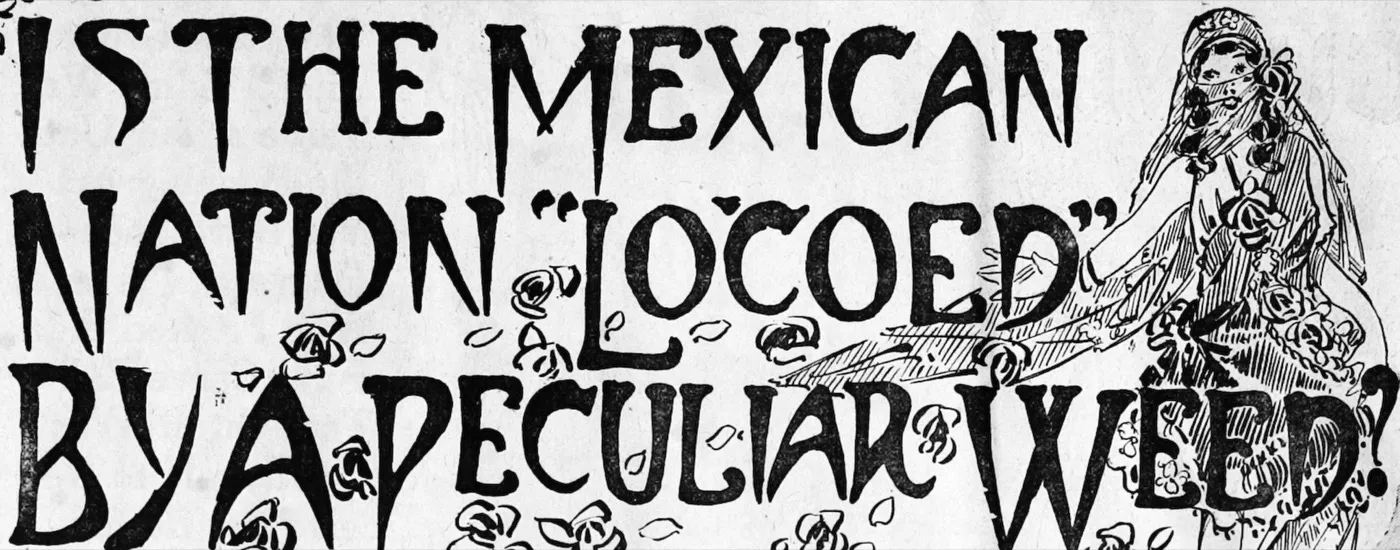
The fear becomes local law
The first American ban to draw on the belief that marijuana causes madness and violence. Western states follow over the next twenty years.
History →The states act first; then Washington gets an agency
Harry J. Anslinger becomes its first commissioner. From 1931 he tells the press that criminals use the drug for courage, and from 1934 he treats it as a serious threat.
History →
He collects cases from newspapers and local officials
In Tampa, Victor Licata kills his family with an axe. A Florida official's letter brings the story to Anslinger; marijuana is not in Licata's psychiatric record.
History →
Cases like this become the evidence for a federal law
H.R. 6385, drafted by the Treasury's general counsel Herman Oliphant, taxes every sale so heavily that legal supply becomes impractical.
History →
The bill goes to a committee hearing
Anslinger's evidence is largely newspaper clippings and anecdotes. The American Medical Association's counsel, William Woodward, is the only witness against the bill.
History →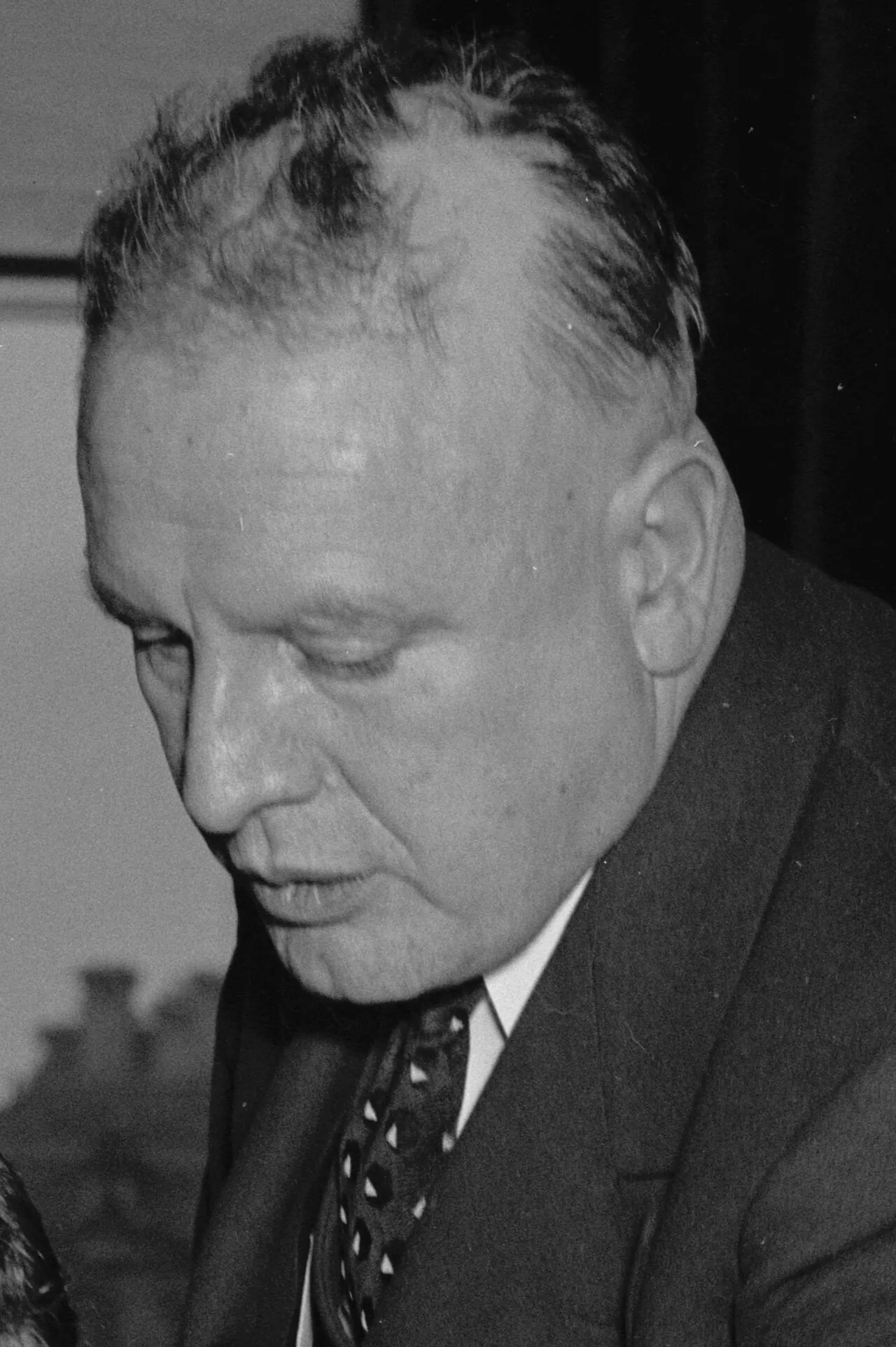
Anslinger takes the same cases to the public
Anslinger's article in The American Magazine, with Licata as its centrepiece, reaches millions of readers.
History →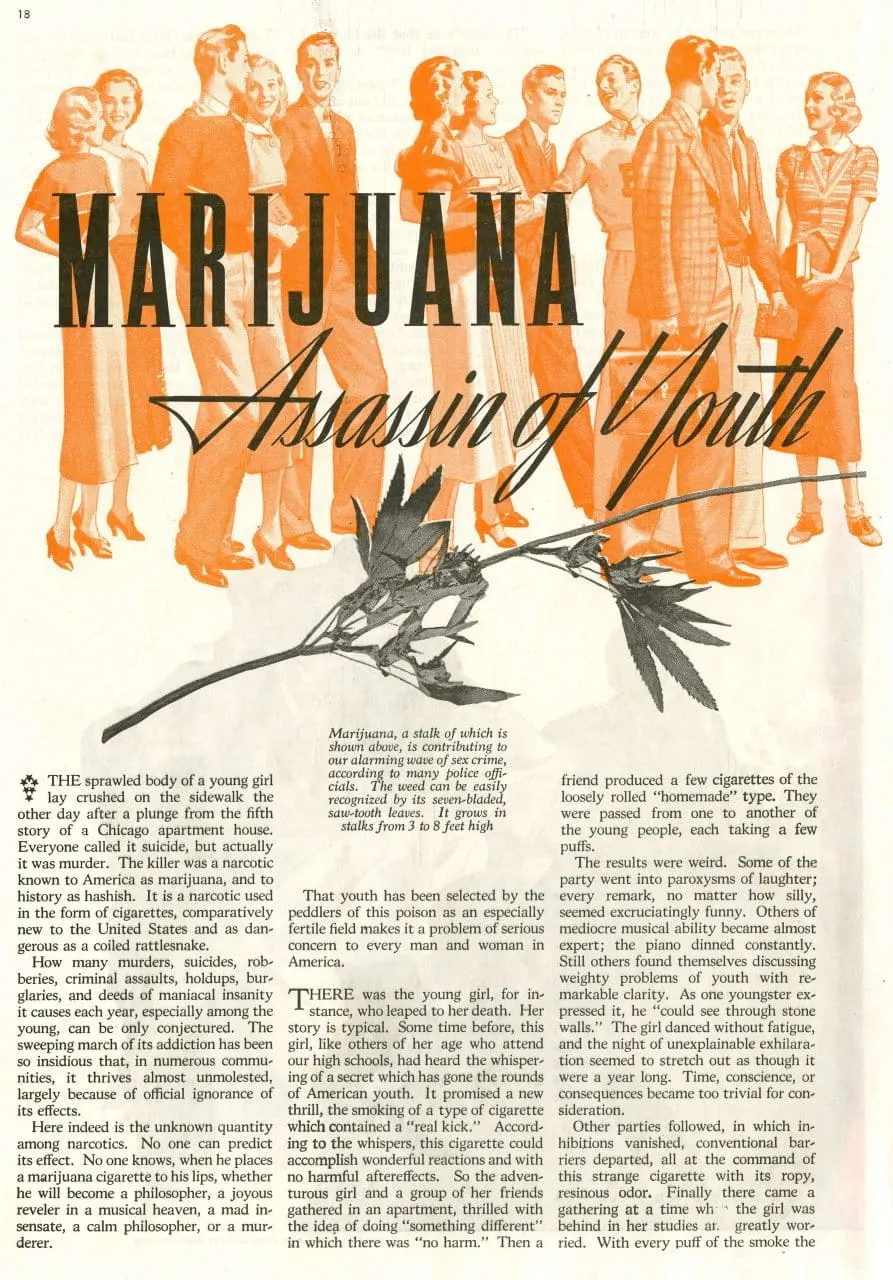
Congress passes the bill with little debate
Federal law takes effect. The first arrests come within days.
History →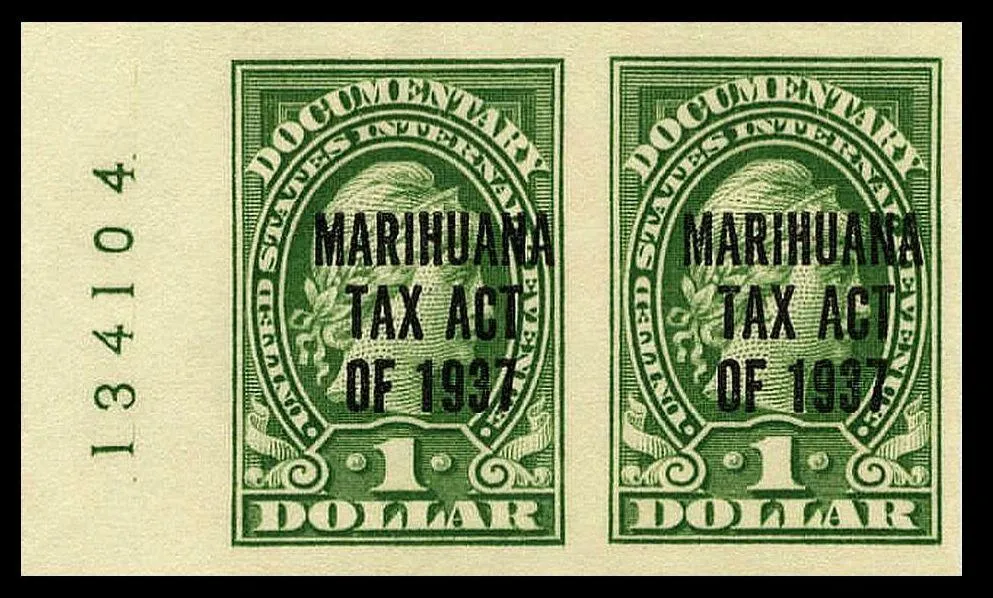
On screen, the warnings arrive after the law
A melodrama of ruined youth, reissued by the exploitation producer Dwain Esper. It spread the fear further, but it came too late to make the law.
History →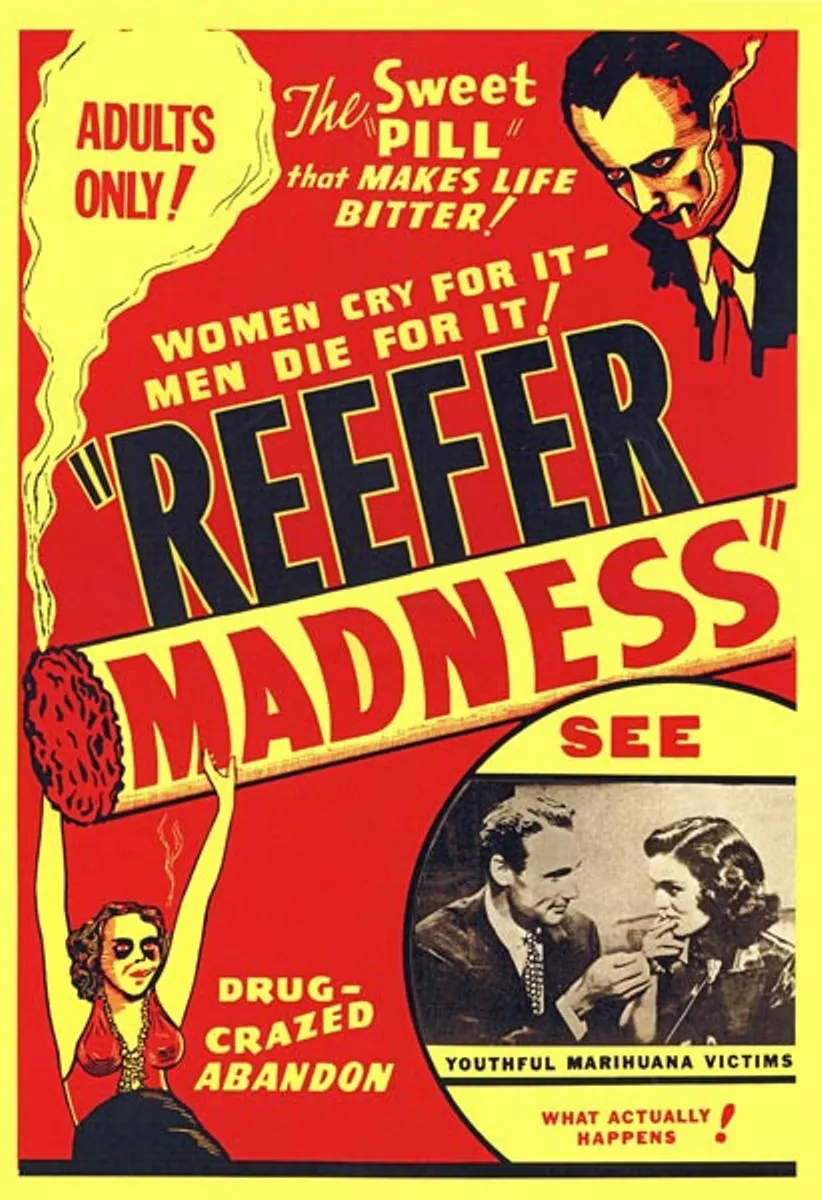
Room III
Reefer Madness was not alone. The Hollywood studios' Production Code, enforced from 1934, barred showing the drug trade, so the drug film belonged to independents who took their prints from town to town and sold the forbidden as a warning. Six of them survive in the public domain. Here is the bill: every one of them can be run in this theatre.
Adults onlyRoadshow attractionsOne week only
Six Shocking Features
The drug films of the exploitation circuit, 1934 to 1949 · now at this theatre
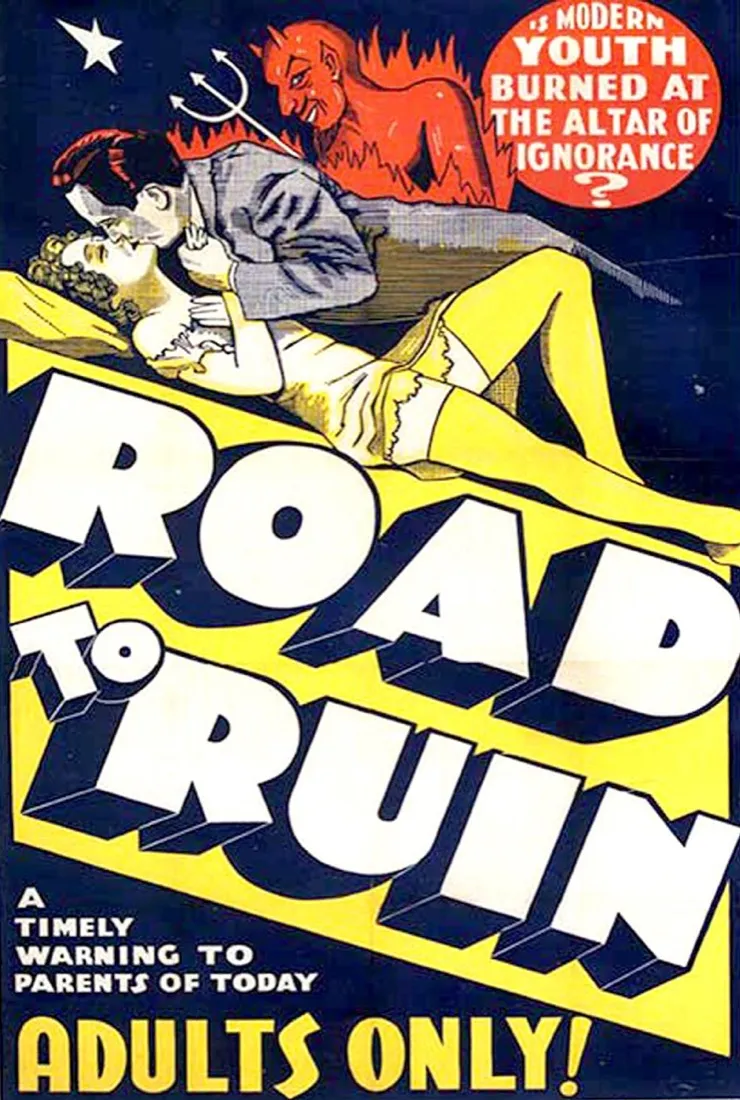
193464 minutes
“Modern youth burned at the altar of ignorance”
Dorothy Davenport and Melville Shyer
A schoolgirl drawn into drink, marijuana and sex, co-directed by Dorothy Davenport under the name Mrs. Wallace Reid. It was billed for adults only, and censors in Virginia demanded a record number of cuts.
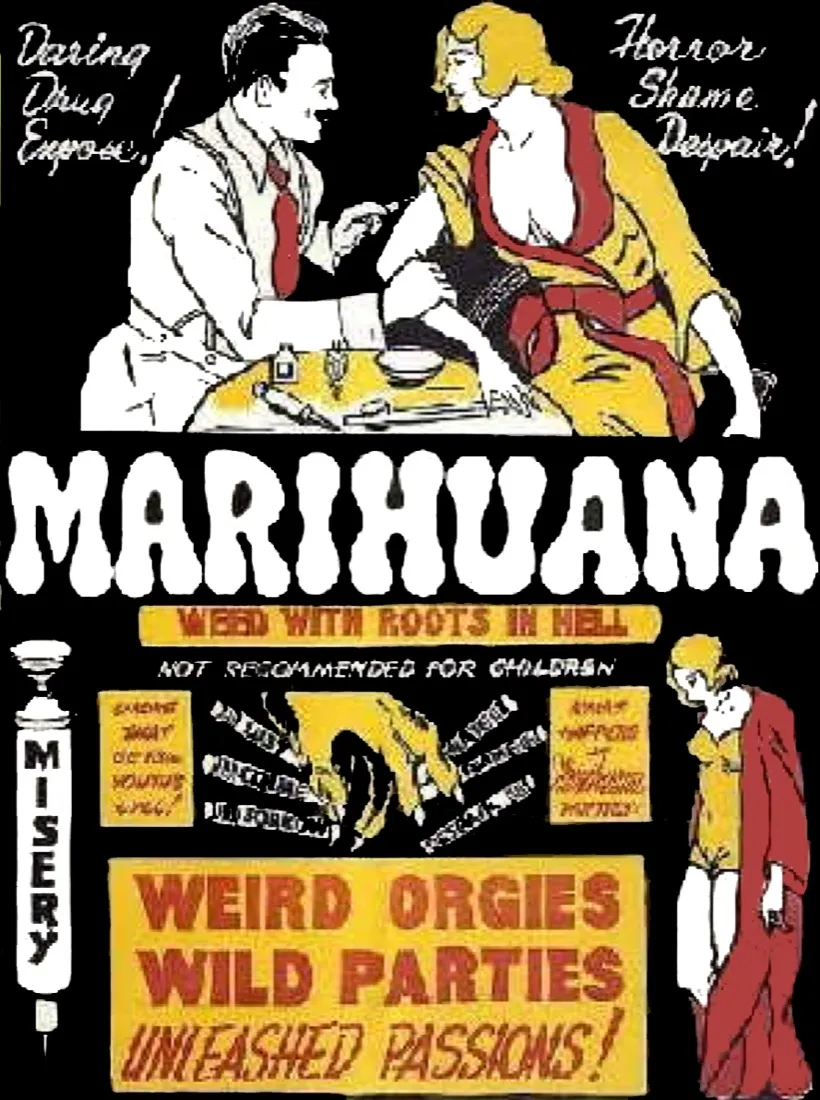
193657 minutes
“Weed with roots in hell”
Dwain Esper, written by Hildagarde Stadie
A young woman's slide from a beach party to the drug trade, from a script by Esper's wife.
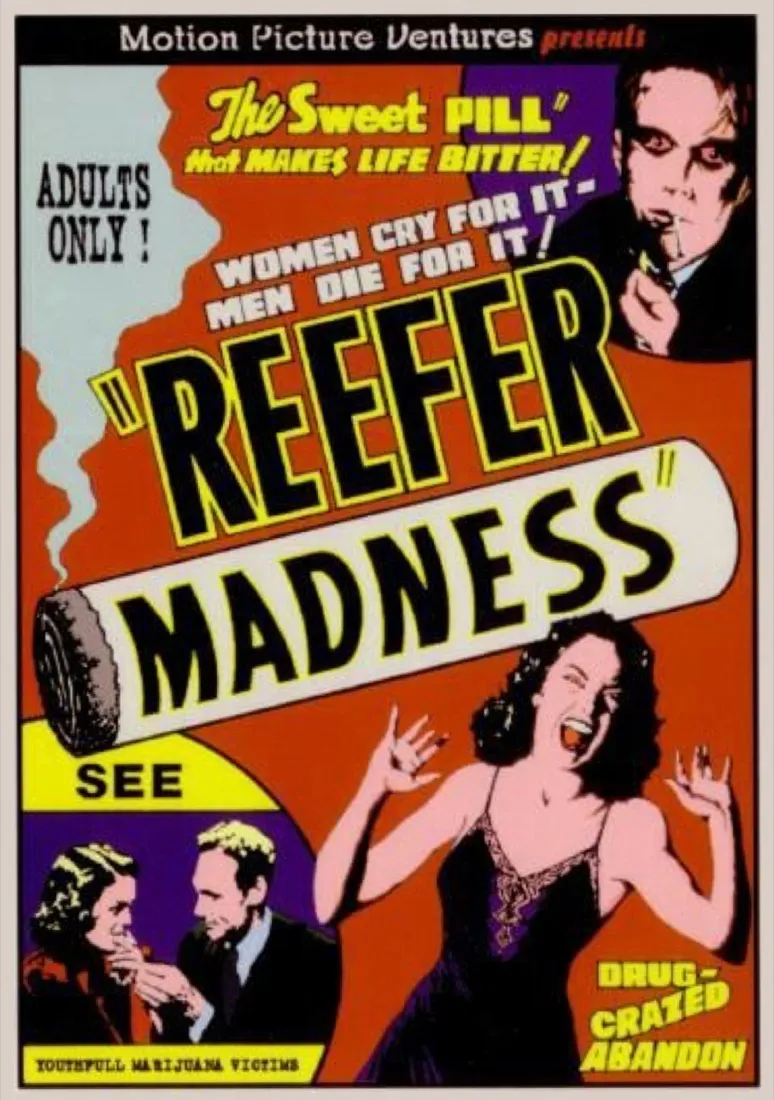
1936–3868 minutes
“Women cry for it, men die for it”
Louis Gasnier, for George Hirliman
A school principal warns parents with the story of teenagers led to murder, suicide and madness. Esper bought it and reissued it under the title that stuck.
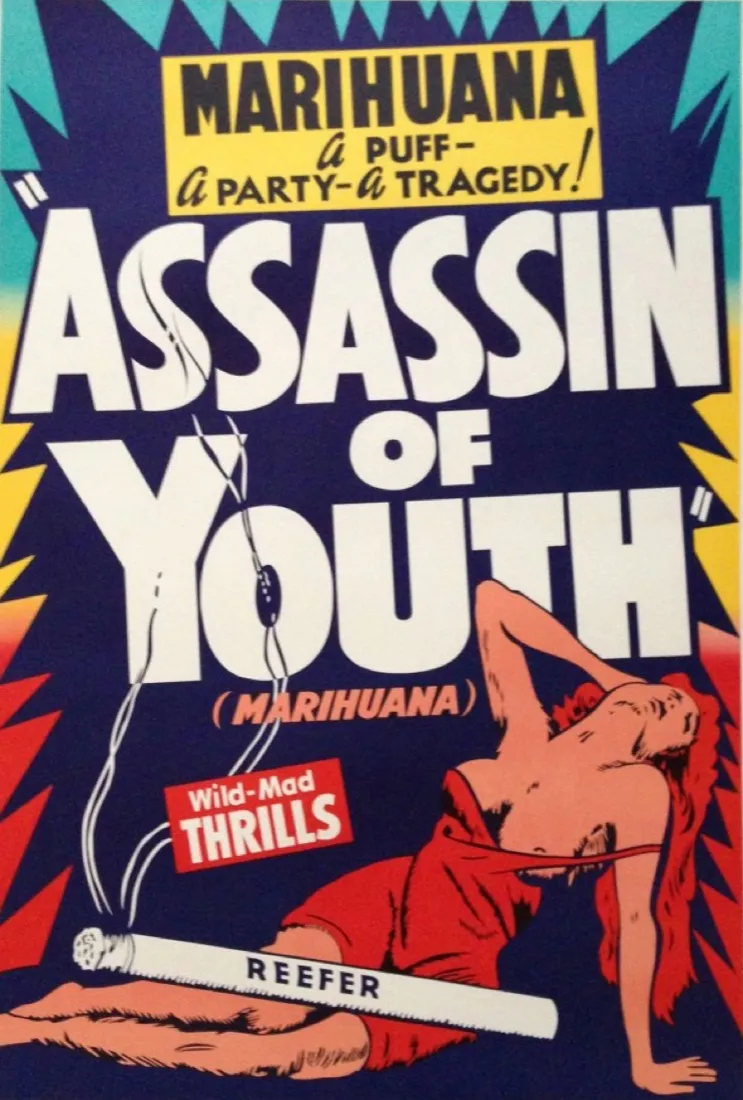
1937feature
“A puff, a party, a tragedy”
Elmer Clifton
A reporter goes undercover among teenage marijuana smokers, where a girl is being framed by relatives after her inheritance. It shares its title with Anslinger's magazine article of the same year.
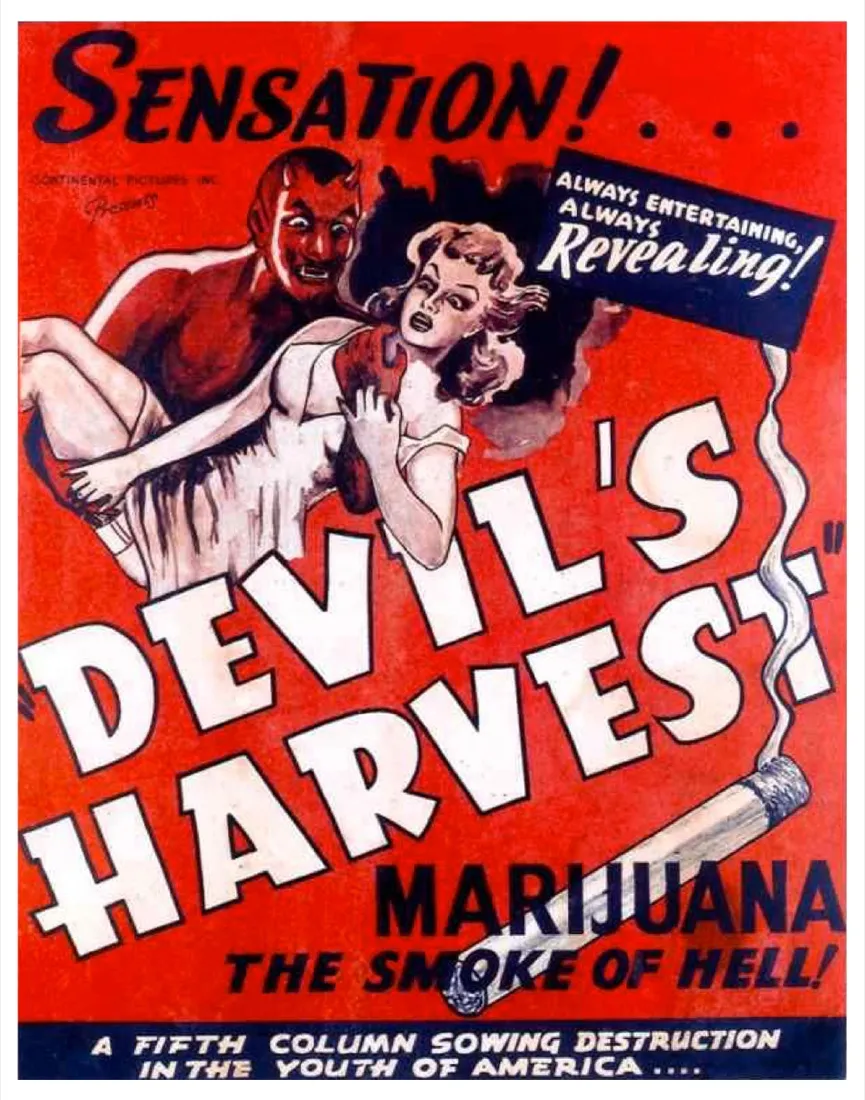
194252 minutes
“Marijuana, the smoke of hell”
Ray Test, for Continental Pictures
Gangsters sell marijuana to students from a hot-dog stand near a school. Made in wartime, its poster called the drug a fifth column.
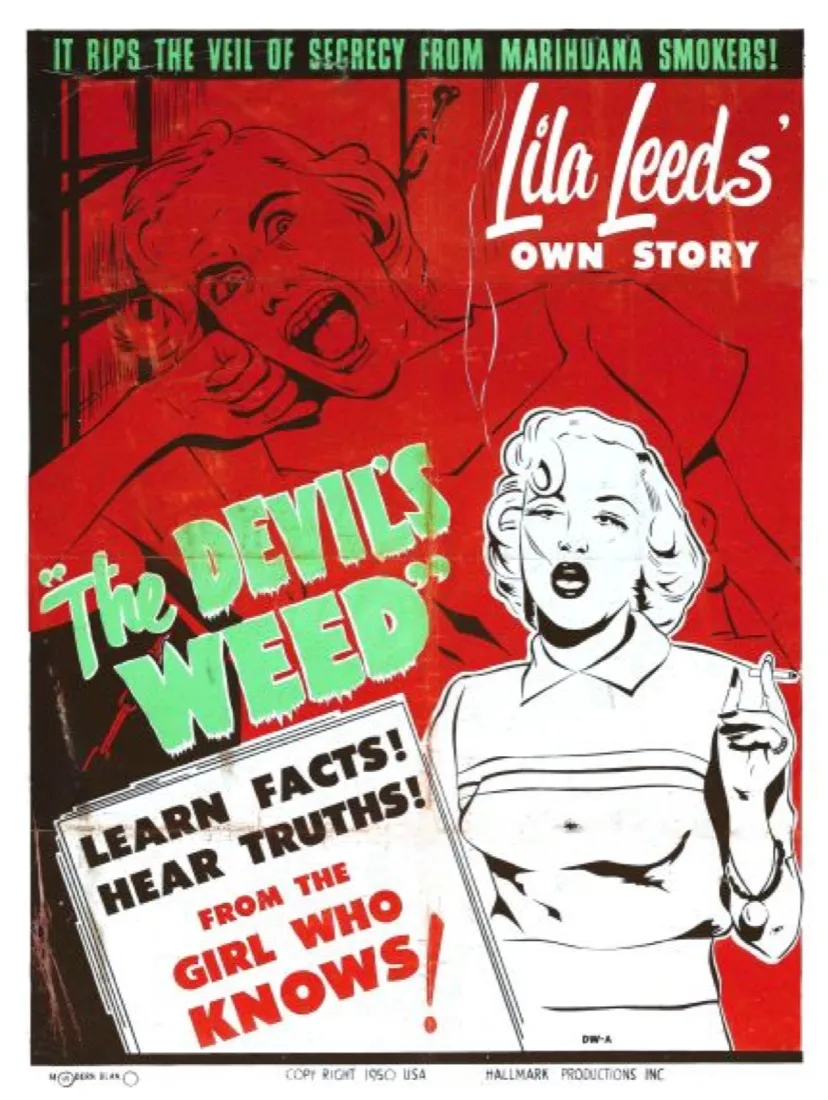
194969 minutes
“Lila Leeds' own story”
Sam Newfield, as Sherman Scott
Made to cash in on the 1948 arrest of Robert Mitchum and Lila Leeds, starring Leeds herself as a showgirl ruined by marijuana. The showman Kroger Babb reissued it as The Devil's Weed and Wild Weed.
The Production Code, enforced from 1934, kept the drug trade off Hollywood's screens. The subject went to small independents with no stars and tiny budgets.
A written foreword, or a lecturer on stage, presented the film as education for parents. It was the excuse that let a sensational subject past local censors.
Prints travelled with their own showmen, who rented a cinema for a few days, advertised hard, and moved on before word of mouth caught up.
The films are in the public domain and play from the Internet Archive only when you run them. On roadshows: Eric Schaefer — “Bold! Daring! Shocking! True!”: A History of Exploitation Films, 1919–1959 (1999). The Production Code: Britannica — Motion Picture Production Code, and its drug rule in our history.
Room IV
The films lived on their posters. Exploitation distributors had no stars to sell, so the poster sold the subject: big type, hot colours, a woman in danger and a promise of the forbidden, wrapped in a warning. The same tricks moved onto the covers of the cheap paperbacks of the 1950s. Pick a device to see how often it was used, and open any poster to look closer.
Every poster here, from the 1930s to the 1950s.
MarihuanaFilm · 1936
MarihuanaFilm · 1936
MarihuanaFilm · 1936, reissue
Reefer MadnessFilm · reissue
Reefer MadnessFilm · reissue
The Burning QuestionFilm
The Burning QuestionFilm
Assassin of YouthFilm · 1937
The Road to RuinFilm · 1934
Devil's HarvestFilm · 1942
Devil's HarvestFilm · 1942
Devil's HarvestFilm · 1942
The Devil's WeedFilm · 1949
The Devil's WeedFilm · 1949
MarihuanaFilm · 1950
MarihuanaFilm · 1950
Big Jim McLain, as MarijuanaFilm · 1952
Marijuana GirlPaperback · 1951
Reefer GirlPaperback
Reefer ClubPaperback
Reefer BoyPaperback
The Marijuana MobPaperback
MarihuanaPaperback · 1951
Musk, Hashish and BloodPaperback
The posters and covers are from the Reefer Madness collection of Stanford Research into the Impact of Tobacco Advertising (SRITA). Dates are given where the film or edition is known; many posters are undated reissues. Modern parodies, theatre posters and DVD covers in that collection are not shown.
Room V
The films were fiction; the sentences were not. A docket of people the law caught, and of what the law came to demand, with each sentence drawn to scale on the bars: every step to the right is ten times longer.
In the act's first three months agents made 369 seizures. In about half of the cases of the next few years the person held less than an ounce and no sale was alleged.
Sentences not recorded here
History →Richard Bonnie and Charles Whitebread — The Marijuana Conviction (1974)The jazz singer and her husband, convicted after police found marijuana and rolling papers at their home.
90 days in jail
History →A little Boggs act: selling, possessing or administering a narcotic drug, marijuana included.
5 to 99 years, without parole, probation or suspension
History →A civil-rights organiser who handed one joint to an undercover officer. Texas counted it as a sale. Freed in 1972, when a federal judge ruled he should not have been tried in Houston.
30 years in prison
History →In 1954 the federal judges of the Fifth Circuit unanimously asked Congress to remove the mandatory minimums; Anslinger denounced them (history). In 1969 the Supreme Court struck the Marihuana Tax Act down (history).
Room VI
The monster travelled. Cannabis entered international law at Geneva on another country's say-so, and the American case was argued at the League of Nations. The most direct contradictions came from Cairo and Mexico City. Read the wires.
Telegram1924-12From Geneva
Mohamed El Guindy, Egypt
HASHISH AS DANGEROUS AS OPIUM AND A MAJOR CAUSE OF INSANITY STOP ASKS THE SAME CONTROLS STOP NO FORMAL EVIDENCE PRODUCED STOP
Telegram1925-02From Geneva
The Second Opium Conference
INDIAN HEMP ADDED TO THE INTERNATIONAL OPIUM CONVENTION STOP EXPORT AND IMPORT FOR MEDICAL AND SCIENTIFIC USE ONLY STOP FIRST TREATY TO COVER CANNABIS STOP
Telegram1930From Cairo
Russell Pasha, Cairo police
HASHISH THE VICE OF THE CITY SLUMS STOP DOES COMPARATIVELY LITTLE HARM STOP VILLAGE SMOKERS REGARDED AS A JOKE STOP
Telegram1938-06From Geneva
Harry J. Anslinger, United States
MARIJUANA KEEPS ITS TRADITION OF MURDER, ASSAULT, RAPE AND MENTAL DETERIORATION STOP
Telegram1938-06From Geneva
Russell Pasha, Egypt, in reply
HASHISH ADDICTION LEADS TO NO PARTICULAR CRIME WAVE STOP THE ADDICT IS A TIRESOME INDIVIDUAL, NOT A DANGEROUS CRIMINAL STOP
Telegram1938-10From Mexico City
Dr Leopoldo Salazar Viniegra
NOT ONE CASE OF PSYCHOSIS IN TEN YEARS DEFINITELY CAUSED BY MARIJUANA STOP CALLS THE MADNESS A MYTH STOP THE PRESS CALLS HIM MAD STOP
Telegram1940-07From Mexico City
Government of Mexico
HEALTH-BASED DRUG REGULATION SUSPENDED AFTER FIVE MONTHS, UNDER PRESSURE FROM THE UNITED STATES STOP
History →Isaac Campos — Reefer Madness Past and Present: Dr. Leopoldo Salazar Viniegra, Mexico, and the United States (2021)
The League's 1938 exchange, by the account in Squaring a Circle: Cannabis and the Dubious Legacy of the League of Nations; Salazar Viniegra and Mexico in 1940, by Isaac Campos.
Room VII
A warning becomes a joke, and then a word. The film failed as a warning, but its title did not: once students had laughed at it, “reefer madness” became the name for any drug scare built on fear rather than evidence, and it is used more today than when the film was new.
Point at a year. Before 1971 the phrase barely appears; the year Stroup began showing the film, it jumps.
Data: Google Books Ngram Viewer — “reefer madness”, English, 1960–2022, read in October 2026. Books only, and only those Google has scanned.
Keith Stroup, founder of the reform group NORML, finds a print in the Library of Congress, learns the film is in the public domain and buys a copy.
History →Keith Stroup →Source ↗Stroup screens it after his lectures to raise money for reform. Students who were meant to be frightened laugh.
History →Source ↗It joins the late-night cult circuit, and its overacting makes it a classic of camp. Leonard Maltin calls it the granddaddy of all worst movies.
Source ↗Sean Abley's stage adaptation opens, the first of several.
Source ↗Kevin Murphy and Dan Studney's musical turns the warnings into show tunes.
History →Source ↗Eric Schlosser calls his book on America's black markets Reefer Madness. Its marijuana chapter follows Mark Young, given life without parole for a minor role in a marijuana deal.
History →Source ↗A colourised DVD, with a mocking commentary by Mike Nelson of Mystery Science Theater 3000. The joke is now the product.
Source ↗The musical becomes a television film for Showtime, with Alan Cumming and Kristen Bell.
History →Source ↗Never protected by copyright, it can be watched, copied and remixed by anyone. Its title is now shorthand for any exaggerated drug scare.
Source ↗Scroll the strip: the film's later life, frame by frame.
Room VIII
Nothing disappears behind the story. Here is every document, connection and reading the exhibition rests on. Primary evidence is a document from the time itself, such as a film, a speech or a report. A documented connection is something historians have shown from the record. An interpretation is a reading or a popular story, some of them repeated far more often than they are proven. Filter by kind.
1890s–1915Newspaper
Many tied to anti-Mexican propaganda; the Library of Congress lists them with a warning.
Primary evidence
1915Law
The first US measure built on the madness-and-violence belief.
Documented connection
1930Institution
Harry J. Anslinger is its first commissioner.
Documented connection
1931Press statement
His first public endorsement of the crime claim, by Bonnie and Whitebread's account.
Primary evidence
History →Richard Bonnie and Charles Whitebread — The Marijuana Conviction (1974)
1933Case
Diagnosed with dementia praecox; marijuana absent from his psychiatric reports.
Documented connection
1936–38Film
The film itself, in the public domain.
Primary evidence
1937Bill
Prepared by the Treasury's general counsel, Herman Oliphant.
Primary evidence
History →Richard Bonnie and Charles Whitebread — The Marijuana Conviction (1974)
1937Testimony
The American Medical Association's counsel says the evidence is newspaper stories.
Primary evidence
1937Magazine
Anslinger's article in The American Magazine.
Primary evidence
1937Law
Federal tax and registration that made legal supply impractical.
Documented connection
1937Court
A Denver court, within days of the act.
Documented connection
1937Memo
Anslinger's confidential memo to his agents.
Primary evidence
History →Richard Bonnie and Charles Whitebread — The Marijuana Conviction (1974)
1938Memo
Press reports almost hysterical, Anslinger writes.
Primary evidence
History →Richard Bonnie and Charles Whitebread — The Marijuana Conviction (1974)
1938Debate
At the League of Nations: the addict is tiresome, not a dangerous criminal.
Primary evidence
1944Report
No link to addiction, serious crime or harder drugs in New York.
Documented connection
1951Testimony
Smokers mildly intoxicated, no dependence; violence unproven.
Primary evidence
History →Richard Bonnie and Charles Whitebread — The Marijuana Conviction (1974)
1972Report
Recommends removing criminal penalties for possession.
Documented connection
1924Speech
As dangerous as opium, the delegate says; no evidence is produced.
Primary evidence
1930Report
Cairo's police chief to the League of Nations.
Primary evidence
1936Film
The exploitation cycle's other weed film.
Primary evidence
1934–68Rule
The studios' own censorship; drug films were made and shown outside it.
Documented connection
1938Paper
A Mexican psychiatrist to the Academy of Medicine.
Primary evidence
1940Diplomacy
Under American pressure, after five months.
Documented connection
History →Isaac Campos — Reefer Madness Past and Present: Dr. Leopoldo Salazar Viniegra, Mexico, and the United States (2021)
1948–49Court
Sixty days each; his fame grew, her career ended.
Documented connection
1949Film
A scandal turned into a warning, starring Leeds.
Primary evidence
1951Law
Mandatory minimum sentences for marijuana and narcotics alike.
Documented connection
1954Resolution
The Fifth Circuit, unanimously; Anslinger denounces them.
Primary evidence
1969Court
The Supreme Court strikes the Marihuana Tax Act down.
Documented connection
—Claim
A popular story with no document behind it in the sources here.
Interpretation
—Claim
Often repeated, unconfirmed.
Interpretation
—Reading
The film reached screens around and after the act; the act has its own documentary history.
Interpretation
Collections worth a visit: the Hash Marihuana & Hemp Museum, Stanford's research collection and the Library of Congress guide. The poster is in the public domain (Motion Picture Ventures, via Wikimedia Commons); the magazine page is from the Hash Marihuana & Hemp Museum's collection.