Paraguay
18/100
#48 of 196 worldwide
#8 of 12 in South America
Up to 10 g exclusively for personal use may be exempt from punishment, subject to judicial assessment. A December 2025 medical THC/CBD pilot regulates specialist prescriptions and authorised dispensing; patient home growing remains prohibited.
In short all countries →
- Can I carry it?NoEven a small amount can bring a fine or a charge
- Can I grow it?NoIt is a crime
- Can I buy it?LimitedOn prescription only
- Can I use it in public?NoNot in public, and even at home the law does not protect it
- What if I'm caught?Fine or prisonUsually a fine; prison is possible
A rough guide read from the scores and the rules below, not legal advice. The details and the exceptions are in each segment: select an answer to jump to it.
Cannabis in Paraguay not part of the score · all 16 datasets ↓
Who uses it
About 1 in 63
people aged 12–65 in Paraguay used cannabis in the past year: about 80,000 people.
- Past year
- 1.6%
- South America median
- 3%
- Aged 15–16, 2005
- 3.0%
UNODC · survey 2005
Source Past-year cannabis use among people aged 12–65. People who used cannabis in the past year, from a 2005 survey, applied to today's population aged 12–65. The population is approximate: the survey ages cut through an age group, or were not recorded and ages 15–64 are used.Survey ages and years vary, and some surveys include children. Rates are not age-standardised; do not compare countries directly.
UNODC World Drug Report 2026, annex table 1.2. Population from the World Bank, aged 12–65. The whole dataset →
Use across South America
9thhighest of 12 surveyed countries
- 🇨🇴 Colombia2.7%
- 🇵🇪 Peru1.6%
- 🇵🇾 Paraguay1.6%
- 🇻🇪 Venezuela1.4%
- 🇧🇴 Bolivia1.1%
Past-year use, latest survey of each. Survey years and ages differ. On the map →
Cannabis in figures
- Cannabis seized1,046,035kg in 2024 · 2024
- Research on cannabis1.4papers per million people · 2025
- Cannabis in the news0.0012%of global news: cannabis articles from here · 2025
The dot: where it stands among the countries each dataset covers, lowest to highest. All datasets ↓
Score breakdown 18/100 · how the scores are made
Illegal for personal use, and enforced — in 2024 a woman in her sixties was jailed over two plants.[5] A bill letting patients with a medical certificate grow at home was passed by Congress in August 2020[6] and vetoed by the president that September;[7] the Senate voted for it again in November 2020,[8] and in April 2022 it was still pending in the Chamber of Deputies. No report that it took effect was found.[6]
Supply is trafficking under the drug law.[4]
Personal use within the exemption is not punished; public use risks arrest.[4]
There is no adult-use retail route.[4] Under Resolution 488/2025, registered patients can receive medicinal products combining THC, CBD or other cannabinoids through an exceptional temporary pilot: a PROINCUMEC-registered specialist prescribes on a quadruplicate form, and authorised pharmacies/dispensaries supply under traceability controls. This legal route does not establish that particular high-THC products are registered, stocked or widely available.[9][10]
Context not part of the score · every country, by topic →
There is no legal recreational supply. Up to 10 g for exclusively personal use is exempt from punishment, but a judge advised by a forensic doctor decides, so arrest and prosecution remain possible — and home growing is illegal and enforced.[4][5] Personal use is not punished within the exemption, though public use risks arrest; supply is trafficking.[4]
Law 6007 created PROINCUMEC and its patient registry.[11] Resolution 488/2025, effective on signature on 19 December 2025 under Health Ministry Resolution 902/2025, sets up a two-year exceptional pilot for medicinal combinations of THC, CBD and other cannabinoids.[9] Prescribers must be registered specialists and patients must also register; the rules cover specified treatment-resistant symptoms and other justified specialist indications, with a quadruplicate prescription and follow-up.[9] The April 2022 count of three doctors and forty patients is historical.[6] Patient home cultivation was vetoed in 2020.[7] The pilot covers medicinal products with variable proportions of THC, CBD and other cannabinoids, made by licensed producers and supplied under specialist prescription and traceability. These pilot products have an exceptional registration regime; the rules do not demonstrate named products currently in stock.[9]
No law provides for clubs, but one operates in the open. In January 2023 the Cooperativa de Cannabis del Paraguay set up a Club de Cannabis to link its growers in San Pedro directly with registered users: members must be adults and sign up beforehand, on the health regulator's own patient form, and receive medicinal oil and ointment; the cooperative said it also registers people buying flower for recreational use.[12] It signed up 431 people in a single morning in an Asunción square and said more than 3,000 forms had been filled in before.[12] No action by the authorities against it was reported, and in April 2025 the Club de Cannabis del Paraguay was co-organising a public 4/20 gathering in Asunción ahead of a congressional hearing on a cannabis regulation bill.[13]
Decree 2725 of 2019 regulates importing propagation material for industrial hemp, along with its cultivation, processing and sale, all under authorisation from the agriculture ministry working with the anti-drug secretariat and the seed service.[14] It covers non- psychoactive cannabis only.[14]
Industrial hemp has been authorised since October 2019 under Decree 2725, covering import of propagation material, cultivation, processing and sale under agriculture-ministry authorisation.[14][4] A Paraguayan firm began exporting hemp foods in 2021.[15]
The medical pilot requires licensed production, approved industrial plans, certified seed and traceability from seed to final product. Participation and product information must be notified to DINAVISA; a production licence alone does not prove operating cultivation or finished output.[9] Twelve pharmaceutical firms were licensed to produce medical cannabis under a cap of thirteen, lifted in 2022; in 2022 patients said none was growing in the country.[16][6] Hemp has been authorised since October 2019, and a Paraguayan firm began exporting hemp foods in 2021.[15] The illicit crop dwarfs both: an estimated 6,000 to 8,000 hectares, mostly in Amambay and Canindeyú, with 77% of the harvest going to Brazil.[4][16][8][15][17]
Paraguay grows cannabis mainly for export: the anti-drug agency says most production is aimed at the Brazilian market and run by large criminal organisations.[18] Between August 2023 and April 2026 the agency reported destroying close to 21 million kilos of marijuana, counting both seized product and crops in the field, a loss it valued at 629 million dollars at domestic prices.[18] That included more than 1,913 tonnes of processed marijuana and 6,322 hectares of plantations, with the border department of Amambay far ahead (3,177 hectares), followed by Canindeyú and Caaguazú.[18] Much of the eradication is done jointly with Brazil's federal police.[18]
There is no legal recreational supply for anyone. Article 30 of the drug law exempts from punishment a person holding a small amount exclusively for personal use, with 10 g of cannabis as the guideline, but a judge advised by a forensic doctor decides whether it was personal use.[4]
National Traffic Law article 66(a), as amended by Law 6868, prohibits driving after consuming narcotics or medicines that diminish driving aptitude, whatever the concentration per litre of blood.[19] This wording does not establish a particular THC detection cutoff.[19] Article 113(g), amended by Law 6842, separately classifies laboratory-established intoxication from drugs altering normal driving capacity as a very serious administrative offence; article 113(h) covers test refusal.[20] The published Law 5016 sets very serious fines at eleven to twenty legal minimum daily wages, with points or disqualification where applicable; this is not a fixed guaraní tariff.[21] Articles 106–107 permit retention/removal of the vehicle and require authorised intoxication tests.[21] Criminal unsafe-driving provisions can apply in addition; the 2014 amendment to Penal Code article 217 specifies up to two years' imprisonment or a fine.[21] Municipal enforcement and current licence-ban periods remain to be checked rather than inferred from the alcohol limits.[21]
No arrest totals were found in reachable sources. Enforcement visibly reaches small growers: in 2024 a woman in her sixties was jailed over two plants.[5] The weight of enforcement falls on the crop in the field (see black market).[18]
No record if the exemption is applied; pre-trial detention is the real risk.[5]
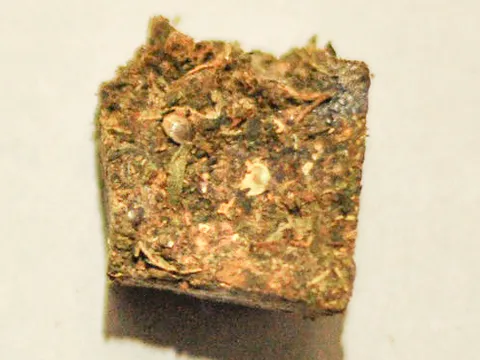
Paraguay is the region's growing house: an estimated 6,000 to 8,000 hectares, mostly in Amambay and Canindeyú, with 77% of the harvest going to Brazil.[4][16][8][15][17] The pressed form it travels in is brick weed.
Taking cannabis into or out of Paraguay is a separate offence from possessing it, normally charged as smuggling or trafficking, with far heavier penalties. That holds almost everywhere, including between two places where cannabis is legal.
The rules that allow or tolerate small amounts inside Paraguay do not cover the border, an airport or the post.
A prescription or medical card from another country is generally not recognised. Travellers who need a cannabis-based medicine should ask Paraguay's embassy before travelling.[22]
General guidance that applies to almost every country, not a check of Paraguay's customs rules.
Culture the atlas →
Datasets not part of the score
What other organisations publish about Paraguay, and where it stands among the countries each one covers. Each dataset has a page of its own, with a world map and every country's figure.
Use
UNODC · 2005
Cannabis use
1.6%of people aged 12–65
ages 12–65 · survey 2005 · 80,000 people · UNODC 2026
Source Survey ages and years vary, and some surveys include children. Rates are not age-standardised; do not compare countries directly.UNODC · 2005
Cannabis use at 15 and 16
3%in the past year
Higher than 14% of 49 countriesLowestHighest4.2% ever · 1.6% in the past month · 2005 · ages 15–16
WHO, Our World in Data · 2020
Alcohol drunk per person
5.62litres of pure alcohol a year
5.68 · 20005.68 · 20015.29 · 20025.19 · 20035.42 · 20045.88 · 20056.16 · 20066.57 · 20076.59 · 20086.63 · 20096.37 · 20106.27 · 20116.06 · 20125.78 · 20135.55 · 20145.41 · 20155.44 · 20165.53 · 20175.60 · 20185.60 · 20195.62 · 202020002020 Higher than 58% of 187 countriesLowestHighestper person aged 15 or over · 2020 · 5.68 in 2000 · 6.37 in 2010
Law
UNODC · 2024
Cannabis seized
1,046,035kg in 2024
510,309 · 2015413,993 · 20161,074,187 · 20171,020,167 · 2018390,827 · 2019469,177 · 2020387,341 · 20211,081,793 · 2022679,028 · 20231,046,035 · 202420152024 Higher than 98% of 163 countriesLess seizedMore seized1,045,866 kg of herb · 170 kg of resin · 510,309 kg in 2015 · 469,177 kg in 2020
Society
OpenAlex · 2025
Research on cannabis
1.4papers per million people
0.6 · 20171.0 · 20180.6 · 20190.4 · 20200.4 · 20210.7 · 20221.0 · 20231.4 · 20241.4 · 202520172025 Higher than 57% of 176 countriesLowestHighest10 papers in 2025
Cato and Fraser Institutes · 2023
Human Freedom Index
7.49of 10
7.24 · 20007.16 · 20017.09 · 20027.12 · 20037.20 · 20047.29 · 20057.35 · 20067.35 · 20077.41 · 20087.45 · 20097.61 · 20107.57 · 20117.57 · 20127.37 · 20137.38 · 20147.31 · 20157.43 · 20167.40 · 20177.45 · 20187.47 · 20197.08 · 20206.88 · 20217.36 · 20227.49 · 202320002023 Higher than 64% of 164 countriesLess freeFreerrank #60 of 165 · personal freedom 7.78 · economic freedom 7.08
V-Dem, Our World in Data · 2025
Civil liberties
0.81of 1 in 2025
0.37 · 19000.37 · 19010.37 · 19020.37 · 19030.36 · 19040.36 · 19050.36 · 19060.36 · 19070.36 · 19080.36 · 19090.36 · 19100.37 · 19110.36 · 19120.37 · 19130.37 · 19140.37 · 19150.37 · 19160.37 · 19170.37 · 19180.37 · 19190.37 · 19200.37 · 19210.37 · 19220.38 · 19230.46 · 19240.46 · 19250.46 · 19260.46 · 19270.46 · 19280.46 · 19290.45 · 19300.45 · 19310.45 · 19320.45 · 19330.45 · 19340.45 · 19350.44 · 19360.39 · 19370.39 · 19380.39 · 19390.37 · 19400.36 · 19410.36 · 19420.36 · 19430.36 · 19440.36 · 19450.38 · 19460.30 · 19470.30 · 19480.31 · 19490.31 · 19500.31 · 19510.31 · 19520.31 · 19530.18 · 19540.16 · 19550.16 · 19560.16 · 19570.16 · 19580.16 · 19590.15 · 19600.15 · 19610.15 · 19620.16 · 19630.16 · 19640.16 · 19650.16 · 19660.16 · 19670.15 · 19680.14 · 19690.14 · 19700.14 · 19710.14 · 19720.14 · 19730.15 · 19740.15 · 19750.15 · 19760.15 · 19770.15 · 19780.15 · 19790.17 · 19800.17 · 19810.17 · 19820.17 · 19830.17 · 19840.17 · 19850.17 · 19860.19 · 19870.19 · 19880.22 · 19890.72 · 19900.72 · 19910.79 · 19920.80 · 19930.80 · 19940.80 · 19950.80 · 19960.80 · 19970.80 · 19980.81 · 19990.83 · 20000.83 · 20010.83 · 20020.83 · 20030.84 · 20040.84 · 20050.84 · 20060.84 · 20070.86 · 20080.87 · 20090.87 · 20100.87 · 20110.85 · 20120.83 · 20130.83 · 20140.84 · 20150.84 · 20160.84 · 20170.84 · 20180.84 · 20190.80 · 20200.80 · 20210.79 · 20220.79 · 20230.79 · 20240.81 · 202519002025 Higher than 57% of 175 countriesFewer libertiesMore liberties0.46 in 1925 · 0.15 in 1961 · 0.72 in 1990
Our World in Data, World Bank · 2025
Population
7,013,078people in 2025
463,602 · 1900564,592 · 1910713,685 · 1920898,760 · 19301,138,105 · 19401,504,351 · 19501,883,517 · 19602,388,030 · 19703,053,239 · 19804,035,752 · 19905,100,875 · 20005,737,973 · 20106,603,741 · 20207,013,078 · 202519002025 Higher than 45% of 196 countriesLowestHighest463,602 in 1900 · 1,504,351 in 1950 · 5,100,875 in 2000
CEPII
Former colonial rulers
Once ruled by Spain
World Bank · 2025
Government effectiveness
48of 100
32 · 199627 · 199826 · 200024 · 200224 · 200329 · 200433 · 200535 · 200635 · 200739 · 200841 · 200941 · 201041 · 201140 · 201240 · 201341 · 201440 · 201542 · 201643 · 201745 · 201846 · 201944 · 202044 · 202145 · 202246 · 202348 · 202448 · 202519962025 Higher than 39% of 195 countriesLowestHighestestimate -0.23 on a scale of −2.5 to 2.5 · 2025 · 26 in 2000 · 40 in 2015
Transparency International · 2024
Corruption Perceptions Index
24of 100
25 · 201224 · 201324 · 201427 · 201530 · 201629 · 201729 · 201828 · 201928 · 202030 · 202128 · 202228 · 202324 · 202420122024 Higher than 17% of 178 countriesLowestHighest0 highly corrupt, 100 very clean · 2024 · 27 in 2015 · 28 in 2020
Pew Research Center · 2020
Most common religion
Christians
the largest group · 2020
World Bank · 2025
Income per person
$17,246per person
9,961 · 199010,039 · 19919,947 · 199210,177 · 199310,458 · 199410,907 · 199510,824 · 199611,032 · 199710,801 · 199810,434 · 19999,997 · 20009,748 · 20019,610 · 20029,902 · 200310,186 · 200410,289 · 200510,672 · 200611,140 · 200711,750 · 200811,600 · 200912,737 · 201013,108 · 201112,833 · 201213,699 · 201314,218 · 201414,426 · 201514,825 · 201615,318 · 201715,591 · 201815,319 · 201914,990 · 202015,401 · 202115,223 · 202215,832 · 202316,367 · 202417,246 · 202519902025 Higher than 50% of 187 countriesLowestHighestat purchasing power parity, 2021 dollars · 2025 · $9,961 in 1990 · $12,737 in 2010
World Bank · 2024
Development indicators
81.6%use the internet
0% · 19900% · 19960.1% · 19970.2% · 19980.4% · 19990.7% · 20001.1% · 20011.8% · 20022.1% · 20033.5% · 20047.9% · 20058% · 200611.2% · 200714.3% · 200818.9% · 200919.8% · 201024.8% · 201129.3% · 201236.9% · 201343% · 201449.7% · 201553.4% · 201661.1% · 201765% · 201868.5% · 201974% · 202077% · 202176.3% · 202278.1% · 202381.6% · 202419902024 Higher than 51% of 195 countriesLowestHighest69.9% live in towns · 6.5% aged 65+ · life expectancy 74 · 2024 · 0.7% in 2000 · 19.8% in 2010
GDELT · 2025
Cannabis in the news
0.0012%of global news: cannabis articles from here
0.0012% · 20170.0012% · 20180.0011% · 20190.0008% · 20200.0007% · 20210.0009% · 20220.0009% · 20230.0013% · 20240.0012% · 202520172025 Higher than 82% of 147 countriesLowestHighest2025 average, 348 days · 0.0012% in 2018 · 0.0007% in 2021
Plant and market
GBIF · 2025
Records of the cannabis plant
2dated records
1 · 20172 · 202520172025 Higher than 12% of 128 countriesLowestHighest0 more without a date · 1 in 2025
Enforcement 2 reports · the Cannabis Enforcement Tracker →
How the law above is applied: raids, seizures, fields destroyed, arrests and sentences, as recorded by the Cannabis Enforcement Tracker, our companion site.
- EradicationNueva Alianza 57: 222 hectares destroyed in Paraguay's forest reserves
In twelve days, Paraguay's anti-drug agency and Brazil's Federal Police destroyed 222 hectares of cannabis and 44 growers' camps, much of it inside nature reserves such as Mbaracayú and Morombí.
- EradicationNueva Alianza 53: 309 hectares of cannabis destroyed on Paraguay's border
Over ten days, Paraguay's anti-drug agency and Brazil's Federal Police destroyed 309 hectares of cannabis, 96 growers' camps and more than 39 tonnes of the drug in the forests of Canindeyú, Caaguazú and Alto Paraná.
History 21 of 22 checked against a source
Score and entries per decade
18 today, from 11 before its first recorded change
This country's score Entries that moved the score Context only
20253 entries0 score changes
Medical ✓
Paraguay opens a temporary medical THC and CBD pilot
Registered specialists can prescribe medicinal combinations of THC, CBD and other cannabinoids under a two-year pilot for registered patients, with quadruplicate prescriptions and authorised dispensing. DINAVISA’s resolution takes effect on signature and implements the Health Ministry’s exceptional-access decision, with licensed production and traceability requirements.
Tightening ✓
Paraguay and Brazil destroy 285 hectares of cannabis in ten days
The fifty-second phase of the joint operation Nueva Alianza, by Paraguay's anti-drug secretariat and Brazil's federal police, eradicated 285 hectares in Amambay and dismantled 83 growers' camps. The secretariat valued the loss to traffickers at 130 million dollars and calls the operation the largest of its kind in the world by volume destroyed.
Debate ✓
Paraguay's Congress tries to merge seven cannabis bills
A public hearing examined a draft law on the comprehensive regulation of cannabis. Senator Líder Amarilla said seven bills with the same aim were before the two chambers and should become one; medical and industrial use were already regulated, he said, and what mattered now was recreational use and trade, as a source of development for the departments where cannabis is grown.
20241 entry0 score changes
20222 entries0 score changes
Medical ✓
Paraguay lifts the cap on medical cannabis licences
Decree 7761 removed the limit of thirteen licences and the rule that medical cannabis could be grown only in the Central department. The regulator had reported that very few products were reaching patients with refractory epilepsy and multiple sclerosis. A licence requires a pharmaceutical laboratory in Paraguay and runs for five years.
Medical ✓
Paraguayan patients call the medical cannabis law a dead letter
Four years after the law, the national register held three doctors and forty patients. The patients' association Mamá Cultiva said that no state research had been done, that the licensed firms were not growing in the country and that no oil was being distributed; it estimated that 700,000 to a million people could need the treatment.
20211 entry0 score changes
20201 entry0 score changes
20193 entries0 score changes
Hemp ✓
Paraguay authorises industrial hemp for small farmers
President Mario Abdo Benítez signed a decree allowing non-psychoactive hemp to be grown, processed and sold under authorisation from the agriculture ministry. A trial followed in five departments, with about forty growers and sixty hectares by 2021. The peasant federation was sceptical, recalling earlier crops promoted by the state that found no market.
Tightening ✓
Paraguay uproots a record 1,468 hectares of cannabis in a year
It was the highest figure of a decade in which 15,045 hectares were destroyed, nearly two thirds of them in Amambay. The plantations were estimated at 6,000 to 8,000 hectares, with two to four harvests a year and a crop that could approach 30,000 tonnes; 77% went to Brazil and 20% to Argentina. Paraguay seized more than 1,000 tonnes a year, more than any other country.
Debate ✓
A Paraguayan senator proposes legalising cannabis outright
Senator Paraguayo Cubas presented a bill to legalise growing, selling and using cannabis for medical and recreational purposes. It was sent to committees. In September the Senate passed a narrower bill, by Víctor Ríos and Patrick Kemper, on cannabis for medical use.
20181 entry0 score changes
20171 entry1 score change
20141 entry0 score changes
20081 entry0 score changes
20021 entry0 score changes
19901 entry0 score changes
19881 entry1 score change
19731 entry0 score changes
19721 entry0 score changes
19691 entry0 score changes
Date not known1 entry1 score change
Sources hover a number in the text to see its source
- Cited
- 22
- Websites
- 12
- Last reviewed
- History checked
- 21/22
Most cited
- lanacion.com.py5
- bacn.gov.py3
- en.wiktionary.org3
- abc.com.py2
- ferrere.com2
- dinavisa.gov.py1
All 22 sources
- Wiktionary — faso (Lunfardo slang: a marijuana cigarette)archived
- Wiktionary — porro (a marijuana cigarette)archived
- Wiktionary — yerba (grass; slang: marijuana)archived
- International Bar Association — Medical cannabis in Paraguay: regulatory frameworkarchived
- La Nación — Cuestionan reclusión de sexagenaria por tener dos plantas de cannabis (2024)archived
- Última Hora — Ley de uso del cannabis medicinal es letra muerta, denuncianarchived
- La Nación — Ejecutivo veta proyecto de ley que despenaliza el cultivo de marihuana para uso medicinal (11 September 2020)archived
- La Nación — Senado se ratifica en uso medicinal de la marihuana (5 November 2020)archived
- DINAVISA — signed Resolution 488/2025, 19 December 2025Articles 1–6, 17–18, 24 and 26; exceptional two-year medicinal THC/CBD pilot, specialist and patient registration, dispensing and signature-date commencementarchived
- Paraguay state news agency — updated medicinal cannabis rules, 3 February 2026Specialist prescribing, quadruplicate prescriptions, authorised pharmacies/dispensaries and traceabilityarchived
- Ferrere — Bill decriminalising sowing, use and possession of cannabis for medicinal purposesarchived
- ABC Color — La creación del Club de Cannabis es una oportunidad para tener aceites medicinales (23 January 2023)archived
- ABC Color — Organizan encuentro cannábico por el 420 en víspera a estudio de proyecto de ley (14 April 2025)archived
- Decreto N° 2725/2019 — cáñamo industrial (Ministerio de Industria y Comercio, PDF)archived
- La Nación — Paraguay se convierte en líder mundial del cannabis industrial (4 August 2021)archived
- Ferrere — Poder Ejecutivo elimina límites de licencias para producción e industrialización de cannabis medicinal en Paraguay (27 September 2022)archived
- Eduardo Uranga — Paraguay se mantiene como principal productor de marihuana de Sudamérica, Universidad de Navarra, Global Affairs (May 2021)archived
- La Nación (Paraguay) — Senad anuló casi 21 millones de kilos de marihuana (2 April 2026)archived
- Paraguay Congressional Library — Law 6868 amending traffic prohibitionsArticle 1, replacing article 66(a); promulgated 13 December 2021archived
- Paraguay Congressional Library — Law 6842 amending traffic offence classificationsArticle 1, replacing article 113(g)archived
- Paraguay Congressional Library — National Traffic and Road Safety Law 5016/2014Articles 106–107, 113(h), 117–120 and 153archived
- International Narcotics Control Board — Travellers carrying medicines containing controlled substances