Tunisia
3/100
#171 of 196 worldwide
#49 of 54 in Africa
Law 52 still makes use or possession of any amount a crime with one to five years, though since 2017 judges may go below the minimum. A full rewrite has been in committee since 2025.
In short all countries →
- Can I carry it?NoIt is a crime
- Can I grow it?NoIt is a crime
- Can I buy it?NoNo legal source; only authorised medicine and research are excepted
- Can I use it in public?NoNot in public, and even at home the law does not protect it
- What if I'm caught?PrisonPersonal use can lead to prison or compulsory detention
A rough guide read from the scores and the rules below, not legal advice. The details and the exceptions are in each segment: select an answer to jump to it.
Cannabis in Tunisia not part of the score · all 15 datasets ↓
Who uses it
About 1 in 19
people aged 15–64 in Tunisia used cannabis in the past year: 440,000 people.
- Past year
- 5.3%
- Africa median
- 3.1%
UNODC · survey 2017
Source Past-year cannabis use among people aged 15–64. People who used cannabis in the past year, from a 2017 survey, applied to today's population aged 15–64.Survey ages and years vary, and some surveys include children. Rates are not age-standardised; do not compare countries directly.
UNODC World Drug Report 2026, annex table 1.2. Population from the World Bank, aged 15–64. The whole dataset →
Use across Africa
11thhighest of 28 surveyed countries
- 🇿🇼 Zimbabwe6.9%
- 🇸🇱 Sierra Leone6.5%
- 🇹🇳 Tunisia5.3%
- 🇪🇬 Egypt3.9%
- 🇳🇦 Namibia3.9%
Past-year use, latest survey of each. Survey years and ages differ. On the map →
Cannabis in figures
- Police contact for drug use or possession59per 100,000 people · 2021
- Cannabis seized1,815kg in 2024 · 2024
- Research on cannabis2.3papers per million people · 2025
- Cannabis in the news0.0003%of global news: cannabis articles from here · 2025
The dot: where it stands among the countries each dataset covers, lowest to highest. All datasets ↓
What they call it
- zatla[1]Tunisian Arabic · zaṭlacannabis, especially hashish; the everyday wordIn the atlas →
- takrouri[1]Arabic · takrūrīthe older name used in protectorate decreesIn the atlas →
Score breakdown 3/100 · how the scores are made
Law 92-52 punishes use or possession for personal consumption with one to five years in prison and a 1,000–3,000 dinar fine, with no quantity threshold.[2] Since the 2017 amendment, judges may apply the Penal Code's mitigating circumstances to use and possession, lowering the sentence to as little as one day or converting it into a fine of up to 6,000 dinars.[2][3][4] The change was not limited to first-time offenders, and it does not apply to trafficking.[3] Knowingly frequenting a drug den carries six months to three years and a 1,000–5,000 dinar fine.[2]
| Amount | What happens | Punishment | Fine |
| Use or possession for personal consumptionNo quantity threshold; since 2017 a judge may reduce this to one day or a fine of up to 6,000 dinars | CriminalPersonal use | 1–5 years | TND 1,000 – TND 3,000 |
| Knowingly frequenting a drug den | CriminalFrequenting | 6 months – 3 years | TND 1,000 – TND 5,000 |
Article 2 bans cultivating, harvesting and producing cannabis at any stage of growth, with no hemp or personal-growing exception.[2] Growing for trafficking carries six to ten years and a 5,000–10,000 dinar fine, and a few plants grown for personal use are charged under the use-or-possession offence instead.[2] Landowners must destroy plants that come up on their land or pay 50 dinars per plant.[2]
| Amount | What happens | Punishment | Fine |
| Growing for trafficking | CriminalCultivation for trafficking | 6–10 years | TND 5,000 – TND 10,000 |
| A few plants for personal useCharged under the use-or-possession offence where there is no evidence of trafficking | CriminalPersonal use | 1–5 years | TND 1,000 – TND 3,000 |
Drug enforcement has intensified. The interior ministry told parliament that 15,253 drug cases and 27,338 people were recorded in 2025, nearly 89% of them aged 19 to 40.[5] The justice minister said in November 2025 that more than 10,000 prisoners were held for drug offences, in a system holding over 30,000 people against a design capacity of about 18,000.[6] A 40-article bill to replace Law 52 has been in committee since April 2025 but had not been voted by October 2026.[7]
Supply for trafficking carries six to ten years and a 5,000–10,000 dinar fine; importing, exporting or smuggling with intent to circulate carries ten to twenty years and a 20,000–100,000 dinar fine.[2] A criminal association for drug offences carries twenty years to life, and premises used for use, storage or concealment carry ten to twenty years.[2] Penalties reach the offence's maximum when it involves a minor, a school, a stadium, a café, a hospital or another listed public place.[2]
| Amount | What happens | Punishment | Fine |
| Supply or trafficking | CriminalTrafficking | 6–10 years | TND 5,000 – TND 10,000 |
| Import, export or smuggling with intent | CriminalSmuggling | 10–20 years | TND 20,000 – TND 100,000 |
| Criminal associationTwenty years to life imprisonment | CriminalAssociation | 20 years to life imprisonment | TND 100,000 – TND 1,000,000 |
| Premises used for use or storage | CriminalPremises | 10–20 years | TND 20,000 – TND 100,000 |
Use is a crime under the same article as personal possession: one to five years and a 1,000–3,000 dinar fine.[2] Judges may now reduce that to one day or a fine, and a person who asks for detoxification before the facts are discovered can avoid prosecution by completing treatment.[2][3] In practice urine tests taken in custody are the usual evidence.[8]
No legal source. Article 2 allows narcotics only for authorised medicine, veterinary medicine, pharmacy and scientific research, and no approved cannabis medicine, patient route or recreational licence was found.[2] The medical and research exceptions run through the health ministry's pharmacy directorate, not a cannabis programme.[2]
Context not part of the score · every country, by topic →
There is no legal recreational market. Use or possession of any amount is a crime carrying one to five years and a 1,000–3,000 dinar fine, with no quantity threshold.[2] Since 2017 judges may apply mitigating circumstances to use and possession, down to one day or a fine, while trafficking remains excluded.[3] A 40-article bill to rewrite Law 52 has been in committee since April 2025.[7] Law 52 has governed since 1992.
No medical cannabis programme. Article 2 permits narcotics for authorised medicine and pharmacy, but no approved cannabis medicine, patient registry or prescription route was found.[2] Courts may order detoxification after conviction, and a first voluntary treatment request can prevent prosecution.[2]
No cannabis clubs are known, and the law leaves no room for them: growing cannabis and supplying it to another person are both prohibited.[2] The "cannabis shops" that opened in 2020 were advocacy spaces, not licensed clubs.[8]
Law 92-52 covers listed narcotic plants at any stage of growth and bans growing, holding, buying or handing them over, but its articles do not mention seeds; the annexed table was not available.[2] Landowners must destroy plants that come up on their land or pay 50 dinars per plant.[2] The seed and clone statuses here are therefore an inference, not an express rule.[2]
No hemp or CBD exemption and no THC threshold. Article 1 covers cannabis in any form and at any stage of growth, and Article 2 bans all cultivation except the medical and research exceptions.[2] No industrial-hemp licence was found.[2]
No lawful cannabis production. Article 2 bans all agricultural and industrial operations except authorised medicine, veterinary medicine, pharmacy and scientific research, and no cannabis cultivation or processing for the market was authorised.[2]
UNODC records 1,815 kg of cannabis resin seized in 2024, against 1,003 kg in 2023, and does not report a herbal-cannabis series for Tunisia.[9] Customs separately reported 760 kg of cannabis in 2025, alongside 80 kg of cocaine and 13.07 million psychotropic tablets.[10] The agency counts overlap and should not be added together.[9][10]
There is no legal recreational supply for anyone. A visitor can be prosecuted for use or possession, and a foreigner convicted must be expelled after sentence, with a ten-year re-entry ban for a lesser offence and a lifetime ban for a serious one.[2]
No cannabis-specific driving offence or THC limit was confirmed. The road code's drug provision as consolidated covers alcohol, and in July 2025 the National Road Safety Observatory announced rapid saliva tests without a start date or published threshold.[11] Drug-driving enforcement therefore remains unverified.[11]
The interior ministry recorded 15,253 drug cases and 27,338 people in 2025, nearly 89% aged 19 to 40; the figures are not broken down by drug.[5] In March 2026 it reported 14,300 trafficking cases and 20,289 trafficking arrests for 2025, alongside 181,998 judicial cases and 69,164 arrests in total.[12] The justice minister said in November 2025 that more than 10,000 prisoners were held for drug offences.[6] National Guard figures put trafficker arrests at 4,982 in 2024, against 3,165 in 2023.[13]
A conviction is a criminal record that can block public-sector employment and travel.[8] Courts may also impose up to ten years of administrative surveillance and five to ten years' loss of public office, civic rights and passports.[2] Foreigners must be expelled after sentence, with a ten-year re-entry ban for a lesser offence and a lifetime ban for a serious one.[2]
Cannabis is *zatla* in everyday Tunisian Arabic and *takrouri* in the protectorate's decrees; both are described in the zatla entry.[1] The state sold takrouri through its tobacco monopoly from 1890 until the 1953 ban, and the 1964 law ended the remaining medical exception.[1] Tunisia ended legal sales in 1953.
Taking cannabis into or out of Tunisia is a separate offence from possessing it, normally charged as smuggling or trafficking, with far heavier penalties. That holds almost everywhere, including between two places where cannabis is legal.
A prescription or medical card from another country is generally not recognised. Travellers who need a cannabis-based medicine should ask Tunisia's embassy before travelling.[14]
General guidance that applies to almost every country, not a check of Tunisia's customs rules.
Culture the atlas →
Datasets not part of the score
What other organisations publish about Tunisia, and where it stands among the countries each one covers. Each dataset has a page of its own, with a world map and every country's figure.
Use
UNODC · 2017
Cannabis use
5.35%of people aged 15–64
2.6% · 20135.35% · 201720132017 ages 15–64 · survey 2017 · 440,000 people · UNODC 2026
Source Survey ages and years vary, and some surveys include children. Rates are not age-standardised; do not compare countries directly.WHO, Our World in Data · 2020
Alcohol drunk per person
1.71litres of pure alcohol a year
1.63 · 20001.63 · 20011.62 · 20021.63 · 20031.66 · 20041.71 · 20051.68 · 20061.69 · 20071.68 · 20081.70 · 20091.66 · 20101.66 · 20111.72 · 20121.84 · 20131.95 · 20142.03 · 20152.04 · 20162.02 · 20172.01 · 20182.01 · 20191.71 · 202020002020 Higher than 25% of 187 countriesLowestHighestper person aged 15 or over · 2020 · 1.63 in 2000 · 1.66 in 2010
Law
UNODC · 2021
Police contact for drug use or possession
59per 100,000 people
Higher than 51% of 101 countriesFewerMore7,266 people in 2021 · all drugs together
UNODC · 2024
Cannabis seized
1,815kg in 2024
34 · 2016759 · 20171,155 · 20182,042 · 2019432 · 2020612 · 20211,003 · 20231,815 · 202420162024 Higher than 45% of 163 countriesLess seizedMore seized1,815 kg of resin · 432 kg in 2020
Society
OpenAlex · 2025
Research on cannabis
2.3papers per million people
0.1 · 20020.1 · 20060.1 · 20070.2 · 20080.1 · 20090.1 · 20100.1 · 20110.6 · 20120.1 · 20130.1 · 20140.4 · 20150.2 · 20161.1 · 20170.2 · 20180.6 · 20191.2 · 20201.8 · 20211.9 · 20223.2 · 20232.1 · 20242.3 · 202520022025 Higher than 68% of 176 countriesLowestHighest28 papers in 2025 · 1 in 2010
Cato and Fraser Institutes · 2023
Human Freedom Index
5.69of 10
5.11 · 20005.15 · 20015.05 · 20025.04 · 20035.12 · 20045.12 · 20055.10 · 20065.09 · 20075.03 · 20084.99 · 20094.88 · 20106.36 · 20116.36 · 20126.38 · 20136.44 · 20146.40 · 20156.40 · 20166.41 · 20176.33 · 20186.27 · 20196.16 · 20206.13 · 20215.90 · 20225.69 · 202320002023 Higher than 25% of 164 countriesLess freeFreerrank #123 of 165 · personal freedom 5.56 · economic freedom 5.88
V-Dem, Our World in Data · 2025
Civil liberties
0.69of 1 in 2025
0.11 · 19000.11 · 19010.11 · 19020.11 · 19030.11 · 19040.11 · 19050.11 · 19060.12 · 19070.12 · 19080.12 · 19090.12 · 19100.12 · 19110.11 · 19120.11 · 19130.11 · 19140.11 · 19150.11 · 19160.11 · 19170.11 · 19180.12 · 19190.12 · 19200.12 · 19210.12 · 19220.12 · 19230.12 · 19240.12 · 19250.12 · 19260.12 · 19270.12 · 19280.12 · 19290.12 · 19300.12 · 19310.12 · 19320.12 · 19330.11 · 19340.12 · 19350.11 · 19360.11 · 19370.11 · 19380.11 · 19390.10 · 19400.10 · 19410.10 · 19420.10 · 19430.10 · 19440.11 · 19450.11 · 19460.11 · 19470.11 · 19480.11 · 19490.11 · 19500.11 · 19510.11 · 19520.11 · 19530.11 · 19540.11 · 19550.19 · 19560.28 · 19570.40 · 19580.40 · 19590.39 · 19600.39 · 19610.43 · 19620.43 · 19630.46 · 19640.46 · 19650.46 · 19660.46 · 19670.46 · 19680.46 · 19690.46 · 19700.46 · 19710.46 · 19720.46 · 19730.45 · 19740.46 · 19750.46 · 19760.46 · 19770.46 · 19780.46 · 19790.46 · 19800.47 · 19810.46 · 19820.47 · 19830.47 · 19840.46 · 19850.46 · 19860.46 · 19870.32 · 19880.32 · 19890.31 · 19900.32 · 19910.32 · 19920.31 · 19930.31 · 19940.31 · 19950.31 · 19960.31 · 19970.31 · 19980.31 · 19990.31 · 20000.31 · 20010.31 · 20020.31 · 20030.31 · 20040.31 · 20050.30 · 20060.31 · 20070.31 · 20080.31 · 20090.31 · 20100.77 · 20110.79 · 20120.77 · 20130.76 · 20140.79 · 20150.79 · 20160.82 · 20170.80 · 20180.79 · 20190.79 · 20200.79 · 20210.75 · 20220.69 · 20230.70 · 20240.69 · 202519002025 Higher than 42% of 175 countriesFewer libertiesMore liberties0.12 in 1925 · 0.39 in 1961 · 0.31 in 1990
Our World in Data, World Bank · 2025
Population
12,348,573people in 2025
1,878,648 · 19002,193,797 · 19102,337,611 · 19202,611,086 · 19303,094,602 · 19403,608,997 · 19504,267,299 · 19605,131,394 · 19706,606,194 · 19808,324,509 · 19909,764,940 · 200010,765,984 · 201011,974,058 · 202012,348,573 · 202519002025 Higher than 59% of 196 countriesLowestHighest1,878,648 in 1900 · 3,608,997 in 1950 · 9,764,940 in 2000
CEPII
Former colonial rulers
Once ruled by France; Turkey
World Bank · 2025
Government effectiveness
47of 100
64 · 199664 · 199864 · 200061 · 200256 · 200357 · 200457 · 200562 · 200663 · 200760 · 200860 · 200957 · 201056 · 201156 · 201252 · 201354 · 201454 · 201553 · 201654 · 201755 · 201855 · 201952 · 202052 · 202149 · 202248 · 202347 · 202447 · 202519962025 Higher than 37% of 195 countriesLowestHighestestimate -0.28 on a scale of −2.5 to 2.5 · 2025 · 64 in 2000 · 54 in 2015
Transparency International · 2024
Corruption Perceptions Index
39of 100
41 · 201241 · 201340 · 201438 · 201541 · 201642 · 201743 · 201843 · 201944 · 202044 · 202140 · 202240 · 202339 · 202420122024 Higher than 48% of 178 countriesLowestHighest0 highly corrupt, 100 very clean · 2024 · 38 in 2015 · 44 in 2020
Pew Research Center · 2020
Most common religion
Muslims
the largest group · 2020
World Bank · 2025
Income per person
$13,018per person
6,743 · 19906,860 · 19917,241 · 19927,253 · 19937,351 · 19947,406 · 19957,822 · 19968,136 · 19978,418 · 19988,822 · 19999,134 · 20009,381 · 20019,408 · 20029,752 · 200310,264 · 200410,529 · 200510,984 · 200611,614 · 200711,990 · 200812,230 · 200912,458 · 201012,069 · 201112,436 · 201212,588 · 201312,824 · 201412,803 · 201512,804 · 201612,955 · 201713,163 · 201813,244 · 201911,956 · 202012,444 · 202112,712 · 202212,651 · 202312,775 · 202413,018 · 202519902025 Higher than 42% of 187 countriesLowestHighestat purchasing power parity, 2021 dollars · 2025 · $6,743 in 1990 · $12,458 in 2010
World Bank · 2024
Development indicators
76.5%use the internet
0% · 19900% · 19940% · 19950% · 19960% · 19970.1% · 19981.6% · 19992.8% · 20004.3% · 20015.3% · 20026.5% · 20038.5% · 20049.7% · 200513% · 200617.1% · 200727.5% · 200834.1% · 200936.8% · 201039.1% · 201141.4% · 201243.8% · 201346.2% · 201446.5% · 201549.6% · 201655.5% · 201764.2% · 201866.7% · 201968.6% · 202068.3% · 202176.5% · 202419902024 Higher than 44% of 195 countriesLowestHighest70.4% live in towns · 9.5% aged 65+ · life expectancy 76.7 · 2024 · 2.8% in 2000 · 36.8% in 2010
GDELT · 2025
Cannabis in the news
0.0003%of global news: cannabis articles from here
0.0004% · 20170.0002% · 20180.0002% · 20190.0001% · 20200.0002% · 20210.0002% · 20220.0002% · 20230.0003% · 20240.0003% · 202520172025 Higher than 56% of 147 countriesLowestHighest2025 average, 348 days · 0.0002% in 2018 · 0.0002% in 2021
Enforcement 4 reports · the Cannabis Enforcement Tracker →
How the law above is applied: raids, seizures, fields destroyed, arrests and sentences, as recorded by the Cannabis Enforcement Tracker, our companion site.
- SeizureTunisia counted 14,300 drug-trafficking cases in 2025
The interior ministry reported on 7 March 2026 that 2025 brought 181,998 judicial cases in total, 14,300 of them drug-trafficking cases, and 69,164 arrests, 20,289 for drug trafficking.
- SeizureTunisia plans saliva tests for drug-driving
Colonel Sami Saoudi of the National Road Safety Observatory announced on 27 July 2025 that police would get rapid saliva tests for drugs, to be used at road checks and after traffic offences. No start date was given.
- ArrestA new wave of cannabis arrests hits young Tunisians
An investigation published on 18 March 2024 found cannabis users facing random street stops, house raids, phone searches and pre-trial detention, with lawyers saying the repression was the worst since Ben Ali.
- SeizureSaied orders a harder drug crackdown
On 6 November 2023 President Kais Saied met the interior minister, the national guard commander and the director general of national security and called for more patrols and a tougher fight against drugs.
History 25 of 25 checked against a source
Score and entries per decade
3 today, from 100 before its first recorded change
This country's score Entries that moved the score Context only
20263 entries0 score changes
Debate ✓
Tunisia's Law 52 committee leans toward treatment for users
The committee's rapporteur, Yasser Ghorari, said hearings with doctors, psychologists, pharmacists, police and the justice ministry had left the committee considering lighter penalties for users and tougher ones for traffickers. It was also looking at access to care without fear of prosecution, confidentiality and more treatment centres. The bill remained in committee; no vote had been held.
Debate ✓
Tunisia's parliament hears the interior ministry on amending Law 52
The general legislation committee of parliament heard representatives of the interior ministry on a members' bill to amend Law 52 of 18 May 1992 on narcotics. The ministry reported about 15,253 drug cases in 2025 involving about 27,338 people, nearly 89% of them aged 19 to 40. It said a commission drawn from all the ministries and bodies concerned would prepare a text for an overall revision of the law, and proposed updating the schedules of substances annexed to it.
Debate ✓
Tunisia's Law 52 rewrite adds wiretaps and secret software
The general legislation committee began hearing the sponsors of bill 11/2025 on 26 February 2026. Article 37 would let prosecutors intercept communications for up to four months, renewable once; the bill also provides for software that captures speech, images and location. It would repeal the core offence articles and keep tougher penalties for trafficking.
20252 entries0 score changes
Enforcement ✓
Tunisian customs report 760 kg of cannabis seized in 2025
Customs spokesman General Chokri Jabri said on 6 December 2025 that customs had seized 760 kg of cannabis, 80 kg of cocaine and more than 13 million psychotropic tablets in 2025. The figures cover customs only, not police and national guard seizures. He presented them as strong results for the year.
Debate ✓
Tunisia's parliament takes up a full rewrite of Law 52
In April 2025 the general legislation committee received a 40-article private member's bill to replace the core of Law 52. It would repeal Articles 4–8, 11 and 18, raise fines and separate use, possession and trafficking; it had been tabled in February 2025. The committee began hearing witnesses in 2026 and had not voted by October 2026.
20212 entries0 score changes
Easing ✓ Article
The Kef court cuts the 30-year cannabis sentences
After the appeal hearing was postponed from February to 9 March, a court in El Kef reduced the sentences of the three men to two years in prison, according to a report of 10 March. The January verdict had drawn criticism from citizens, civil society and human rights organisations and calls to amend Law 52, which sets a minimum of one year in prison and a fine from 1,000 dinars for use.
Enforcement ✓ Article
A Tunisian court gives three men 30 years for smoking cannabis
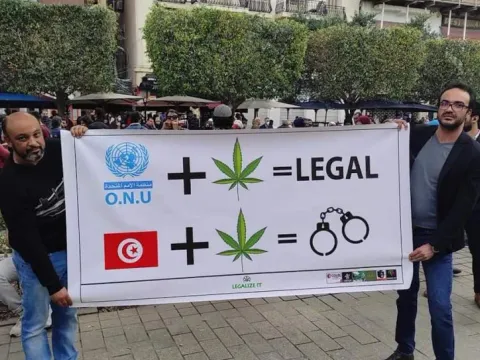
A judge at the El Kef Court of First Instance sentenced three young men to 30 years in prison for using cannabis in a public place. The court applied the maximum penalties available under Law 52 after the act took place in a sports stadium, one of the aggravating locations in Article 11; the judgment's arithmetic was not independently verified. The men had spent a year and a half in pretrial detention. Hundreds joined protests in Tunis against Law 52 in the following weeks, and on 13 February the Prime Minister, Hichem Mechichi, met civil society groups and spoke of breaking with the deterrent penal approach.
20172 entries1 score change
Easing ✓ Article
Tunisia gives judges discretion in drug cases
Parliament amended Law 52 so judges could apply mitigating circumstances to use or possession for personal use and to knowingly frequenting a drug den. The change was not limited to first-time offenders, and trafficking penalties were untouched. It took effect on 8 May 2017.
13+2 points
Easing ✓
Tunisia lets judges pardon first-time cannabis users
With a wider reform of Law 52 blocked in parliament, the National Security Council under President Beji Caid Essebsi let judges grant a pardon as soon as a first cannabis-use conviction is pronounced, so the person avoids prison. Trials under the law had risen from 732 in 2011 to 5,744 in 2016.
20161 entry0 score changes
20151 entry0 score changes
20111 entry0 score changes
20091 entry0 score changes
19921 entry1 score change
19901 entry0 score changes
19761 entry0 score changes
19642 entries0 score changes
Ban ✓
Tunisia bans cannabis even for medicine
Law 64-47 prohibited growing, harvesting, holding, selling, transporting, using and consuming cannabis and its preparations, even for human or veterinary medicine. It set one to five years and a 100–10,000-dinar fine, doubled penalties for repeat offences, and fined 5 dinars per plant left standing. It replaced the 1953 decree and remained the base of Tunisian drug law until Law 92-52 replaced it in 1992.
International ✓
Tunisia joins the Single Convention on Narcotic Drugs
Tunisia ratified the Single Convention on Narcotic Drugs of 1961 on 8 September 1964. The convention lists cannabis and cannabis resin among its controlled drugs and obliges its parties to limit their production, trade, possession and use to medical and scientific purposes.
19531 entry1 score change
19391 entry0 score changes
19271 entry0 score changes
18901 entry1 score change
18841 entry0 score changes
18751 entry1 score change
15501 entry0 score changes
Sources hover a number in the text to see its source
- Cited
- 14
- Websites
- 12
- Last reviewed
- History checked
- 25/25
Most cited
- lapresse.tn2
- legislation-securite.tn2
- businessnews.com.tn1
- data.unodc.org1
- hrw.org1
- incb.org1
All 14 sources
- UltraTunisia — Interview with Karim Chiair on regulating cannabis (18 February 2021)Uses zatla for cannabis and takrouri as the older name.archived
- Tunisia — Law 92-52 of 18 May 1992 on narcotics (consolidated, DCAF legal database)Articles 1–9, 11–12, 14, 16–20 and 24; UNODC copy consulted for the same articles.archived
- Tunisia — Law 2017-39 of 8 May 2017 amending Law 92-52Single article replacing Article 12; Penal Code Article 53 applies to Articles 4 and 8 only.archived
- Tunisia — Penal Code, Article 53 (Lois.tn)Article 53(7): where the penalty is five years or less, reduction to one day or a fine of up to double the maximum.archived
- Tunisie Numérique — Plus de 15 mille affaires de drogue en 2025 (26 June 2026)15,253 cases; 27,338 people; 89% aged 19–40.archived
- TalkingDrugs — Nine years after reform, Tunisia's drug law still fills its prisons (9 March 2026)Justice minister: more than 10,000 drug prisoners; prison population over 30,000.archived
- Webdo — Loi 52: la Tunisie veut distinguer consommateurs et trafiquants (23 September 2026)Bill 11/2025 still in committee; treatment-oriented position.archived
- Human Rights Watch — "All This for a Joint": Tunisia's repressive drug law and a roadmap for its reform (2016)archived
- UNODC Data Portal — Drug seizures, reported seizures in kilogram equivalentsTunisia: 1,815 kg cannabis resin in 2024; 1,003 kg in 2023.archived
- La Presse — Saisie de 13 millions de comprimés, 80 kg de cocaïne et 760 kg de cannabis en 2025 (6 December 2025)Customs: 760 kg cannabis; 80 kg cocaine; 13.07 million tablets.archived
- Tunisie Numérique — Tunisia to launch saliva-based drug test for drivers (27 July 2025)Announcement; no start date or threshold.archived
- Business News — Tunisie 2025: 181,998 affaires judiciaires et 20,289 arrestations pour trafic de drogue (7 March 2026)14,300 trafficking cases; 20,289 trafficking arrests; 181,998 judicial cases.archived
- La Presse — 5,000 trafiquants arrêtés en 2024 en Tunisie (28 January 2025)4,982 traffickers arrested in 2024; 3,165 in 2023.archived
- International Narcotics Control Board — Travellers carrying medicines containing controlled substances