9/100
#119 of 196 worldwide
#23 of 54 in Africa
Possession for personal use can bring up to seven years' rigorous imprisonment and a fine of up to 50,000 Birr. Supply with the intent to traffic starts at five years.
In short all countries →
- Can I carry it?NoIt is a crime
- Can I grow it?NoIt is a crime
- Can I buy it?NoThere is no legal source
- Can I use it in public?NoNot in public, and even at home the law does not protect it
- What if I'm caught?PrisonPersonal use can lead to prison or compulsory detention
A rough guide read from the scores and the rules below, not legal advice. The details and the exceptions are in each segment: select an answer to jump to it.
Cannabis in Ethiopia not part of the score · all 14 datasets ↓
Who uses it
About 1 in 38
people aged 15–64 (assumed) in Ethiopia used cannabis in the past year: about 2 million people.
- Past year
- 2.6%
- Africa median
- 3.1%
UNODC · survey 1999
Source Past-year cannabis use among people aged 15–64 (assumed). People who used cannabis in the past year, from a 1999 survey, applied to today's population aged 15–64. The population is approximate: the survey ages cut through an age group, or were not recorded and ages 15–64 are used. An earlier figure: UNODC's 2026 table has none for this country.Survey ages and years vary, and some surveys include children. Rates are not age-standardised; do not compare countries directly.
An earlier UNODC figure, as collected in Wikipedia's list of annual cannabis use by country. Population from the World Bank, aged 15–64. The whole dataset →
Use across Africa
18thhighest of 28 surveyed countries
- 🇰🇲 Comoros2.9%
- 🇸🇳 Senegal2.8%
- 🇪🇹 Ethiopia2.6%
- 🇸🇴 Somalia2.5%
- 🇨🇻 Cabo Verde2.4%
Past-year use, latest survey of each. Survey years and ages differ. On the map →
Cannabis in figures
- Research on cannabis0.1papers per million people · 2025
- Cannabis in the news0%of global news: cannabis articles from here · 2025
The dot: where it stands among the countries each dataset covers, lowest to highest. All datasets ↓
What they call it
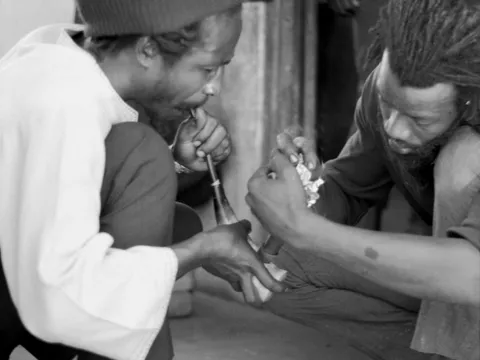
- Ganja[1]Rastafaricannabis; smoked communally in Shashemene, the Land of Promise settlement
Score breakdown 9/100 · how the scores are made
Neighbours
- 🇪🇷 Eritrea10
- 🇩🇯 Djibouti9
- 🇪🇹 Ethiopia9
- 🇰🇪 Kenya6
- 🇸🇩 Sudan5
- 🇸🇴 Somalia3
- 🇸🇸 South Sudan2
Article 525(4) of the 2004 Criminal Code punishes planting, buying, receiving, making, possessing, selling or delivering a narcotic for private use by oneself or another, and unlawful use, with rigorous imprisonment of up to seven years and a fine of up to 50,000 Birr.[2][3] Those figures are the statutory ceilings. The 2005 code's separation of personal use from trafficking is traced in the 2005 code.
| Amount | What happens | Punishment | Fine |
| Personal use (Article 525(4))Rigorous imprisonment up to seven years and fine up to 50,000 Birr; statutory ceilings | CriminalPersonal use | Up to 7 years | Up to ETB 50,000 |
Growing for one's own use falls under the same ceiling of seven years. Growing with the intent to traffic is a different offence: rigorous imprisonment of not less than five years and a fine of up to 100,000 Birr. The aggravated trafficking cases start at ten years and a fine of up to 200,000 Birr.[2][3] The article states those minimums and does not set a maximum term for them.
| Amount | What happens | Punishment | Fine |
| Growing for own useSame seven-year ceiling as personal use | CriminalPersonal use | Up to 7 years | — |
| Growing with intent to trafficAt least five years and fine up to 100,000 Birr; no maximum term stated | CriminalTrafficking | At least 5 years | Up to ETB 100,000 |
| Aggravated traffickingAt least ten years and fine up to 200,000 Birr; no maximum term stated | CriminalAggravated trafficking | At least 10 years | Up to ETB 200,000 |
The personal-use offence is rigorous imprisonment of up to seven years. Trafficking-intent offences start at five years, and the aggravated cases at ten.[2] No account of how often ordinary users are jailed was found.
Delivering or selling a narcotic for private use by another person is the personal-use offence, with up to seven years. Supply with the intent to traffic starts at five years, and the aggravated cases at ten.[2][3]
| Amount | What happens | Punishment | Fine |
| Supply for another person's private usePersonal-use offence ceiling | CriminalPersonal use | Up to 7 years | — |
| Supply with intent to trafficAt least five years; no maximum term stated | CriminalTrafficking | At least 5 years | — |
| Aggravated supplyAt least ten years; no maximum term stated | CriminalAggravated trafficking | At least 10 years | — |
Use is an offence. This applies equally in Shashamane, the Rastafari settlement, despite its reputation.[4]
Context not part of the score · every country, by topic →
There is no legal way to get cannabis. Personal use can bring rigorous imprisonment of up to seven years and a fine of up to 50,000 Birr.[2] Rastafari who settled at Shashamane in the 1960s get no exception: use is an offence there too.[4]
No medical cannabis. A 2010 health law had replaced the 1999 drug law with a special-permit regime for narcotic drugs, later rewritten in the 2019 food-and-medicine law.(/history/ethiopia-drug-permits-health-law-2010/) In March 2019 the health minister said growing cannabis for medical purposes had never been recognised or approved, and the Investment Commission said it would issue no permit to grow it, after a proposed farm in the Amhara region caused a public outcry.[5][6] The code draws no hemp distinction either: all forms, including CBD and hemp, count as illicit.[7]
No cannabis clubs are known, and the law leaves no room for them: growing cannabis and supplying it to another person are both prohibited.[2][4]
No seed or cutting exception was found: planting for private use falls under the personal-use offence, with up to seven years' rigorous imprisonment.[2] Shashamane is known for growing cannabis, mostly for local use, with no exception in the law.[4]
No hemp regime was found: no THC threshold, licence, or fibre exemption was located, and the 2019 outcry ended the only proposed legal grow. All forms, including CBD and hemp-derived items, count as illicit.[5][6][7]
No licensed cannabis production exists; what is grown, including around Shashamane, is unlicensed and falls under the cultivation offences.[4][2]
Ethiopia sits on a transit route: a March 2026 customs operation seized narcotics both smuggled in through border towns and destined for neighbouring countries, alongside 17 suspects and 10 vehicles.[8] With no legal supply, all domestic cannabis moves through this illegal market.[2]
There is no legal recreational supply for anyone. Possession for personal use can bring rigorous imprisonment of up to seven years and a fine of up to 50,000 Birr.[2] Bringing medical cannabis into the country, whatever the prescription, is equally prohibited.[7]
Article 75 of the 2024 Road Transport Traffic Control Regulation prohibits driving or attempting to drive under the influence of drugs or while taking them, including medication or substances that may diminish driving competence; it sets no numerical THC allowance.[9] Drivers involved in a fatal crash may have to take a drug test, with refusal treated as positive, and traffic controllers may hold a drug-influenced driver's vehicle for twelve hours unless another fit person drives it.[9] Article 98 repealed Regulation 208/2011 as amended by 395/2017 while preserving compatible earlier directives, and Article 95 refers penalties to Schedule B, but that schedule is absent from the Ministry of Justice PDF reviewed, so no current fine or licence-ban duration is asserted here.[9]
In a single March 2026 surveillance week, joint customs and police operations arrested 17 suspects moving contraband that included narcotics.[8] No account of how often ordinary users are arrested was found.
The retained sources describe no consequence beyond the sentence itself: personal use brings rigorous imprisonment of up to seven years and a fine of up to 50,000 Birr, with no account found of how often ordinary users are jailed.[2]
In the 1960s Rastafari from the Caribbean settled on land set aside for them near Shashamane; the town became known for growing cannabis, mostly for local use, with no exception in the law.[4] The settlers' use belongs to the wider Rastafari sacrament tradition, which Ethiopian law does not recognise. Communal gatherings still centre on smoking ganja, and researchers find most young users in town get it easily and cheaply.[1] Production concentrates around Shashemene, with the improved Ethiopia–Kenya highway carrying larger seizures into Kenya.[10]
Taking cannabis into or out of Ethiopia is a separate offence from possessing it, normally charged as smuggling or trafficking, with far heavier penalties. That holds almost everywhere, including between two places where cannabis is legal.
A prescription or medical card from another country is generally not recognised. Travellers who need a cannabis-based medicine should ask Ethiopia's embassy before travelling.[11]
General guidance that applies to almost every country, not a check of Ethiopia's customs rules.
Culture the atlas →
Datasets not part of the score
What other organisations publish about Ethiopia, and where it stands among the countries each one covers. Each dataset has a page of its own, with a world map and every country's figure.
Use
UNODC · 1999
Cannabis use
2.6%of people aged 15–64 (assumed)
survey 1999 · 2,000,000 people · earlier figure, not in UNODC 2026
Source Survey ages and years vary, and some surveys include children. Rates are not age-standardised; do not compare countries directly.WHO, Our World in Data · 2020
Alcohol drunk per person
3.06litres of pure alcohol a year
1.20 · 20001.20 · 20011.15 · 20021.14 · 20031.21 · 20041.40 · 20051.47 · 20061.54 · 20071.53 · 20081.59 · 20091.67 · 20101.81 · 20111.95 · 20122.11 · 20132.27 · 20142.52 · 20152.77 · 20163.08 · 20173.36 · 20183.36 · 20193.06 · 202020002020 Higher than 37% of 187 countriesLowestHighestper person aged 15 or over · 2020 · 1.20 in 2000 · 1.67 in 2010
Society
OpenAlex · 2025
Research on cannabis
0.1papers per million people
0.0 · 20000.0 · 20070.0 · 20080.0 · 20110.0 · 20140.0 · 20150.0 · 20160.0 · 20170.0 · 20180.0 · 20190.0 · 20200.1 · 20210.1 · 20220.1 · 20230.1 · 20240.1 · 202520002025 Higher than 18% of 176 countriesLowestHighest18 papers in 2025
Cato and Fraser Institutes · 2023
Human Freedom Index
4.70of 10
5.16 · 20005.21 · 20015.35 · 20025.11 · 20035.62 · 20045.25 · 20055.15 · 20065.12 · 20075.04 · 20085.19 · 20095.15 · 20105.03 · 20114.90 · 20124.89 · 20134.81 · 20144.77 · 20154.77 · 20164.97 · 20175.24 · 20185.55 · 20195.27 · 20205.07 · 20215.08 · 20224.70 · 202320002023 Higher than 6% of 164 countriesLess freeFreerrank #155 of 165 · personal freedom 4.49 · economic freedom 5.01
V-Dem, Our World in Data · 2025
Civil liberties
0.30of 1 in 2025
0.14 · 19000.15 · 19010.15 · 19020.15 · 19030.15 · 19040.15 · 19050.15 · 19060.15 · 19070.15 · 19080.15 · 19090.15 · 19100.14 · 19110.15 · 19120.15 · 19130.15 · 19140.15 · 19150.15 · 19160.16 · 19170.16 · 19180.16 · 19190.16 · 19200.16 · 19210.16 · 19220.16 · 19230.16 · 19240.16 · 19250.16 · 19260.16 · 19270.16 · 19280.16 · 19290.16 · 19300.16 · 19310.16 · 19320.16 · 19330.16 · 19340.16 · 19350.14 · 19360.14 · 19370.14 · 19380.14 · 19390.14 · 19400.16 · 19410.17 · 19420.17 · 19430.17 · 19440.17 · 19450.17 · 19460.17 · 19470.17 · 19480.17 · 19490.17 · 19500.17 · 19510.17 · 19520.17 · 19530.17 · 19540.18 · 19550.18 · 19560.18 · 19570.18 · 19580.18 · 19590.18 · 19600.18 · 19610.19 · 19620.19 · 19630.19 · 19640.19 · 19650.19 · 19660.19 · 19670.19 · 19680.19 · 19690.19 · 19700.19 · 19710.19 · 19720.19 · 19730.12 · 19740.06 · 19750.05 · 19760.05 · 19770.05 · 19780.05 · 19790.06 · 19800.06 · 19810.06 · 19820.06 · 19830.06 · 19840.06 · 19850.06 · 19860.05 · 19870.06 · 19880.06 · 19890.06 · 19900.28 · 19910.38 · 19920.38 · 19930.38 · 19940.39 · 19950.39 · 19960.39 · 19970.39 · 19980.39 · 19990.39 · 20000.39 · 20010.40 · 20020.39 · 20030.39 · 20040.39 · 20050.37 · 20060.38 · 20070.38 · 20080.38 · 20090.38 · 20100.38 · 20110.38 · 20120.37 · 20130.36 · 20140.35 · 20150.33 · 20160.34 · 20170.49 · 20180.56 · 20190.53 · 20200.46 · 20210.43 · 20220.36 · 20230.29 · 20240.30 · 202519002025 Higher than 15% of 175 countriesFewer libertiesMore liberties0.16 in 1925 · 0.18 in 1961 · 0.06 in 1990
Our World in Data, World Bank · 2025
Population
135,472,051people in 2025
17,719,308 · 190017,576,370 · 191017,476,313 · 192017,476,313 · 193017,476,313 · 194017,670,418 · 195021,376,688 · 196027,829,135 · 197034,428,515 · 198047,609,760 · 199067,411,496 · 200090,538,518 · 2010118,917,670 · 2020135,472,051 · 202519002025 Higher than 95% of 196 countriesLowestHighest17,719,308 in 1900 · 17,670,418 in 1950 · 67,411,496 in 2000
CEPII
Former colonial rulers
Once ruled by
World Bank · 2025
Government effectiveness
40of 100
22 · 199622 · 199822 · 200023 · 200222 · 200331 · 200433 · 200537 · 200639 · 200743 · 200843 · 200943 · 201043 · 201144 · 201242 · 201344 · 201442 · 201543 · 201642 · 201742 · 201842 · 201942 · 202039 · 202138 · 202239 · 202338 · 202440 · 202519962025 Higher than 26% of 195 countriesLowestHighestestimate -0.62 on a scale of −2.5 to 2.5 · 2025 · 22 in 2000 · 42 in 2015
Transparency International · 2024
Corruption Perceptions Index
37of 100
33 · 201233 · 201333 · 201433 · 201534 · 201635 · 201734 · 201837 · 201938 · 202039 · 202138 · 202237 · 202337 · 202420122024 Higher than 43% of 178 countriesLowestHighest0 highly corrupt, 100 very clean · 2024 · 33 in 2015 · 38 in 2020
Pew Research Center · 2020
Most common religion
Christians
the largest group · 2020
World Bank · 2025
Income per person
$3,095per person
874 · 1990778 · 1991681 · 1992744 · 1993741 · 1994760 · 1995827 · 1996826 · 1997773 · 1998788 · 1999810 · 2000851 · 2001838 · 2002796 · 2003877 · 2004952 · 20051,025 · 20061,109 · 20071,194 · 20081,262 · 20091,381 · 20101,493 · 20111,577 · 20121,697 · 20131,821 · 20141,957 · 20152,085 · 20162,223 · 20172,311 · 20182,438 · 20192,517 · 20202,588 · 20212,656 · 20222,758 · 20232,892 · 20243,095 · 202519902025 Higher than 10% of 187 countriesLowestHighestat purchasing power parity, 2021 dollars · 2025 · $874 in 1990 · $1,381 in 2010
World Bank · 2024
Development indicators
21.9%use the internet
0% · 19900% · 19950% · 19960% · 19970% · 19980% · 19990% · 20000% · 20010.1% · 20020.1% · 20030.2% · 20040.2% · 20050.3% · 20060.4% · 20070.4% · 20080.5% · 20090.8% · 20101.1% · 20112.9% · 20124.6% · 20137.7% · 201413.9% · 201515.4% · 201615.6% · 201715.9% · 201816% · 201916.1% · 202016.7% · 202118% · 202220.3% · 202321.9% · 202419902024 Higher than 10% of 195 countriesLowestHighest23.6% live in towns · 3.2% aged 65+ · life expectancy 67.6 · 2024 · 0% in 2000 · 0.8% in 2010
GDELT · 2025
Cannabis in the news
0%of global news: cannabis articles from here
0% · 20170% · 20180% · 20190% · 20200% · 20210% · 20220% · 20230% · 20240% · 202520172025 Higher than 0% of 147 countriesLowestHighest2025 average, 348 days · 0% in 2018 · 0% in 2021
Plant and market
GBIF · 2026
Records of the cannabis plant
17dated records
5 · 197513 · 202114 · 202215 · 202316 · 202417 · 202619752026 Higher than 54% of 128 countriesLowestHighest2 more without a date · 1 in 2026
History 14 of 15 checked against a source
Entries per decade
Entries that moved the score Context only
20192 entries0 score changes
Medical ✓ Article
Ethiopia refuses a medical cannabis farm after a public outcry
Africana Cannabis Holding, a venture of Ethiopian and Canadian investors, proposed a farm and factory in Dembecha, in the Amhara region, to grow cannabis for medicine and export. When the local administration posted news of a meeting with residents, protests spread online. The health minister, Amir Aman, said growing cannabis for medical purposes had neither been recognised nor approved and that such requests had been and would be denied; the head of the Investment Commission said no permit to grow cannabis in Ethiopia would be issued.
Other law ✓ Article
Ethiopia sets fifteen-day prescription checks for controlled medicines
Ethiopia's replacement medicine law required pharmacies dispensing narcotic or psychotropic medicines to check an original prescription issued within the previous fifteen days, with the prescriber's name, the institution's stamp and a readable serial number. Each prescription could cover only one controlled medicine. The law replaced the 2010 medicine controls while keeping special import permits and locked storage.
20101 entry0 score changes
20052 entries0 score changes
Other law ✓ Article
Ethiopia's new criminal code separates personal use from trafficking
Ethiopia's new criminal code punished unauthorised drug possession, growing or supply for private use with up to seven years in prison and a fine of up to 50,000 birr. Trafficking carried at least five years, rising to at least ten for organised or professional dealing, repeat offences and other aggravated cases. It replaced the 1957 code while preserving the application of special criminal laws.
Enforcement ✓
The United States warns American Rastafari about Ethiopia's drug law
The American authorities warned Rastafari travelling from the United States that cannabis is illegal in Ethiopia and that possession could bring up to six months in prison.
19991 entry0 score changes
19941 entry0 score changes
19931 entry0 score changes
19652 entries0 score changes
Culture & science ✓
Rastafari settle on the emperor's land at Shashamane
In the 1960s Rastafari from the Caribbean began to settle on land near Shashamane that Emperor Haile Selassie had set aside for them. The town later became known for growing cannabis, mostly for local use; an American report of 1998 described moderate quantities grown in the area. The law made no exception for the settlers.
International ✓
Ethiopia joins the Single Convention on Narcotic Drugs
Ethiopia acceded to the Single Convention on Narcotic Drugs of 1961 on 29 April 1965. The convention lists cannabis and cannabis resin among its controlled drugs and obliges its parties to limit their production, trade, possession and use to medical and scientific purposes.
19581 entry0 score changes
19471 entry0 score changes
19421 entry0 score changes
13201 entry0 score changes
Date not known1 entry1 score change
Sources hover a number in the text to see its source
- Cited
- 11
- Websites
- 11
- Last reviewed
- History checked
- 14/15
Most cited
- addisfortune.news1
- incb.org1
- journals.plos.org1
- justice.gov.et1
- leafwell.com1
- newbusinessethiopia.com1
All 11 sources
- PLOS One — Substance use among young people in the West Arsi Zone, Ethiopia: a cross-sectional study (2025)archived
- UNODC SHERLOC — Ethiopia Criminal Code, Article 525 (2004)Article 525(1)–(4)archived
- WIPO Lex — Criminal Code of Ethiopia, Proclamation No. 414/2004, Article 525Article 525(1)–(4)archived
- Leafwell — Is marijuana legal in Ethiopia?archived
- The Reporter Ethiopia — Planned cannabis project faces backlash (16 March 2019)archived
- Addis Fortune — A soft, misunderstood drug (23 March 2019)archived
- ZennJet — Ethiopia RED travel guide (2025)archived
- New Business Ethiopia — Customs Commission seizes contraband goods, including narcotics (30 March 2026)archived
- Ethiopia Ministry of Justice — Road Transport Traffic Control Council of Ministers Regulation No. 557/2024 (Federal Negarit Gazette, 19 August 2024)Articles 75, 95, 98–99; gazette pages 15866–15867 and 15879–15884; final schedule page is blankarchived
- Global Initiative Against Transnational Organized Crime — Criminality in Ethiopia (Organized Crime Index 2023)archived
- International Narcotics Control Board — Travellers carrying medicines containing controlled substances