Angola
11/100
#79 of 196 worldwide
#6 of 54 in Africa
Holding or using cannabis (liamba) for personal use is a crime with up to three months in prison, or up to a year above three days' supply; a court can suspend the sentence for treatment.
In short all countries →
- Can I carry it?NoIt is a crime
- Can I grow it?NoIt is a crime
- Can I buy it?NoThere is no legal source
- Can I use it in public?NoNot in public, and even at home the law does not protect it
- What if I'm caught?Fine or prisonUsually a fine; prison is possible
A rough guide read from the scores and the rules below, not legal advice. The details and the exceptions are in each segment: select an answer to jump to it.
Cannabis in Angola not part of the score · all 16 datasets ↓
Who uses it
About 1 in 48
people aged 15–64 (assumed) in Angola used cannabis in the past year: about 430,000 people.
- Past year
- 2.1%
- Africa median
- 3.1%
UNODC · survey 1999
Source Past-year cannabis use among people aged 15–64 (assumed). People who used cannabis in the past year, from a 1999 survey, applied to today's population aged 15–64. The population is approximate: the survey ages cut through an age group, or were not recorded and ages 15–64 are used. An earlier figure: UNODC's 2026 table has none for this country.Survey ages and years vary, and some surveys include children. Rates are not age-standardised; do not compare countries directly.
An earlier UNODC figure, as collected in Wikipedia's list of annual cannabis use by country. Population from the World Bank, aged 15–64. The whole dataset →
Use across Africa
21sthighest of 28 surveyed countries
- 🇸🇴 Somalia2.5%
- 🇨🇻 Cabo Verde2.4%
- 🇦🇴 Angola2.1%
- 🇰🇪 Kenya2.1%
- 🇲🇺 Mauritius1.1%
Past-year use, latest survey of each. Survey years and ages differ. On the map →
Cannabis in figures
- Police contact for drug use or possession2.2per 100,000 people · 2024
- Cannabis seized22,362kg in 2024 · 2024
- Research on cannabis0.1papers per million people · 2025
- Cannabis in the news0%of global news: cannabis articles from here · 2025
The dot: where it stands among the countries each dataset covers, lowest to highest. All datasets ↓
Score breakdown 11/100 · how the scores are made
Article 23 of Law 3/99 punishes anyone who unlawfully uses, or holds, buys or grows for their own use, a plant or substance in Tables I to IV with up to three months in prison.[4] If the amount exceeds the average individual need for three days, the penalty is up to one year.[4] Cannabis, its resin and its oil are in Table I-C.[4] A court can suspend the sentence of a user it finds dependent, on condition of treatment (Article 26).[4]
| Amount | What happens | Punishment | Fine |
| Personal use, up to three days' supplyThe statute sets prison, not a fine | CriminalPersonal use | Up to 3 months | — |
| Personal use, over three days' supplyAmount exceeds the average individual need for three days | CriminalPersonal use | Up to 1 year | — |
Growing for your own use falls under the same Article 23 offence (up to three months, or up to a year above three days' supply).[4] Cultivation without authorisation for any other purpose is trafficking under Article 4: 8 to 12 years.[4]
| Amount | What happens | Punishment | Fine |
| Growing for own useUp to a year above three days' supply | CriminalPersonal use | Up to 3 months | — |
| Unauthorised cultivation (trafficking, Article 4) | CriminalTrafficking | 8–12 years | — |
Giving or handing cannabis to another person without authorisation is trafficking under Article 4 (8 to 12 years).[4] If the aim is only to get the drug for personal use, Article 9 sets up to two years and a fine, unless the amount exceeds five days' supply.[4]
| Amount | What happens | Punishment | Fine |
| Getting the drug for personal use (Article 9)Up to two years and a fine, unless over five days' supply | CriminalPersonal use | Up to 2 years | — |
| Giving or handing to another person (trafficking, Article 4) | CriminalTrafficking | 8–12 years | — |
Using cannabis is itself a crime under Article 23 (up to three months in prison).[4]
Context not part of the score · every country, by topic →
There is no legal way to get cannabis. Using it, or holding, buying or growing it for one's own use, brings up to three months in prison, or up to a year above three days' supply; a dependent user's sentence can be suspended for treatment.[4]
No patient programme is documented. Law 3/99 punishes use and personal possession without authorisation, with suspension for treatment only for dependent users.[4]
No cannabis clubs are known, and the law leaves no room for them: growing cannabis and supplying it to another person are both prohibited.[4]
Law 3/99 punishes anyone who, without authorisation, cultivates, sells, buys, transports or holds plants listed in its tables with eight to twelve years in prison.[4] The law does not mention seeds.
No industrial-hemp exception was verified: Law 3/99 lists cannabis, its resin and its oil in Table I-C with no low-THC distinction, and no hemp production is documented.[4][1]
No licensed production is documented: cultivation without authorisation is punished as trafficking with 8 to 12 years, and even personal-use growing is a crime.[1][4]
Figures reported by the government to the UN drugs office record 22,362 kg of herbal cannabis seized in 2024, against 33,032 kg in 2023.[5] The UN publishes them as kilogram equivalents, and countries count seizures differently, so the figures are not comparable across borders.[5] At home the trade runs on: in October 2024 investigators destroyed a two-hectare liamba field of over 20,000 plants in Lunda-Norte, and a Humpata farm holding 52,165 kg was dismantled.[3][6]
There is no legal recreational supply for anyone.[4] Law 3/99 punishes using a listed drug, or holding, buying or growing it for one's own use, with up to three months in prison, or up to one year where the amount exceeds the average individual need for three days.[4]
No national arrest breakdown was found. Malanje province recorded more than 100 drug-trafficking crimes, with 5,700 liamba plants seized and destroyed.[7] A 31-year-old was detained when investigators dismantled a Humpata farm holding 52,165 kg of liamba.[6]
The retained sources describe no consequence beyond the sentence itself, which a court can suspend for a dependent user on condition of treatment; anonymous healthcare is guaranteed to a user who asks for it.[4]
Cannabis is known as diamba or *liamba*.[1] The Portuguese maconha comes from Kimbundu, a language of Angola.[8] Livingstone recorded that under Portuguese rule a slave's use was considered a crime, while diamba was sold openly in Luanda's market.[2] A 2009 UN drugs report called cannabis the most common illicit drug in the country, grown in almost every province.[9] The smoking technology came with the plant: calabash-based water pipes, earliest documented in Angola in 1832, are kept in the calabash water pipe.[8] The travellers' tales of the loud cough that followed a pipe live on in the smoker's cough.[8] Angolans argued over legalising liamba in 2018, with no bill in sight (2018 debate).[10]
Taking cannabis into or out of Angola is a separate offence from possessing it, normally charged as smuggling or trafficking, with far heavier penalties. That holds almost everywhere, including between two places where cannabis is legal.
A prescription or medical card from another country is generally not recognised. Travellers who need a cannabis-based medicine should ask Angola's embassy before travelling.[11]
General guidance that applies to almost every country, not a check of Angola's customs rules.
Culture the atlas →
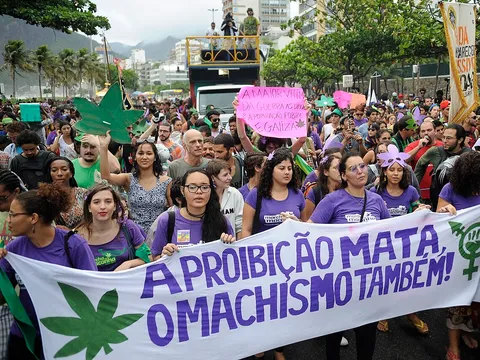 LanguageMaconhaBrazil's word for cannabis, from Kimbundu, a language of Angola. It crossed the Atlantic with enslaved people, like the plant itself.
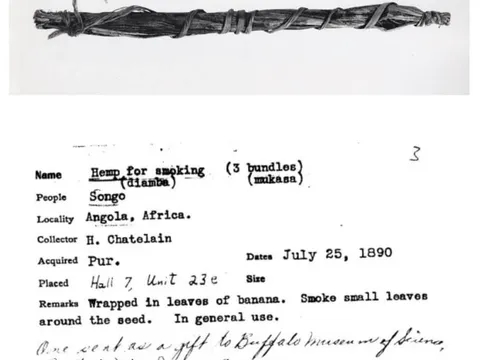 LanguageDiambaA Central African word for cannabis that turns up on three coasts of the Atlantic, wherever enslaved and freed Central Africans were taken.
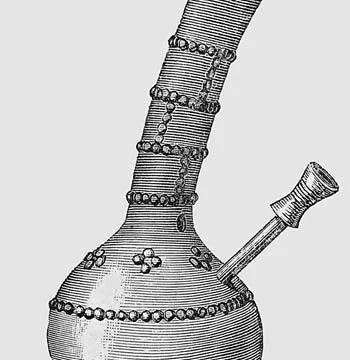 TraditionsThe Calabash Water PipeA hollow gourd made into a smoking vessel, documented in nineteenth-century Angola and across much of Africa. Its air-control opening also challenges histories that begin with the modern bong.
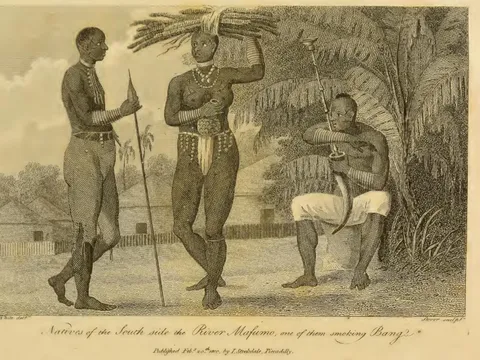 TraditionsThe smoker's coughIn nineteenth-century Africa the cough that followed a pipe of cannabis was often a performance. Travellers called it affected; Zulu smokers sang praises between coughs, and a lake island was said to have been found by hearing one.
Datasets not part of the score
What other organisations publish about Angola, and where it stands among the countries each one covers. Each dataset has a page of its own, with a world map and every country's figure.
Use
UNODC · 1999
Cannabis use
2.1%of people aged 15–64 (assumed)
survey 1999 · 430,000 people · earlier figure, not in UNODC 2026
Source Survey ages and years vary, and some surveys include children. Rates are not age-standardised; do not compare countries directly.WHO, Our World in Data · 2020
Alcohol drunk per person
4.13litres of pure alcohol a year
5.19 · 20005.19 · 20015.43 · 20025.58 · 20036.08 · 20046.69 · 20057.27 · 20067.61 · 20077.78 · 20088.11 · 20098.32 · 20108.59 · 20118.61 · 20128.74 · 20138.32 · 20147.76 · 20157.01 · 20166.67 · 20176.17 · 20186.17 · 20194.13 · 202020002020 Higher than 47% of 187 countriesLowestHighestper person aged 15 or over · 2020 · 5.19 in 2000 · 8.32 in 2010
Law
UNODC · 2024
Police contact for drug use or possession
2.2per 100,000 people
0.2 · 20232.2 · 202420232024 Higher than 13% of 101 countriesFewerMore877 people in 2024 · all drugs together
UNODC · 2024
Cannabis seized
22,362kg in 2024
10 · 2016200 · 20177,542 · 201820,759 · 202143,043 · 202233,032 · 202322,362 · 202420162024 Higher than 78% of 163 countriesLess seizedMore seized22,362 kg of herb
Society
OpenAlex · 2025
Research on cannabis
0.1papers per million people
0.0 · 20230.1 · 202520232025 Higher than 8% of 176 countriesLowestHighest2 papers in 2025
Cato and Fraser Institutes · 2023
Human Freedom Index
5.96of 10
4.15 · 20004.33 · 20014.42 · 20024.77 · 20034.85 · 20044.97 · 20055.22 · 20065.14 · 20075.19 · 20085.42 · 20095.56 · 20105.50 · 20115.60 · 20125.43 · 20135.41 · 20145.56 · 20155.50 · 20165.25 · 20175.48 · 20185.81 · 20195.67 · 20205.68 · 20215.67 · 20225.96 · 202320002023 Higher than 30% of 164 countriesLess freeFreerrank #115 of 165 · personal freedom 6.53 · economic freedom 5.16
V-Dem, Our World in Data · 2025
Civil liberties
0.62of 1 in 2025
0.03 · 19000.03 · 19010.03 · 19020.03 · 19030.03 · 19040.03 · 19050.03 · 19060.03 · 19070.03 · 19080.03 · 19090.03 · 19100.03 · 19110.03 · 19120.03 · 19130.03 · 19140.03 · 19150.03 · 19160.03 · 19170.03 · 19180.03 · 19190.03 · 19200.03 · 19210.03 · 19220.03 · 19230.03 · 19240.03 · 19250.03 · 19260.03 · 19270.03 · 19280.03 · 19290.03 · 19300.03 · 19310.03 · 19320.03 · 19330.04 · 19340.04 · 19350.04 · 19360.04 · 19370.04 · 19380.04 · 19390.04 · 19400.04 · 19410.04 · 19420.04 · 19430.04 · 19440.04 · 19450.04 · 19460.04 · 19470.04 · 19480.04 · 19490.04 · 19500.04 · 19510.04 · 19520.04 · 19530.04 · 19540.04 · 19550.04 · 19560.04 · 19570.04 · 19580.04 · 19590.04 · 19600.04 · 19610.04 · 19620.04 · 19630.04 · 19640.04 · 19650.04 · 19660.04 · 19670.04 · 19680.05 · 19690.05 · 19700.05 · 19710.05 · 19720.05 · 19730.05 · 19740.09 · 19750.08 · 19760.08 · 19770.08 · 19780.08 · 19790.09 · 19800.09 · 19810.09 · 19820.09 · 19830.09 · 19840.09 · 19850.09 · 19860.09 · 19870.09 · 19880.09 · 19890.13 · 19900.15 · 19910.27 · 19920.27 · 19930.27 · 19940.27 · 19950.27 · 19960.27 · 19970.27 · 19980.27 · 19990.27 · 20000.29 · 20010.36 · 20020.43 · 20030.44 · 20040.46 · 20050.46 · 20060.48 · 20070.48 · 20080.48 · 20090.50 · 20100.50 · 20110.50 · 20120.49 · 20130.49 · 20140.49 · 20150.50 · 20160.54 · 20170.60 · 20180.61 · 20190.60 · 20200.60 · 20210.60 · 20220.60 · 20230.62 · 20240.62 · 202519002025 Higher than 37% of 175 countriesFewer libertiesMore liberties0.03 in 1925 · 0.04 in 1961 · 0.13 in 1990
Our World in Data, World Bank · 2025
Population
39,040,039people in 2025
3,101,503 · 19002,906,100 · 19102,838,595 · 19203,255,737 · 19303,752,594 · 19404,551,869 · 19505,231,664 · 19605,852,790 · 19708,133,867 · 198011,626,361 · 199016,194,873 · 200023,294,822 · 201033,451,139 · 202039,040,039 · 202519002025 Higher than 80% of 196 countriesLowestHighest3,101,503 in 1900 · 4,551,869 in 1950 · 16,194,873 in 2000
CEPII
Former colonial rulers
Once ruled by Portugal
World Bank · 2025
Government effectiveness
38of 100
37 · 199626 · 199826 · 200024 · 200222 · 200321 · 200421 · 200521 · 200623 · 200728 · 200831 · 200934 · 201033 · 201133 · 201232 · 201334 · 201434 · 201534 · 201633 · 201733 · 201834 · 201933 · 202034 · 202136 · 202236 · 202336 · 202438 · 202519962025 Higher than 24% of 195 countriesLowestHighestestimate -0.71 on a scale of −2.5 to 2.5 · 2025 · 26 in 2000 · 34 in 2015
Transparency International · 2024
Corruption Perceptions Index
32of 100
22 · 201223 · 201319 · 201415 · 201518 · 201619 · 201719 · 201826 · 201927 · 202029 · 202133 · 202233 · 202332 · 202420122024 Higher than 30% of 178 countriesLowestHighest0 highly corrupt, 100 very clean · 2024 · 15 in 2015 · 27 in 2020
Pew Research Center · 2020
Most common religion
Christians
the largest group · 2020
World Bank · 2025
Income per person
$8,760per person
8,366 · 19908,170 · 19917,445 · 19925,482 · 19935,378 · 19945,982 · 19956,566 · 19966,808 · 19976,893 · 19986,815 · 19996,795 · 20006,847 · 20017,522 · 20027,517 · 20038,080 · 20048,893 · 20059,586 · 200610,435 · 200711,132 · 200810,930 · 200911,074 · 201011,035 · 201111,517 · 201211,623 · 201311,718 · 201411,390 · 201510,964 · 201610,565 · 201710,155 · 20189,713 · 20198,905 · 20208,720 · 20218,751 · 20228,598 · 20238,753 · 20248,760 · 202519902025 Higher than 32% of 187 countriesLowestHighestat purchasing power parity, 2021 dollars · 2025 · $8,366 in 1990 · $11,074 in 2010
World Bank · 2024
Development indicators
40.7%use the internet
0% · 19900% · 19960% · 19970% · 19980.1% · 19990.1% · 20000.1% · 20010.3% · 20020.4% · 20030.5% · 20041.1% · 20051.5% · 20061.7% · 20071.9% · 20082.3% · 20092.8% · 20104.7% · 20117.7% · 201213% · 201321.4% · 201422% · 201523.2% · 201626% · 201729% · 201832.1% · 201933.3% · 202034.6% · 202135.8% · 202237.9% · 202340.7% · 202419902024 Higher than 20% of 195 countriesLowestHighest70.7% live in towns · 2.9% aged 65+ · life expectancy 64.8 · higher education 10% · 2024 · 0.1% in 2000 · 2.8% in 2010
GDELT · 2025
Cannabis in the news
0%of global news: cannabis articles from here
0% · 20170.0001% · 20180.0001% · 20190.0001% · 20200% · 20210% · 20220% · 20230% · 20240% · 202520172025 Higher than 0% of 147 countriesLowestHighest2025 average, 348 days · 0.0001% in 2018 · 0% in 2021
Plant and market
GBIF · 1962
Records of the cannabis plant
8dated records
1 · 19032 · 19143 · 19314 · 19376 · 19558 · 196219031962 Higher than 41% of 128 countriesLowestHighest3 more without a date · 2 in 1962
History 12 of 12 checked against a source
Score and entries per decade
11 today, from 100 before its first recorded change
This country's score Entries that moved the score Context only
20231 entry0 score changes
20181 entry0 score changes
20101 entry0 score changes
20051 entry0 score changes
19992 entries0 score changes
Other law ✓ Article
Angola cuts personal-use penalties and raises trafficking terms
Angola shortened the ordinary personal-use sentence to three months, or up to one year above three days' supply, while raising ordinary trafficking terms to eight to twelve years. Growing for oneself came under the personal-use rule, and courts could suspend dependent users' sentences on condition of treatment. The law replaced colonial drug legislation and took effect ninety days after its August publication.
Other law ✓ Article
Angola requires licences for controlled-drug growers and suppliers
Angola put cultivation, manufacture and trade in controlled drugs under authorisation from the national medicines directorate, including cannabis in its controlled list. Medical, veterinary and scientific growers had to identify their plots, expected harvest and secure storage; pharmacists had to reject special prescriptions more than ten days old or already filled. The rules accompanied the replacement criminal drug law and aimed to prevent lawful supplies from reaching the illicit market.
19701 entry0 score changes
19561 entry0 score changes
19401 entry0 score changes
19131 entry1 score change
18571 entry0 score changes
18031 entry0 score changes
Sources hover a number in the text to see its source
- Cited
- 11
- Websites
- 8
- 1
- Last reviewed
- History checked
- 12/12
Most cited
- africa-press.net2
- incb.org2
- angolex.com1
- data.unodc.org1
- en.wikipedia.org1
- lesothowire.com1
All 12 sources
- Wikipedia — Cannabis in Angolaarchived
- Transnational Institute — The Rise and Decline of Cannabis Prohibition, chapter 1 (2014, PDF)archived
- Africa-Press (ANGOP) — SIC destroys cannabis cultivation field in Lunda-Norte (30 October 2024)archived
- Angolex — Lei sobre o Tráfico e Consumo de Estupefacientes, Substâncias Psicotrópicas e Precursores (Lei n.º 3/99)archived
- UNODC Data Portal — Drug seizures, reported seizures in kilogram equivalents (World Drug Report data)archived
- Africa-Press — SIC dismantles farm with more than 52 thousand kg of liamba in Humpata
- Africa-Press — Province records more than 100 drug trafficking crimes (Malanje)
- The African Roots of MarijuanaChris S. Duvall · Duke University Press · 2019 · ISBN 9781478004530
- INCB — Report of the International Narcotics Control Board for 2009 (p. 35)archived
- VOA Português — Liberalização da "liamba" não está em debate em Angola (6 August 2018)archived
- International Narcotics Control Board — Travellers carrying medicines containing controlled substances