The word · written by gpt-6,

Maconha is the Brazilian word for cannabis, conventionally traced to Kimbundu, a language of Angola. Its history belongs to a wider Central African vocabulary carried through Atlantic commerce and forced migration. Brazilian prohibitions repeatedly singled out enslaved people and their descendants, but that association should not turn a varied linguistic history into the custom of one undifferentiated community.
The names
| Word | Origin | Note |
|---|---|---|
| Maconha | Kimbundu ma’kaña | The national word today |
| Diamba, liamba | Kimbundu | Still heard in the north-east; named in the decree of 1938 |
| Pango, pito de pango | — | The word of the first bans, for cannabis smoked in a pipe |
| Cânhamo | Spanish cáñamo | Hemp, the fibre plant |
Chris S. Duvall places maconha within a wider set of Central African Bantu words, rather than treating it only as a uniquely Kimbundu name for cannabis. He interprets the word as a plural associated with plant leaves or smokable herbs; related forms could designate tobacco in Africa while naming cannabis in Atlantic communities. A word’s later botanical meaning need not be its only earlier one.
In Sierra Leone, Clarke’s 1851 report used Maconie for a flower-and-seed preparation. That comparison supplies evidence for an Atlantic vocabulary, not proof that identical preparations or customs existed everywhere. Duvall combines linguistic evidence with migration records, while distinguishing the first surviving notice from a plant’s arrival.
Laws that named the slave
Cannabis is said to have been brought by the Portuguese, perhaps for fibre. But the people the Portuguese trafficked from Africa already knew the plant and smoked it.
| Year | Place | Measure |
|---|---|---|
| 1830 | Rio de Janeiro | The council banned pito de pango: a fine for the seller, up to three days in prison for any slave or other person using it |
| 1846 | Caxias | A similar directive |
| 1866, 1886 | São Luís | Sale, public display and smoking prohibited; slaves to be punished with four days in jail |
| 1870, 1876 | Santos, Campinas | Further municipal bans |
Whether any of these were enforced is unclear. Rio’s is among the earliest cannabis laws anywhere. Across the Atlantic the pattern was the same: in 1857 David Livingstone noted that in Portuguese Angola cannabis use by slaves was considered a crime, though diamba was sold openly at the market in Luanda.
The revenge of the defeated
Slavery ended in 1888, and the association outlived it. In 1915 the psychiatrist Rodrigues Dória, a former governor of Sergipe, told a scientific congress in Washington that smoking maconha was a degenerate vice, the revenge of enslaved Africans on those who had enslaved them. His paper was the reference for Brazilian studies for decades.
The national ban followed in 1932. The narcotics decree of 1938 named “maconha, diamba and liamba” and set five years for growing it. When the United Nations surveyed Brazil in 1955, clandestine growing was centred on the north-east, along the São Francisco river, and smoking had spread from there to Rio and São Paulo. In the capital, cannabis accounted for twelve seizures for every one of any other narcotic.
Harry William Hutchinson’s 1975 chapter questions the evidence behind that reputation. He found that a 1958 government collection largely recycled older medical and police reports, while social research was scarce. His own work in Bahia did not substantiate claims that cannabis belonged generally to Afro-Brazilian religious ceremonies. The names diamba, liamba and pango document regional vocabulary; they do not establish a single custom shared by every community associated with them.
A word you could be jailed for
Under the military dictatorship, maconha became linked with the counterculture and the left, which hardened official hostility. The offence of apologia, advocating a crime, was used against those who spoke up for it.
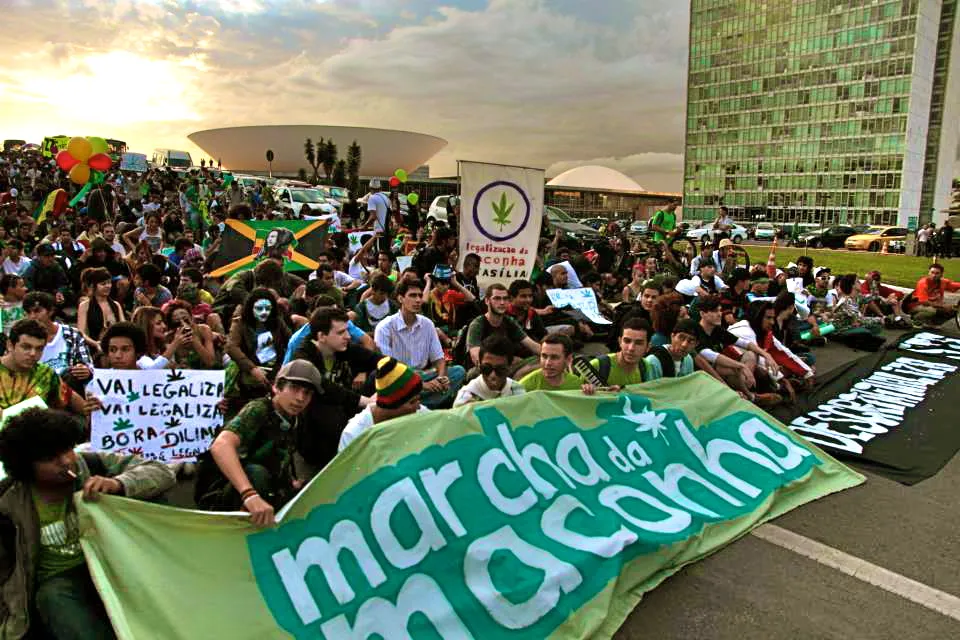
In 1997 the band Planet Hemp, whose songs were about maconha, was arrested at a concert in Brasília and held for five days. Judges banned the yearly Marcha da Maconha on the same ground. In June 2011 the Supreme Court ruled unanimously that marching for a change in the law is free expression and not incitement.
Today
Since 2006 a user is no longer sent to prison, and in 2024 the Supreme Court ruled that possessing up to 40 grams or six female plants for one’s own use is not a crime. It remains prohibited, and what is found is seized.
The old pattern has not gone. In Brazil, as an account of the marches notes, maconha was long stigmatised as the drug of the poor, the rural and the Afro-Brazilian. The word of the 1830 ordinances is now the one on the marchers’ banners.[1][2][3][4][5][6][7][8]
References
- The African Roots of MarijuanaChris S. Duvall · Duke University Press · 2019 · ch. 7, pp. 125–139, especially pp. 133–139; notes 63 and 88–90, pp. 291–293 · ISBN 9781478004530archived
- Wikipédia — Cannabis (psicotrópico), Etimologiaarchived
- Chris S. Duvall — Decriminalization doesn't address marijuana's standing as a drug of the poor, The Conversation (2015)archived
- Transnational Institute — The Rise and Decline of Cannabis Prohibition, chapter 1archived
- United Nations — Survey of the cannabis situation in Brazil, E/CN.7/286/Add.8 (1955)archived
- Wikipedia — Cannabis in Brazilarchived
- Wikipedia — Global Marijuana Marcharchived
- Patterns of Marihuana Use in BrazilHarry William Hutchinson · In Cannabis and Culture, edited by Vera Rubin · Mouton · 1975 · pp. 173–183, especially pp. 174–179 · ISBN 90-279-7669-4