The word · written by gpt-6,

Dagga is what cannabis is called in South Africa and its neighbours. It is a Khoekhoe word, taken up by the Dutch at the Cape in the seventeenth century, written into colonial law in the nineteenth, turned into a word of contempt in the twentieth, and deliberately taken back in the twenty-first.
A Khoekhoe word
The source is the Khoekhoe daxa, said with the rasping sound that survives in the Afrikaans g. The Khoekhoe used it for cannabis and also for species of Leonotis, the shrub still called wild dagga, whose leaves resemble those of cannabis. According to the Oxford dictionary the word also described the feeling of intoxication.
Its first appearance in writing is in the journal of Jan van Riebeeck, commander of the Dutch station at the Cape, in 1658. He ordered that “daccha” be bought in Natal to trade with the Khoekhoe. He may have meant the wild plant; some scholars doubt that anyone could confuse two plants with such different flowers.
Brian du Toit’s chapter in Cannabis and Culture (1975) stresses the identification problem in these early accounts. Descriptions of chewing roots or making small cakes may refer to Leonotis or other plants, while later descriptions explicitly identify hemp. A colonial spelling of dagga is therefore evidence for the word, but not always secure evidence for the botanical species.
Duvall adds another warning: dagga can also mean building mortar. In a note to his 2019 book, he corrects a photograph caption in his earlier Cannabis (2015), acknowledging that men shown “Making Dagga” were preparing adobe, not cannabis for storage. An archival title containing the word therefore needs its material context checked before it becomes cannabis evidence.
Where the Khoekhoe word itself comes from is argued over.
| Theory | Proposed by |
|---|---|
| From Dutch tabak, tobacco, by way of twak, twaga, toaga | Hahn and Lichtenstein |
| From Khoekhoe daXa-b, tobacco; with !am, green, giving “green tobacco” | Brian du Toit, Cannabis in Africa (1980); supported by Jean Branford’s Dictionary of South African English (1978) |
Over three centuries it has been spelled daccha, dacha, dacka, dagha, daggha, tagga and daga.
The other names
Dagga is the word of Afrikaans and of South African English. The African languages have their own.
| Language or country | Word |
|---|---|
| isiZulu, siSwati | insangu |
| Sesotho | matekoane |
| In Zimbabwe | mbanje |
| In Malawi | chamba |
The word of the law
The plant was in wide use among Khoisan and Bantu-speaking peoples before the Dutch arrived in 1652. The Dutch East India Company tried to make a monopoly of it, forbidding settlers to grow it from 1680, found there was no profit in a plant that grew everywhere, and lifted the ban in 1700.
The first modern laws used the botanical name and were aimed at one group. Natal’s law of 1870 forbade Indian indentured labourers to smoke, use or possess “any portion of the hemp plant”. In 1887 a commission on Indian immigration asked for that law to be used to ban cannabis among them outright; no rule seems to have followed. After that the statutes say dagga.
| Year | Law |
|---|---|
| 1903 | The Orange River Colony’s Dagga Prohibition Ordinance |
| 1905 | The Cape lists dagga as a poison, to be sold only by chemists. Dagga farmers of the Middelburg district petition against it |
| 1916 | A draft national bill lists the wild Leonotis as dagga, separately from Indian hemp |
| 1922 | National prohibition of growing, selling, possessing and using it. A month later officials told police to go easy in remote African areas, where an older man’s morning pipe was almost a religious rite |
| 1923 | South Africa asks the League of Nations to put dagga on its list of dangerous drugs |
African opinion was divided too. In 1907 John Dube, editor of Ilanga lase Natal and later a founder of the African National Congress, listed insangu with beer, spirits and polygamy among the customs holding Africans back.
In the Transvaal of those years it was sold “openly and normally” by storekeepers to miners, and the mine managers saw no reason to stop it.
A word turned into an insult
The National Party came to power in 1948 and kept the prohibition. Being an Afrikaans party, and the syllable ga already being an expression of disgust in the language, its people leaned on the word to pour scorn on the drug and on anyone who used it. Convictions fell, a government committee reported in 1952, almost entirely on Africans and Coloured people. Dagga became a word many users would not say.
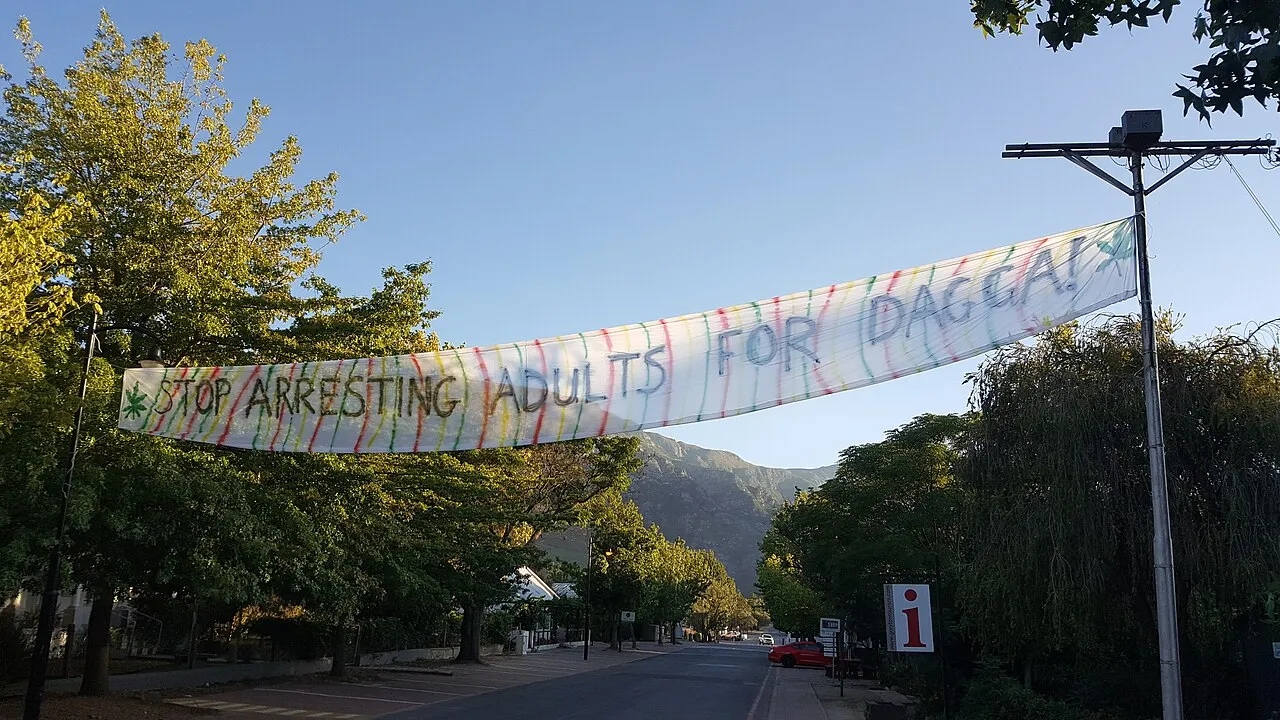
Taken back
The campaigners of the 2000s chose it on purpose. Jeremy Acton founded the Dagga Party in 2009. Julian Stobbs and Myrtle Clarke, arrested at home in 2010 with more than the 115 grams that the law treated as dealing, were named the Dagga Couple by the press, kept the name, and sued seven government departments in what became known as the Trial of the Plant.
Acton was one of the applicants in the case that ended the ban on private use. On 18 September 2018 the Constitutional Court ruled that adults may use, possess and grow cannabis in private. The act that followed in 2024 is the Cannabis for Private Purposes Act: the legislators preferred the Latin.[1][2][3][4][5][6][7][8]
References
- The African Roots of MarijuanaChris S. Duvall · Duke University Press · 2019 · ch. 4, pp. 86–89; note 93, p. 265 · ISBN 9781478004530archived
- Wikipedia — Daggaarchived
- Wikipedia — Cannabis in South Africaarchived
- Dagga: How South Africa Made a Dangerous Drug, 1902–1928Thembisa Waetjen · In Cannabis: Global Histories, edited by Lucas Richert, James H. Mills · MIT Press · 2021 · ISBN 9780262366137
- Wikipedia — Dagga Couplearchived
- Wikipedia — Dagga Partyarchived
- Dagga: The History and Ethnographic Setting of Cannabis sativa in Southern AfricaBrian M. du Toit · In Cannabis and Culture, edited by Vera Rubin · Mouton · 1975 · pp. 92–97 · ISBN 90-279-7669-4
- Prohibition & Resistance: A Socio-Political Exploration of the Changing Dynamics of the Southern African Cannabis Trade, c. 1850–the presentCraig Paterson · Rhodes University · 2009 · MA thesis, pp. 43–47archived