Lesotho
11/100
#88 of 196 worldwide
#10 of 54 in Africa
First African country to license medical cannabis cultivation (2017), mostly for export. Personal use remains illegal although matekoane is widely grown. The 2008 Act has no standalone possession offence; prosecutors use its licensing and trafficking provisions.
In short all countries →
- Can I carry it?NoIt is a crime
- Can I grow it?NoIt is a crime
- Can I buy it?NoNo patient or adult-use purchase route verified
- Can I use it in public?NoNot in public, and even at home the law does not protect it
- What if I'm caught?Fine or prisonUsually a fine; prison is possible
A rough guide read from the scores and the rules below, not legal advice. The details and the exceptions are in each segment: select an answer to jump to it.
Cannabis in Lesotho not part of the score · all 15 datasets ↓
Who uses it
Perhaps 1 in 33
people aged 15–64 (assumed) in Lesotho used cannabis in the past year: about 45,000 people.
- Past year
- 3.1%
- Africa median
- 3.1%
This site’s estimate: there is no national survey.
Source Past-year cannabis use among people aged 15–64 (assumed). This site's figure: there is no national survey, so the median rate of surveyed countries in Africa is applied to people aged 15–64.Survey ages and years vary, and some surveys include children. Rates are not age-standardised; do not compare countries directly.
A median computed on this site from surveyed countries in Africa, using UNODC World Drug Report 2026 figures. Population from the World Bank, aged 15–64. The whole dataset →
Cannabis in figures
- Cannabis seized6,670kg in 2024 · 2024
- Research on cannabis0.4papers per million people · 2024
- Cannabis in the news0%of global news: cannabis articles from here · 2025
The dot: where it stands among the countries each dataset covers, lowest to highest. All datasets ↓
Score breakdown 11/100 · how the scores are made
The Drugs of Abuse Act 2008 has no standalone offence of simple possession or consumption.[2] Prosecutors use section 9, which punishes unlicensed manufacture, acquisition or administration of a drug of abuse with a minimum of five years or M20,000, or both.[2] Possession with intent to supply falls under trafficking in section 43, with a minimum of twenty years or M1,000,000.[2] There is no statutory quantity threshold.[2]
| Amount | What happens | Punishment | Fine |
| Unlicensed acquisition or administrationMinimum five years or M20,000, or both | CriminalAcquisition | At least 5 years | At least LSL 20,000 |
| Possession for supply or traffickingMinimum twenty years or M1,000,000, or both | CriminalTrafficking | At least 20 years | At least LSL 1,000,000 |
Cultivating cannabis without an operator licence is an offence under section 9, with a minimum of five years or M20,000, or both.[2] The definition covers planting, sowing, scattering seed, growing, tending and harvesting.[2] Producing or preparing cannabis for supply can also fall under the twenty-year trafficking offence, an overlap the Act does not resolve.[2]
| Amount | What happens | Punishment | Fine |
| Unlicensed cultivationMinimum five years or M20,000, or both | CriminalCultivation | At least 5 years | At least LSL 20,000 |
| Producing for supply | CriminalTrafficking | At least 20 years | At least LSL 1,000,000 |
Small cases usually bring a fine, but the statutory minima are severe: five years or M20,000 for unlicensed acquisition or cultivation, and twenty years or M1,000,000 for supply.[2] Enforcement falls mainly on small farmers and couriers, while licensed export companies operate under the 2018 and 2025 regulations.[3] No cannabis-only arrest series is published.[4]
Trafficking includes offering, distributing, selling, delivering "on any terms whatsoever", transporting, importing and exporting.[2] The minimum is twenty years or M1,000,000, or both, and there is no small-quantity or gift exception.[2] Possessing chemicals or equipment for illicit cultivation carries ten years or M50,000.[2]
| Amount | What happens | Punishment | Fine |
| Supply or delivery, including giftsMinimum twenty years or M1,000,000, or both | CriminalTrafficking | At least 20 years | At least LSL 1,000,000 |
| Chemicals or equipment for illicit cultivation | CriminalTrafficking | At least 10 years | At least LSL 50,000 |
No legal source for local consumers. Licensed cultivation is for medical and scientific use, mostly export, and there is no domestic patient or dispensary route.[2][5]
Context not part of the score · every country, by topic →
All recreational use is prohibited. The 2008 Act has no simple-possession offence; prosecutors use section 9 for unlicensed acquisition or administration (minimum five years or M20,000) and section 43 for supply (minimum twenty years or M1,000,000).[2] There are no quantity thresholds, and giving cannabis away can be charged as trafficking.[2]
No domestic patient-access scheme. Licensed production is for medical and scientific use, but the 2024 research found no legal route for local patients to obtain medical cannabis.[5] No registered cannabis medicine or dispensary was verified.[2]
No cannabis clubs are known, and the law leaves no room for them: growing cannabis and supplying it to another person are both prohibited.[2]
The 2008 Act defines cannabis as any part of the plant "including the seeds", and cultivation as including planting, sowing and scattering the seed.[2] Seed is therefore a controlled drug, lawful only for holders of a licence under the Act, such as the medical cannabis producers licensed since 2017.[2]
No separate hemp or CBD regime and no THC threshold. "Cannabis" covers any part of the plant, including seeds and leaves, and cannabis is a Schedule 1 drug.[2] Industrial hemp would need the same cannabis licence, and no consumer CBD market was found.[2]
Lesotho began licensing cannabis cultivation for medical and scientific use in 2017 and published detailed licensing regulations in 2018.[6] A 2024 study counted 33 licences, eight registered companies and one GMP-certified exporter to the EU; the sector is export-oriented and foreign-investor-heavy.[5] The 2025 amendment raised fees to M400,000 for an operator and M100,000 for cultivation, manufacturing or testing.[7]
Unlicensed cannabis is one of Lesotho's most significant cash crops, though it appears in no official economic statistics.[3] Farmers treat it as a fallback when other income declines, and enforcement does not match the scale of production.[3] UNODC records 6,670 kg of cannabis herb seized in 2024, against 2,175 kg in 2023.[8] No reliable output estimate was found.[3]
There is no legal recreational supply for anyone. The 2008 Act's licensing and trafficking provisions apply to visitors as to residents, with supply carrying a minimum of twenty years or M1,000,000.[2]
Road Traffic Act section 92 makes it an offence to drive or attempt to drive on a public road while drink or a drug makes the driver incapable of proper control.[9] The 1981 edition sets a M1,000 fine and one year in prison, and permits blood, urine or breath evidence; refusal without reasonable cause supports the prosecution's evidence of condition.[9] There is no numeric THC cutoff.[9]
In 2024, 105 people were brought into formal contact with the police for drug offences and 88 were prosecuted; the figures cover all drugs and are not cannabis-specific.[4] UNODC records 6,670 kg of cannabis herb seized in 2024, against 2,175 kg in 2023.[8] No 2025 or 2026 aggregate was published; recent cases concern licensed-import disputes and the Srugo plants case.[10]
A conviction is a criminal record. The 2008 Act provides for forfeiture of drugs and property connected with an offence, and the 2018 regulations add licence conditions and seed-to-sale controls for lawful operators.[2][6]
Cannabis is known locally as dagga or matekoane, the Sesotho name recorded in the 1955 UN survey.[1] Lesotho became the first African country to license medical cultivation in 2017; licensed production is for medical and scientific use, but the 2024 research found no legal route for local patients.[5][2]
Taking cannabis into or out of Lesotho is a separate offence from possessing it, normally charged as smuggling or trafficking, with far heavier penalties. That holds almost everywhere, including between two places where cannabis is legal.
A prescription or medical card from another country is generally not recognised. Travellers who need a cannabis-based medicine should ask Lesotho's embassy before travelling.[11]
General guidance that applies to almost every country, not a check of Lesotho's customs rules.
Culture the atlas →
 LanguageDaggaThe southern African word, from Khoekhoe. First written down by the Dutch at the Cape in 1658, later a word of contempt, now reclaimed.
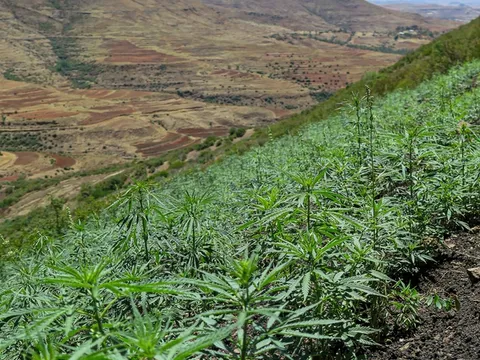 LanguageMatekoaneThe Sesotho word for cannabis connects generations of Basotho smallholder cultivation with South Africa’s market and Lesotho’s newer licensed medical industry.
Datasets not part of the score
What other organisations publish about Lesotho, and where it stands among the countries each one covers. Each dataset has a page of its own, with a world map and every country's figure.
Use
UNODC
Cannabis use
3.07%of people aged 15–64 (assumed)
45,000 people · computed here: the median of surveyed countries in the region, or the figure of the country a territory is part of
Source Survey ages and years vary, and some surveys include children. Rates are not age-standardised; do not compare countries directly.WHO, Our World in Data · 2020
Alcohol drunk per person
4.30litres of pure alcohol a year
3.76 · 20003.76 · 20013.70 · 20023.65 · 20033.65 · 20043.65 · 20053.67 · 20063.71 · 20073.79 · 20083.63 · 20093.39 · 20103.07 · 20112.98 · 20123.04 · 20133.24 · 20143.28 · 20153.38 · 20164.07 · 20174.54 · 20184.54 · 20194.30 · 202020002020 Higher than 50% of 187 countriesLowestHighestper person aged 15 or over · 2020 · 3.76 in 2000 · 3.39 in 2010
Law
UNODC · 2024
Cannabis seized
6,670kg in 2024
2,798 · 20211,342 · 20222,175 · 20236,670 · 202420212024 Higher than 61% of 163 countriesLess seizedMore seized6,670 kg of herb
Society
OpenAlex · 2024
Research on cannabis
0.4papers per million people
0.4 · 19920.4 · 20210.8 · 20230.4 · 202419922024 Higher than 40% of 176 countriesLowestHighest1 papers in 2024
Cato and Fraser Institutes · 2023
Human Freedom Index
6.59of 10
5.97 · 20006.31 · 20016.23 · 20026.10 · 20036.49 · 20046.38 · 20056.36 · 20066.20 · 20076.26 · 20086.25 · 20096.24 · 20106.30 · 20116.41 · 20126.76 · 20136.80 · 20146.85 · 20156.64 · 20166.71 · 20176.67 · 20186.72 · 20196.45 · 20206.41 · 20216.63 · 20226.59 · 202320002023 Higher than 41% of 164 countriesLess freeFreerrank #97 of 165 · personal freedom 7.05 · economic freedom 5.96
V-Dem, Our World in Data · 2025
Civil liberties
0.83of 1 in 2025
0.23 · 19000.23 · 19010.23 · 19020.23 · 19030.23 · 19040.23 · 19050.23 · 19060.23 · 19070.23 · 19080.23 · 19090.23 · 19100.23 · 19110.23 · 19120.23 · 19130.23 · 19140.23 · 19150.23 · 19160.23 · 19170.23 · 19180.23 · 19190.23 · 19200.23 · 19210.23 · 19220.23 · 19230.23 · 19240.23 · 19250.23 · 19260.23 · 19270.23 · 19280.23 · 19290.23 · 19300.23 · 19310.23 · 19320.23 · 19330.23 · 19340.23 · 19350.23 · 19360.23 · 19370.23 · 19380.23 · 19390.23 · 19400.23 · 19410.23 · 19420.23 · 19430.23 · 19440.23 · 19450.23 · 19460.23 · 19470.23 · 19480.23 · 19490.24 · 19500.24 · 19510.27 · 19520.27 · 19530.27 · 19540.27 · 19550.27 · 19560.27 · 19570.27 · 19580.27 · 19590.31 · 19600.32 · 19610.32 · 19620.32 · 19630.32 · 19640.34 · 19650.53 · 19660.53 · 19670.53 · 19680.53 · 19690.35 · 19700.34 · 19710.34 · 19720.34 · 19730.34 · 19740.34 · 19750.34 · 19760.34 · 19770.34 · 19780.36 · 19790.36 · 19800.36 · 19810.36 · 19820.36 · 19830.36 · 19840.36 · 19850.39 · 19860.46 · 19870.46 · 19880.46 · 19890.50 · 19900.51 · 19910.54 · 19920.72 · 19930.73 · 19940.74 · 19950.74 · 19960.74 · 19970.73 · 19980.76 · 19990.76 · 20000.76 · 20010.76 · 20020.76 · 20030.76 · 20040.76 · 20050.76 · 20060.76 · 20070.77 · 20080.77 · 20090.79 · 20100.79 · 20110.79 · 20120.79 · 20130.79 · 20140.71 · 20150.68 · 20160.70 · 20170.76 · 20180.75 · 20190.81 · 20200.81 · 20210.84 · 20220.81 · 20230.79 · 20240.83 · 202519002025 Higher than 63% of 175 countriesFewer libertiesMore liberties0.23 in 1925 · 0.32 in 1961 · 0.50 in 1990
Our World in Data, World Bank · 2025
Population
2,363,325people in 2025
249,213 · 1900281,353 · 1910320,591 · 1920393,273 · 1930480,202 · 1940579,554 · 1950736,507 · 19601,019,273 · 19701,406,530 · 19801,809,698 · 19902,003,919 · 20001,996,256 · 20102,235,727 · 20202,363,325 · 202519002025 Higher than 27% of 196 countriesLowestHighest249,213 in 1900 · 579,554 in 1950 · 2,003,919 in 2000
CEPII
Former colonial rulers
Once ruled by United Kingdom
World Bank · 2025
Government effectiveness
39of 100
57 · 199656 · 199856 · 200056 · 200257 · 200344 · 200448 · 200543 · 200642 · 200746 · 200848 · 200948 · 201048 · 201146 · 201245 · 201344 · 201443 · 201542 · 201641 · 201741 · 201841 · 201939 · 202040 · 202138 · 202237 · 202340 · 202439 · 202519962025 Higher than 26% of 195 countriesLowestHighestestimate -0.64 on a scale of −2.5 to 2.5 · 2025 · 56 in 2000 · 43 in 2015
Transparency International · 2024
Corruption Perceptions Index
37of 100
45 · 201249 · 201349 · 201444 · 201539 · 201642 · 201741 · 201840 · 201941 · 202038 · 202137 · 202239 · 202337 · 202420122024 Higher than 43% of 178 countriesLowestHighest0 highly corrupt, 100 very clean · 2024 · 44 in 2015 · 41 in 2020
Pew Research Center · 2020
Most common religion
Christians
the largest group · 2020
World Bank · 2025
Income per person
$2,721per person
1,422 · 19901,494 · 19911,572 · 19921,603 · 19931,676 · 19941,710 · 19951,786 · 19961,838 · 19971,857 · 19981,861 · 19991,932 · 20002,004 · 20012,025 · 20022,127 · 20032,179 · 20042,275 · 20052,381 · 20062,470 · 20072,589 · 20082,538 · 20092,651 · 20102,749 · 20112,894 · 20122,914 · 20132,931 · 20142,987 · 20153,057 · 20162,925 · 20172,846 · 20182,773 · 20192,517 · 20202,545 · 20212,578 · 20222,592 · 20232,698 · 20242,721 · 202519902025 Higher than 8% of 187 countriesLowestHighestat purchasing power parity, 2021 dollars · 2025 · $1,422 in 1990 · $2,651 in 2010
World Bank · 2024
Development indicators
51.8%use the internet
0% · 19900% · 19960% · 19970% · 19980.1% · 19990.2% · 20000.3% · 20011.1% · 20021.5% · 20032.2% · 20042.6% · 20053% · 20063.4% · 20073.6% · 20083.7% · 20093.9% · 20107% · 201110% · 201215% · 201322% · 201425% · 201532.5% · 201639% · 201740.8% · 201842.3% · 201943.7% · 202045.1% · 202148.1% · 202249% · 202351.8% · 202419902024 Higher than 26% of 195 countriesLowestHighest43.7% live in towns · 3.9% aged 65+ · life expectancy 57.8 · 2024 · 0.2% in 2000 · 3.9% in 2010
GDELT · 2025
Cannabis in the news
0%of global news: cannabis articles from here
0% · 20170% · 20180% · 20190% · 20200% · 20210% · 20220% · 20230% · 20240% · 202520172025 Higher than 0% of 147 countriesLowestHighest2025 average, 348 days · 0% in 2018 · 0% in 2021
Plant and market
GBIF · 2026
Records of the cannabis plant
19dated records
1 · 19992 · 20227 · 202417 · 202519 · 202619992026 Higher than 55% of 128 countriesLowestHighest2 more without a date · 2 in 2026
Enforcement 3 reports · the Cannabis Enforcement Tracker →
How the law above is applied: raids, seizures, fields destroyed, arrests and sentences, as recorded by the Cannabis Enforcement Tracker, our companion site.
- ProsecutionLesotho court dismisses the Srugo cannabis case
The criminal case against Tom Srugo under section 9(1)(a)–(b) read with section 6 was dismissed for lack of prosecution, and a court order directed the return of 337 plants and 4 kg seized from his Thetsane residence in 2024.
- SeizureSouth African pilots intercepted with 500 kg of cannabis
A Federal Airlines aircraft landed unlawfully at Moshoeshoe I airport with 500 kg of cannabis from Thailand, allegedly destined for South Africa.
- SeizurePolice seize a licensed cannabis import at Moshoeshoe I airport
Banel (Pty) Ltd imported 500 kg of dried cannabis flower from Thailand under a permit dated 27 February 2026; police seized it without producing a warrant.
History 15 of 15 checked against a source
Score and entries per decade
11 today, from 100 before its first recorded change
This country's score Entries that moved the score Context only
20251 entry0 score changes
20241 entry0 score changes
20181 entry0 score changes
20171 entry0 score changes
20081 entry0 score changes
19951 entry0 score changes
19811 entry0 score changes
19741 entry0 score changes
19731 entry0 score changes
19661 entry0 score changes
19551 entry0 score changes
19511 entry1 score change
19451 entry1 score change
19311 entry0 score changes
19221 entry1 score change
Sources hover a number in the text to see its source
- Cited
- 11
- Websites
- 9
- 1
- Last reviewed
- History checked
- 15/15
Most cited
- lesotholii.org2
- data.unodc.org1
- documents.un.org1
- incb.org1
- pmc.ncbi.nlm.nih.gov1
- sundayexpress.co.ls1
All 11 sources
- United Nations — Survey of the cannabis situation in Basutoland, E/CN.7/286/Add.1 (1955)Cannabis known locally as dagga or matekoane (p. 6); section 7 penalties as amended by Proclamation 58 of 1951 (pp. 18–19). Read in the local PDF extraction.archived
- Lesotho — Drugs of Abuse Act 5 of 2008Sections 3, 9, 43, 44, 87–89 and 105–108.archived
- Sub-Saharan Africa, Cannabis, and Contemporary Drug PolicyNeil Carrier · In Cannabis: Global Histories, edited by Lucas Richert, James H. Mills · MIT Press · 2021 · pp. 325–330. · ISBN 9780262366137
- UNODC World Drug Report 2026 — drug-related crimes annex2024: 105 people in formal contact; 88 prosecuted, all drugs.archived
- Thetsane — The legal cannabis industry in Lesotho, Journal of Cannabis Research 6:23 (16 May 2024)33 licences, eight companies, one GMP exporter; no local patient access.archived
- Lesotho — Drugs of Abuse (Cannabis) Regulations 2018, Legal Notice 40 of 2018Gazette Vol. 63 No. 37, 18 May 2018; licensing and seed-to-sale rules.
- Mayet & Associates — Lesotho publishes the 2025 cannabis regulations amendment (7 November 2025)Legal Notice 155 of 2025; fees and permit changes.archived
- UNODC Data Portal — Drug seizures, reported seizures in kilogram equivalentsarchived
- Lesotho — Road Traffic Act 8 of 1981Sections 92–94.archived
- Sunday Express — Israeli farmer demands cannabis back (25 October 2026)337 plants and 4 kg; case dismissed 2 June 2026; plants not returned.archived
- International Narcotics Control Board — Travellers carrying medicines containing controlled substances