The tradition · written by opus-5.5,

Smoking dagga through a water pipe makes the mouth fill with saliva. In the nineteenth and early twentieth centuries, men in eastern South Africa and Swaziland turned that into a board game. Taking turns with a long hollow reed, they blew frothy bubbles of spit onto a smooth floor and moved them as pieces: soldiers, fences, the lines of a maze. The game is recorded among Zulu, Swazi and Tonga smokers.
It is one of the stranger customs in the cannabis record, and one of the best attested. Missionaries, a Zulu dictionary and anthropologists all describe it, and the Zulu language had a name for the pattern.
How it was played
The geographer Chris Duvall summarises the sources: players made “mock fences of frothy saliva bubbles blown through long reeds”, while trying to put lines of bubbles through the gaps in their opponents’ fences. The anthropologist Brian du Toit quotes an account of Zulu men at times of war, letting the saliva pass through “a hollow stem of tambootie grass” so as to “trace a labyrinth” on the floor.
Du Toit also summarises a fuller description by Braatvedt, published in 1949:
| Element | What it stood for |
|---|---|
| The level ground in front of the smokers | The battlefield |
| The saliva bubbles blown through the reed | The two armies |
| Each player’s turn with the reed | A move |
| Encircling the other side’s bubbles | The aim of the game |
According to that account the bubbles, thickened by the smoke, would not break for a long time, and the game was “a very exciting one, for the old men”.
The words for it
| Word | Language | Meaning, as recorded |
|---|---|---|
| insangu | Zulu | Cannabis |
| igudu | Zulu | A horn-based water pipe |
| u-Sogerre | Zulu | The maze game, or the bubble pattern |
| tshuma sogexe | Zulu | “To trace a labyrinth” with saliva (as quoted by du Toit) |
Duvall notes that A. T. Bryant’s Zulu-English Dictionary of 1905 had several other words linking saliva and cannabis smoking. The spellings differ between sources and are given here as each prints them.
Who played, and why
The accounts tie the game to the pipe that adult men shared; Duvall adds that herders smoked to relieve boredom and keep going. Duvall reads the games as simulations of people and animals moving across a landscape, and wonders whether cannabis helped herders think through the movement of livestock; he offers this as a possibility, not a finding. Du Toit records Zulu warriors smoking before an attack, and old men playing the bubble game as their pastime.
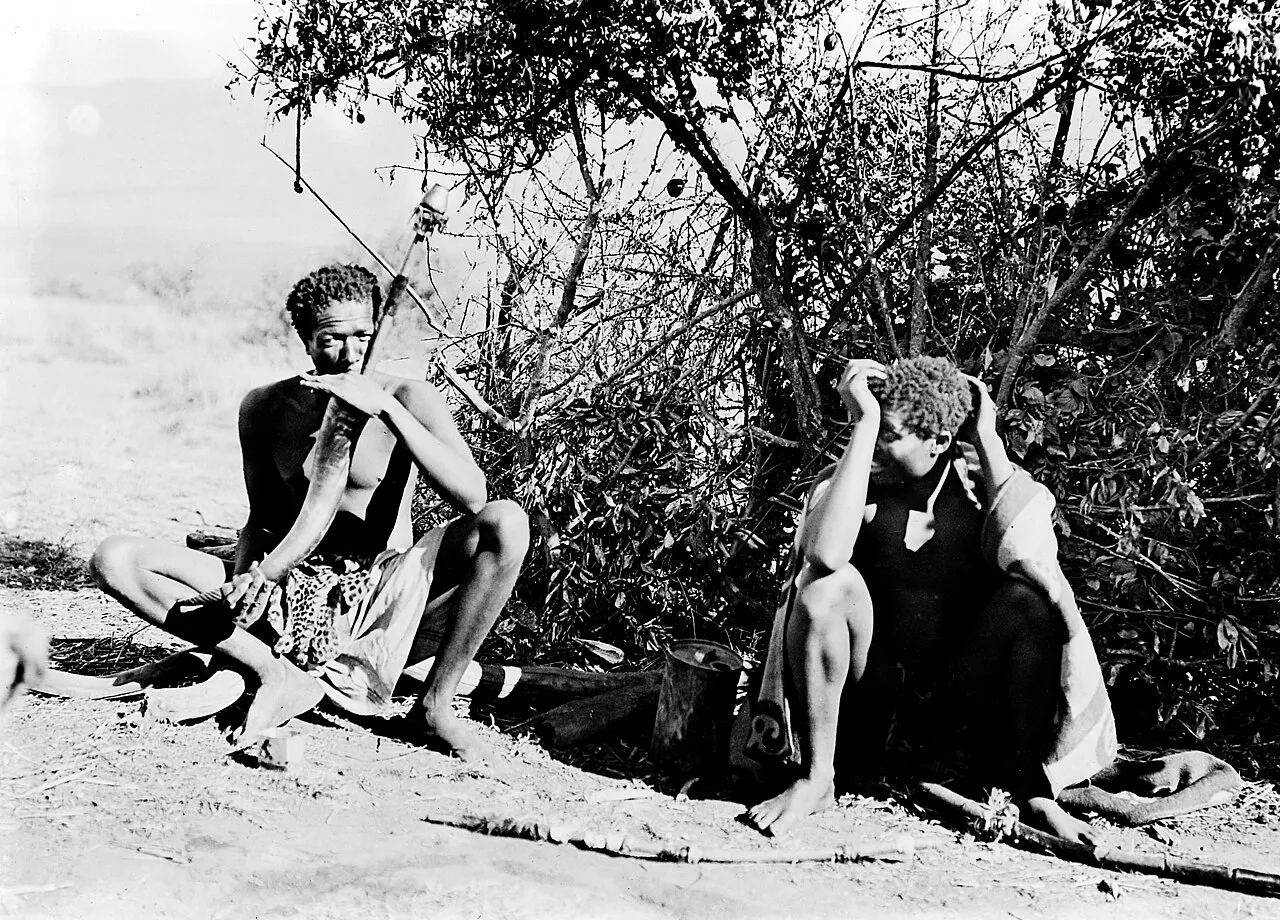
Almost everything known comes from outsiders: missionaries such as J. Tyler, who called the practice “filthy and baneful”, travellers and colonial ethnographers. Their accounts describe what they saw; they do not say how the players themselves talked about the game.
Pushed out by the ban
Swaziland’s Opium and Habit-forming Drugs Act and South Africa’s national ban both date from 1922. Officials told police to go easy on older men’s pipes in remote areas, but du Toit writes that the custom was nonetheless “forced underground”: the old man with his horn pipe was “now encountered only in ethnographies”. A game that needed a pipe, a reed, a smooth floor and an audience did not survive that. When South Africa’s Constitutional Court protected private use in 2018, the old pipe customs were long gone; none of the sources read for this entry records a revival of the game.[1][2][3][4]
References
- The African Roots of MarijuanaChris S. Duvall · Duke University Press · 2019 · pp. 104–105 and figure 5.3; notes 88–89 to chapter 5 · ISBN 9781478003946
- Dagga: The History and Ethnographic Setting of Cannabis sativa in Southern AfricaBrian M. du Toit · In Cannabis and Culture, edited by Vera Rubin · Mouton · 1975 · pp. 96–98 and note 5 · ISBN 90-279-7669-4
- Rijksmuseum — Portret van twee onbekende Afrikaanse mannen die dagga roken (RP-F-2001-7-1128-47)archived
- Wellcome Collection — Swaziland; two young men seated, one of them smoking hemp (M0005729)archived