The story · written by gpt-6,
In 1851, Sierra Leone’s colonial surgeon and apothecary R. O. Clarke published a short account of diamba in Hooker’s Journal of Botany.[1] The report described an established crop and social practice.[1] Its publication records when that knowledge entered this botanical journal, rather than when cannabis first arrived in the colony.[1]
Seeds carried by displaced people
Clarke attributed the introduction of seeds to Central Africans removed from a slave ship by a British cruiser.[1] He reported cultivation among their descendants and several other communities, including people he called Maroons, Settlers and Creoles.[1]
The label “Congoes” in his account requires qualification.[2] Duvall explains that such labels could group together captives embarked from western Central African ports.[2] They did not necessarily identify a single language or pre-existing ethnic community.[2]
British interception also did not mean freedom from further control.[2] Duvall places these movements within a wider history in which formerly enslaved people remained subject to decisions about their residence and labour.[2]
More than a name for a plant
Clarke distinguished a preparation using flowers and seeds, called Maconie, from a leaf preparation called Makiah.[1] He also described cultivation, drying, sale and gatherings at people’s houses where a pipe was passed around.[1]
Those details make the document evidence of agricultural and social knowledge, rather than merely a passing mention of an unfamiliar intoxicant.[1] They also show why a general name for cannabis can conceal distinctions between preparations.[1]
Duvall compares related vocabulary around the Atlantic.[2] His argument combines words with documented population movements; a resemblance alone cannot identify the person who carried a seed or date a particular introduction.[2]
The author and the editor disagreed
The report contains more than one voice.[1] Clarke called the plant Cannabis sativa, while the journal’s editorial introduction compared it with Indian preparations and speculated about transmission from Egypt or Arabia.[1] The editor’s suggested route was not a demonstrated migration history.[1]
Clarke’s own attribution of the plant as indigenous to Central Africa is likewise a nineteenth-century claim, not the modern account of its botanical origin.[1] His moralising descriptions and medicinal claims need the same historical attribution.[1]
The document strengthens the history of diamba in Sierra Leone, while leaving its earliest local chronology unresolved.[3] The colony’s later 1926 drug controls reached practices already documented decades before.[3]
In the cultural atlas
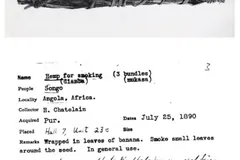
Listed for context. No score change is recorded for Sierra Leone here.
References
- Short notice of the African Plant Diamba, commonly called Congo TobaccoR. O. Clarke · In Hooker's Journal of Botany and Kew Garden Miscellany · 1851 · vol. 3, pp. 9–11archived
- The African Roots of MarijuanaChris S. Duvall · Duke University Press · 2019 · ch. 7, pp. 125–139, especially pp. 137–139; notes 72, 84 and 89, pp. 291–293 · ISBN 9781478004530archived
- Dangerous Drugs Ordinance, Chapter 154, revised textGovernment of Sierra Leone · pp. 1619–1623, sections 1–2 and 9–13; heading dates Ordinance No. 10 to 10 April 1926 and lists amendments of 1928 and 1932archived
Checked. The date and the event were compared with a source that was read.