Rwanda
6/100
#155 of 196 worldwide
#42 of 54 in Africa
Cannabis sits in the highest drug category. Caught use or possession carries one to two years or community service; supply, transport, storage and production carry life imprisonment with a fine of more than 20 million and up to 30 million francs, subject to mitigation down to at least fifteen years. A licensing regime for medical cannabis exists but no patient supply was found.
In short all countries →
- Can I carry it?NoIt is a crime
- Can I grow it?NoIt is a crime
- Can I buy it?NoThere is no legal source
- Can I use it in public?NoNot in public, and even at home the law does not protect it
- What if I'm caught?PrisonPersonal use can lead to prison or compulsory detention
A rough guide read from the scores and the rules below, not legal advice. The details and the exceptions are in each segment: select an answer to jump to it.
Cannabis in Rwanda not part of the score · all 12 datasets ↓
Who uses it
Perhaps 1 in 33
people aged 15–64 (assumed) in Rwanda used cannabis in the past year: about 260,000 people.
- Past year
- 3.1%
- Africa median
- 3.1%
This site’s estimate: there is no national survey.
Source Past-year cannabis use among people aged 15–64 (assumed). This site's figure: there is no national survey, so the median rate of surveyed countries in Africa is applied to people aged 15–64.Survey ages and years vary, and some surveys include children. Rates are not age-standardised; do not compare countries directly.
A median computed on this site from surveyed countries in Africa, using UNODC World Drug Report 2026 figures. Population from the World Bank, aged 15–64. The whole dataset →
Cannabis in figures
The dot: where it stands among the countries each dataset covers, lowest to highest. All datasets ↓
What they call it
- Injaga[1]Kinyarwandacannabis, recorded by Codere in 1959–60 fieldwork
Score breakdown 6/100 · how the scores are made
The drug offence as amended in 2019 expressly covers being caught with narcotics or psychotropic substances, alongside use.[2] Its stated penalty is one to two years in prison or community service.[2] General sentencing rules adopted in 2023 let judges halve fixed terms of at least six months and quarter fines when mitigating circumstances are accepted.[3]
| Amount | What happens | Punishment | Fine |
| Caught with or using narcoticsOr community service. Mitigation can halve the term | CriminalDrug use or possession | 1–2 years | — |
Growing cannabis requires a licence for medical or research purposes under the 2021 order.[4] Unauthorised production falls within the criminal law's highest drug category, which specifies life imprisonment and a fine of more than 20 million and up to 30 million francs.[2][5] General mitigating-circumstance rules allow life imprisonment to be reduced to at least fifteen years.[3]
| Amount | What happens | Punishment | Fine |
| Unlicensed production (Category I drugs)Life imprisonment. Mitigation possible under the 2023 rules | CriminalProduction | Life imprisonment possible | RWF 20,000,000 – RWF 30,000,000 |
Community service is an express alternative to imprisonment for possession or use.[2] The government's 2014 report to the UN counted 1,910 people incarcerated in 2011 for smoking cannabis; that is historical evidence of imprisonment, not a current sentencing rate.[6] The 2023 general rules widened judges' powers to reduce sentences.[3]
Unauthorised giving to another person is included alongside production, transport, storage and sale.[2] Cannabis is in the highest drug category, whose statutory tariff is life imprisonment and a fine of more than 20 million and up to 30 million Rwandan francs.[2][5] The 2023 general rules allow mitigation, including reducing life imprisonment to at least fifteen years.[3]
| Amount | What happens | Punishment | Fine |
| Giving, selling, transporting or storing (Category I drugs)Life imprisonment. Mitigation possible under the 2023 rules | CriminalSupply | Life imprisonment possible | RWF 20,000,000 – RWF 30,000,000 |
Illicit consumption remains a criminal offence.[2] The stated punishment is one to two years in prison or community service, with general judicial powers to reduce or suspend qualifying sentences under the 2023 amendments.[2][3]
| Amount | What happens | Punishment | Fine |
| Using narcoticsOr community service. Mitigation can halve the term | CriminalDrug use | 1–2 years | — |
The 2021 order permits medical use on prescription by a doctor with written health-ministry authority and requires registration of finished products.[4] No cannabis or cannabinoid medicine was found in the FDA's published September 2026 pharmaceutical register.[7] Practical patient supply, including exceptional imports, was not established in this review.[7]
Context not part of the score · every country, by topic →
Cannabis is prohibited and the penalties are severe, yet police keep intercepting large cross-border loads: in December 2017 they seized 400 kg trafficked from DR Congo on the Rubavu–Nyabihu road, as that seizure records.[8] Rubavu in the west and Kirehe in the east are marked as major cannabis trafficking routes, and Rwanda runs joint operations with Tanzania against cross-border trafficking and farm destruction.[8] Use persists: the government counted 1,910 people jailed for smoking cannabis in 2011.[6]
Medical use requires a prescription from a doctor whom the health ministry has authorised in writing to prescribe cannabis.[4] The reviewed September 2026 pharmaceutical register contained no cannabis or cannabinoid medicine; prescribing rules alone do not establish patient supply.[7]
No cannabis clubs are known. Unauthorised growing, transport, storage and supply remain criminal offences in the highest drug category.[2]
The 2021 ministerial order defines cannabis to include its seeds for agricultural purposes and lists eight licences and permits.[4] A cultivation licence covers developing genetic material, and separate import and export permits are required for seeds, genetic materials and other planting material.[4] Everything is confined to medical or research use.[4]
No Rwandan law sets a THC line for hemp: cannabis sits in Category I of very severe drugs, and the 2021 order licenses only medical or research growing.[5][4] No fibre, food or CBD regime appears in the sources reviewed.[4]
The 2021 order licenses medical and research cannabis cultivation and processing.[4] In May 2025, the development board reported off-site infrastructure for the Musanze project 83% complete, with fencing still outstanding;(/history/rwanda-medical-cannabis-site-2025/) reporting described the licensed private producer's plans as aimed mainly at cannabis oils for export.[9]
Rwanda is a destination for Congolese cannabis: police say the narcotics in the December 2017 seizure were trafficked from DR Congo, and mark Rubavu and Kirehe as major trafficking routes.[8] Joint Rwanda–Tanzania operations target cross-border trafficking and destroy cannabis farms along the Kagera.[8]
There is no recreational supply route in the reviewed laws.[4] The possession and use offence states one to two years in prison or community service; authorised medical use requires a prescription from a doctor with written health-ministry authority.[2][4]
The government told the UN Human Rights Committee in 2014 that 1,910 people had been incarcerated in 2011 for smoking cannabis.[6] It separately recorded 2,402 arrests connected with banned substances across 2011–2012.[6] These are historical counts, and the latter figure covers drugs generally.[6]
Community service is a criminal sentence.[3] Under the 2023 general rules, deliberate failure to carry it out properly requires the remaining sentence to be served in a correctional facility.[3]
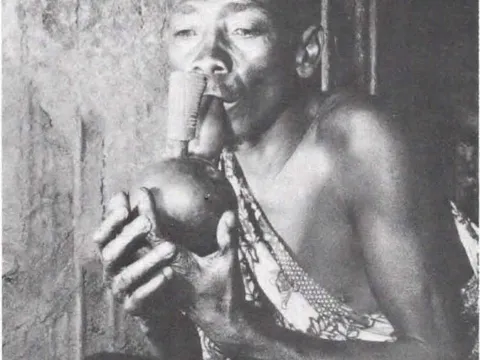
In Rwanda cannabis is injaga, and Codere's 1959–60 photo survey found its use virtually confined to Twa men.[1] They smoked it in the urumogi gourd water-pipe, with deep inhalations that made the water bubble loudly, expecting strong doses to produce violence — an expectation users and onlookers shared.[1] Condemnation was near-universal: 99 of 113 respondents opposed it, a stance the 1960 confinement findings record.[1]
Taking cannabis into or out of Rwanda is a separate offence from possessing it, normally charged as smuggling or trafficking, with far heavier penalties. That holds almost everywhere, including between two places where cannabis is legal.
A prescription or medical card from another country is generally not recognised. Travellers who need a cannabis-based medicine should ask Rwanda's embassy before travelling.[10]
General guidance that applies to almost every country, not a check of Rwanda's customs rules.
Culture the atlas →
Did you know? all cases →
2021 · Rwanda
Rwanda licenses companies to grow cannabis for export. For anyone else, producing or selling it carries twenty years to life.
The full story →
Datasets not part of the score
What other organisations publish about Rwanda, and where it stands among the countries each one covers. Each dataset has a page of its own, with a world map and every country's figure.
Use
UNODC
Cannabis use
3.07%of people aged 15–64 (assumed)
260,000 people · computed here: the median of surveyed countries in the region, or the figure of the country a territory is part of
Source Survey ages and years vary, and some surveys include children. Rates are not age-standardised; do not compare countries directly.WHO, Our World in Data · 2020
Alcohol drunk per person
2.87litres of pure alcohol a year
1.43 · 20001.43 · 20011.42 · 20021.37 · 20031.38 · 20041.40 · 20051.40 · 20061.32 · 20071.25 · 20081.26 · 20091.25 · 20101.26 · 20111.25 · 20121.30 · 20131.36 · 20141.37 · 20151.36 · 20161.34 · 20171.88 · 20181.88 · 20192.87 · 202020002020 Higher than 36% of 187 countriesLowestHighestper person aged 15 or over · 2020 · 1.43 in 2000 · 1.25 in 2010
Society
OpenAlex · 2025
Research on cannabis
0.4papers per million people
0.1 · 20150.1 · 20190.1 · 20200.1 · 20210.1 · 20220.4 · 20240.4 · 202520152025 Higher than 39% of 176 countriesLowestHighest6 papers in 2025
Cato and Fraser Institutes · 2023
Human Freedom Index
5.67of 10
5.58 · 20005.36 · 20015.66 · 20025.74 · 20035.65 · 20045.85 · 20055.95 · 20066.08 · 20075.91 · 20085.92 · 20096.02 · 20105.98 · 20116.03 · 20126.04 · 20136.07 · 20146.19 · 20156.06 · 20166.14 · 20176.19 · 20186.08 · 20195.79 · 20205.82 · 20215.80 · 20225.67 · 202320002023 Higher than 24% of 164 countriesLess freeFreerrank #125 of 165 · personal freedom 5.16 · economic freedom 6.37
V-Dem, Our World in Data · 2025
Civil liberties
0.19of 1 in 2025
0.11 · 19160.11 · 19170.11 · 19180.11 · 19190.11 · 19200.11 · 19210.11 · 19220.11 · 19230.11 · 19240.11 · 19250.11 · 19260.11 · 19270.11 · 19280.11 · 19290.11 · 19300.11 · 19310.12 · 19320.12 · 19330.12 · 19340.12 · 19350.12 · 19360.12 · 19370.12 · 19380.12 · 19390.12 · 19400.12 · 19410.12 · 19420.12 · 19430.13 · 19440.13 · 19450.13 · 19460.13 · 19470.13 · 19480.13 · 19490.13 · 19500.13 · 19510.12 · 19520.12 · 19530.12 · 19540.12 · 19550.13 · 19560.15 · 19570.17 · 19580.16 · 19590.20 · 19600.24 · 19610.28 · 19620.33 · 19630.32 · 19640.32 · 19650.32 · 19660.33 · 19670.33 · 19680.32 · 19690.33 · 19700.33 · 19710.33 · 19720.33 · 19730.25 · 19740.25 · 19750.25 · 19760.25 · 19770.28 · 19780.29 · 19790.29 · 19800.29 · 19810.29 · 19820.29 · 19830.29 · 19840.29 · 19850.29 · 19860.29 · 19870.29 · 19880.29 · 19890.27 · 19900.32 · 19910.35 · 19920.34 · 19930.24 · 19940.26 · 19950.28 · 19960.29 · 19970.29 · 19980.31 · 19990.38 · 20000.38 · 20010.38 · 20020.38 · 20030.37 · 20040.37 · 20050.37 · 20060.37 · 20070.37 · 20080.37 · 20090.36 · 20100.37 · 20110.38 · 20120.39 · 20130.40 · 20140.40 · 20150.31 · 20160.26 · 20170.30 · 20180.32 · 20190.27 · 20200.23 · 20210.23 · 20220.19 · 20230.18 · 20240.19 · 202519162025 Higher than 7% of 175 countriesFewer libertiesMore liberties0.11 in 1925 · 0.24 in 1961 · 0.27 in 1990
Our World in Data, World Bank · 2025
Population
14,569,341people in 2025
1,515,744 · 19001,401,547 · 19101,357,035 · 19201,556,456 · 19301,793,986 · 19402,157,101 · 19503,022,300 · 19603,980,673 · 19705,353,263 · 19807,375,313 · 19908,213,936 · 200010,317,560 · 201013,065,838 · 202014,569,341 · 202519002025 Higher than 61% of 196 countriesLowestHighest1,515,744 in 1900 · 2,157,101 in 1950 · 8,213,936 in 2000
CEPII
Former colonial rulers
Once ruled by Belgium and Luxembourg; Germany
World Bank · 2025
Government effectiveness
60of 100
25 · 199624 · 199824 · 200023 · 200223 · 200338 · 200438 · 200544 · 200644 · 200748 · 200848 · 200951 · 201052 · 201152 · 201254 · 201353 · 201453 · 201557 · 201660 · 201759 · 201857 · 201957 · 202056 · 202158 · 202259 · 202359 · 202460 · 202519962025 Higher than 66% of 195 countriesLowestHighestestimate 0.36 on a scale of −2.5 to 2.5 · 2025 · 24 in 2000 · 53 in 2015
Transparency International · 2024
Corruption Perceptions Index
57of 100
53 · 201253 · 201349 · 201454 · 201554 · 201655 · 201756 · 201853 · 201954 · 202053 · 202151 · 202253 · 202357 · 202420122024 Higher than 75% of 178 countriesLowestHighest0 highly corrupt, 100 very clean · 2024 · 54 in 2015 · 54 in 2020
Pew Research Center · 2020
Most common religion
Christians
the largest group · 2020
World Bank · 2025
Income per person
$3,559per person
1,166 · 19901,114 · 19911,155 · 19921,022 · 1993597 · 1994967 · 1995922 · 1996908 · 1997948 · 1998982 · 19991,055 · 20001,135 · 20011,267 · 20021,267 · 20031,326 · 20041,412 · 20051,502 · 20061,574 · 20071,704 · 20081,765 · 20091,847 · 20101,946 · 20112,064 · 20122,110 · 20132,176 · 20142,313 · 20152,387 · 20162,441 · 20172,578 · 20182,754 · 20192,618 · 20202,776 · 20212,983 · 20223,168 · 20233,325 · 20243,559 · 202519902025 Higher than 13% of 187 countriesLowestHighestat purchasing power parity, 2021 dollars · 2025 · $1,166 in 1990 · $1,847 in 2010
World Bank · 2024
Development indicators
31.7%use the internet
0% · 19900% · 19960% · 19970% · 19980.1% · 19990.1% · 20000.2% · 20010.3% · 20020.4% · 20030.4% · 20040.6% · 20052.1% · 20074.5% · 20087.7% · 20098% · 20107% · 20118% · 20129% · 201310.6% · 201412.5% · 201514.6% · 201617.2% · 201719.2% · 201821.4% · 201923.8% · 202024.4% · 202128% · 202228.8% · 202331.7% · 202419902024 Higher than 14% of 195 countriesLowestHighest29.9% live in towns · 3.9% aged 65+ · life expectancy 68 · higher education 9.4% · 2024 · 0.1% in 2000 · 8% in 2010
Enforcement 1 report · the Cannabis Enforcement Tracker →
How the law above is applied: raids, seizures, fields destroyed, arrests and sentences, as recorded by the Cannabis Enforcement Tracker, our companion site.
- SeizurePolice seize 400 kg of cannabis trafficked from DR Congo
Police intercepted a car on the Rubavu–Nyabihu road carrying 320 kg of cannabis and a motorcycle in Rubavu carrying 80 kg, after residents tipped them off.
History 14 of 15 checked against a source
Entries per decade
Entries that moved the score Context only
20251 entry0 score changes
20231 entry0 score changes
20211 entry0 score changes
20192 entries0 score changes
Other law ✓ Article
Rwanda expressly includes possession in its drug-use offence
Rwanda’s amended drug offence expressly covered being caught with narcotics or psychotropic substances, alongside consuming them, from 29 November 2019. The clause retained one to two years in prison or community service, an alternative already written into the 2018 law. Separate production and supply offences kept their much heavier tariffs, including a statutory life sentence for the highest category.
Other law ✓
Rwanda places cannabis in its highest drug category
Rwanda’s health ministry expressly listed cannabis with cocaine, heroin and opium in the highest narcotics category when its classification order took effect on 11 March 2019. The 2018 criminal law tied that category to a statutory life sentence and a fine for unlawful production and supply activities. The order also allowed controlled medical and research use under the drug-control law.
20181 entry0 score changes
20141 entry0 score changes
20122 entries0 score changes
Other law ✓ Article
Rwanda sets prison plus a fine for illicit drug use
Rwanda’s replacement criminal code specified one to three years in prison and a fine of 50,000 to 500,000 francs for illicit drug use from 14 June 2012. The 1977 code had allowed a fine alone, with a wider prison range of three months to five years. Making, transforming, importing or selling drugs unlawfully carried three to five years and a fine, with doubled penalties for international acts.
Other law ✓
Rwanda sets authorisation rules for medical and research drugs
Rwanda required authorisation for producing, distributing and using controlled drugs for medical or research purposes, with record keeping and controls on cross-border trade. The law took effect on 9 April 2012 and directed the health minister to set security and authorisation rules. That power later supported the cannabis licensing order issued in 2021.
20021 entry0 score changes
19811 entry0 score changes
19771 entry0 score changes
19711 entry0 score changes
19601 entry0 score changes
Date not known1 entry1 score change
Sources hover a number in the text to see its source
- Cited
- 10
- Websites
- 8
- Last reviewed
- History checked
- 14/15
Most cited
- minijust.gov.rw3
- archive.org1
- incb.org1
- moh.gov.rw1
- monitoring.rwandafda.gov.rw1
- police.gov.rw1
All 10 sources
- Helen Codere — Social and Cultural Context of Cannabis Use in Rwanda (1975), chapter in Rubin (ed), Cannabis and CulturePrinted pp. 217–226. In Rwanda the drug is injaga; found confined to Twa men; urumogi gourd water-pipe; 99 of 113 Rwandan male interviewees against allowing use. Passages read in the local PDF of the Rubin volume.
- Minijust Rwanda — consolidated penal code with 2019 drug amendments (PDF)Articles 257–264 (2018 code), Article 11 (2019 amendment). Use and possession: one to two years or community service. Highest-category supply and production: life imprisonment, fine above 20 to 30 million.archived
- Minijust Rwanda — 2023 penal code amendments on fines, mitigation and community service (PDF gazette extract).Articles 1–3, 23. Mitigation: life to at least 15 years; fixed terms halved; fines quartered. Wilful community-service failure: remainder served in custody.archived
- RLRC — cannabis order, consulted in 2024 (copy)archived
- Rwanda — 2019 narcotics categorisation order (Ministry of Health, PDF)Articles 1–4. Cannabis, cannabis oil and cannabis resin in Category I (very severe narcotic drugs). THC and cannabis oil in the Schedule I psychotropics list.archived
- Rwanda — 2014 report to the UN Human Rights Committee (PDF)Paras 166–167. 1,910 incarcerations for cannabis smoking in 2011; 2,402 all-drug arrests in 2011–12; treaty ratification dates.archived
- Rwanda FDA — human medicines register (consulted list, September 2026 edition)Full HTML table downloaded 27 October 2026: over 2,600 rows; searched cannabis, cannabidiol, tetrahydrocannabinol, dronabinol, nabilone, nabiximols, Sativex, Epidiolex and Epidyolex; no matches; does not cover individual exceptional imports.archived
- Rwanda National Police — Breaking chain of drug supply, 400kgs of cannabis seized (19 December 2017)archived
- Rwanda Development Board — Musanze medical cannabis project update (May 2025)
- International Narcotics Control Board — Travellers carrying medicines containing controlled substances