Gambia
9/100
#121 of 196 worldwide
#25 of 54 in Africa
First-time possession of 0.1–150 grams carries a 50,000–100,000-dalasi fine, one to two years in prison, or both.
In short all countries →
- Can I carry it?NoIt is a crime
- Can I grow it?NoIt is a crime
- Can I buy it?NoThere is no legal source
- Can I use it in public?NoNot in public, and even at home the law does not protect it
- What if I'm caught?PrisonPersonal use can lead to prison or compulsory detention
A rough guide read from the scores and the rules below, not legal advice. The details and the exceptions are in each segment: select an answer to jump to it.
Cannabis in the Gambia not part of the score · all 15 datasets ↓
Who uses it
Perhaps 1 in 33
people aged 15–64 (assumed) in the Gambia used cannabis in the past year: about 49,000 people.
- Past year
- 3.1%
- Africa median
- 3.1%
This site’s estimate: there is no national survey.
Source Past-year cannabis use among people aged 15–64 (assumed). This site's figure: there is no national survey, so the median rate of surveyed countries in Africa is applied to people aged 15–64.Survey ages and years vary, and some surveys include children. Rates are not age-standardised; do not compare countries directly.
A median computed on this site from surveyed countries in Africa, using UNODC World Drug Report 2026 figures. Population from the World Bank, aged 15–64. The whole dataset →
Cannabis in figures
- Police contact for drug use or possession22per 100,000 people · 2023
- Cannabis seized1,938kg in 2024 · 2024
- Research on cannabis0.7papers per million people · 2025
- Cannabis in the news0%of global news: cannabis articles from here · 2025
The dot: where it stands among the countries each dataset covers, lowest to highest. All datasets ↓
What they call it
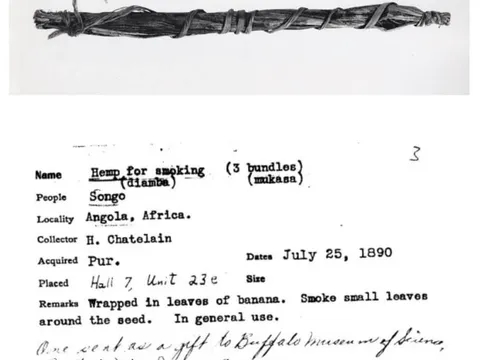
- Diamba[1]English (Gambia)cannabis; the coast-wide word moved through Gambian ports
Score breakdown 9/100 · how the scores are made
The enacted 2014 amendment gives first-time cannabis possession its own scale. For 0.1–150 grams it allows a fine of 50,000–100,000 dalasi, one to two years in prison, or both;[2] for 151–500 grams, 100,000–150,000 dalasi or two to five years, or both;[2] from 501 grams, 150,000–250,000 dalasi or three to ten years, or both.[2] The general possession rule remains separate, as do trafficking offences.[3]
| Amount | What happens | Punishment | Fine |
| First-time possession, 0.1–150 gFine or prison or both | CriminalPossession | 1–2 years | GMD 50,000 – GMD 100,000 |
| First-time possession, 151–500 gFine or prison or both | CriminalPossession | 2–5 years | GMD 100,000 – GMD 150,000 |
| First-time possession, from 501 gFine or prison or both | CriminalPossession | 3–10 years | GMD 150,000 – GMD 250,000 |
Unauthorised cannabis growing is prohibited.[3] The 2014 amendment expressly extends the cultivation provision to prohibited drugs and the First Schedule, where cannabis is listed; its penalty allows a fine of at least 50,000 dalasi, at least three years in prison, or both.[2] The law separately provides for specifically authorised scientific cultivation.[3]
| Amount | What happens | Punishment | Fine |
| Unauthorised cultivationFine of at least 50,000 dalasi, at least three years, or both | CriminalCultivation | At least 3 years | At least GMD 50,000 |
| Authorised scientific cultivationSpecifically authorised; no general licence route | LegalLicensed research growing | — | — |
Prison remains possible for first-time cannabis possession, alongside a fine alternative.[2] The drug agency, autonomous since 2005,(/history/gambia-autonomous-drug-agency-2005/) described burdensome fines in its 2019–2023 strategy, prison sentences and limited rehabilitation, and called for alternatives for young and first-time offenders.[4]
The 2011 amendment raised the minimum fine in the general trafficking clause to ten million dalasi, alongside at least ten years in prison.[5] The quantity rule covers more than ten grams of cannabis resin or two kilograms of cannabis, unless the accused proves the possession was not for trafficking.[3] Separate supply offences also apply.[6]
Use is prosecuted through possession.[7]
None: no lawful cannabis supply route operates.[7]
Context not part of the score · every country, by topic →
There is no legal recreational supply. First-time possession runs on the 2014 scale: 0.1–150 g brings a 50,000–100,000-dalasi fine or one to two years, rising to 150,000–250,000 dalasi or three to ten years from 501 g; trafficking starts at ten years and ten million dalasi.[2][5] In 2024 the drug agency arrested 1,219 people in 1,208 cases, seizing 1.9 tonnes of cannabis plus 2.2 tonnes from plantations.[8]
No medical cannabis programme: the reviewed sources establish no patient route, and the only authorised growing is scientific.[7][3]
No cannabis clubs are known, and the law leaves no room for them: growing cannabis and supplying it to another person are both prohibited.[7][9]
No industrial-hemp exception was verified: the 2003 Act and its amendments list cannabis in the First Schedule and restrict growing to authorised purposes with no low-THC distinction, and no hemp production is documented.[3][2]
No licensed production: unauthorised growing is prohibited, and only specifically authorised scientific cultivation is provided for.[3]
Figures reported by the government to the UN drugs office record 1,924 kg of herbal cannabis seized in 2024, against 1,954 kg in 2023, and 14 kg of cannabis resin seized in 2024, against 9.6 kg in 2023.[10] The UN publishes them as kilogram equivalents, and countries count seizures differently, so the figures are not comparable across borders.[10]
There is no legal recreational supply.[2] The 2014 first-offender scale for cannabis possession starts at 0.1–150 grams, with a fine of 50,000–100,000 dalasi, one to two years in prison, or both; the enacted scale provides longer prison ranges for larger quantities.[2]
Motor Traffic Act section 48(1) prohibits drug-impaired driving, attempting to drive, or being in charge of a motor vehicle on a road, parking place or other public place.[11] It covers both inability to control the vehicle properly and impaired efficiency as a driver.[11] Section 48(3) permits a uniformed police officer to arrest an offender without warrant.[11] The security-legislation publication is marked Issue 1/2009: its main text describes twelve-month disqualification with a special-reasons exception, while section 100 and the penalty schedule give different sanction wording, including a five-year disqualification.[11] Current fines and licence-ban terms are therefore left unresolved pending amendment/consolidation checks.[11] Drug toxicology, specimen-refusal rules and a numeric THC cutoff were not established.[11]
The Drug Law Enforcement Agency reported 1,219 people arrested in 1,208 drug cases in 2024;[8] 1,014 were Gambians and 205 foreigners.[8] It seized 1.9 tonnes of cannabis sativa and 2.2 tonnes from plantations, and cannabis made up 54.7% of all seizures.[8]
A conviction is a criminal record, as the D150,000 possession fine case shows.[12]
The coast's word is diamba: Bantu in origin, it moved up the coast through ports including Bathurst, carried by the seamen and traders the colonial state tried to police.[1] Gambia banned the plant in the 1930s ban wave; the modern law is the 2003 Act with its 2010, 2011 and 2014 amendments, and the 2019 strategy that called for treatment and alternatives to prison (see the 2019 strategy).
Taking cannabis into or out of Gambia is a separate offence from possessing it, normally charged as smuggling or trafficking, with far heavier penalties. That holds almost everywhere, including between two places where cannabis is legal.
A prescription or medical card from another country is generally not recognised. Travellers who need a cannabis-based medicine should ask Gambia's embassy before travelling.[13]
General guidance that applies to almost every country, not a check of Gambia's customs rules.
Culture the atlas →
Datasets not part of the score
What other organisations publish about Gambia, and where it stands among the countries each one covers. Each dataset has a page of its own, with a world map and every country's figure.
Use
UNODC
Cannabis use
3.07%of people aged 15–64 (assumed)
49,000 people · computed here: the median of surveyed countries in the region, or the figure of the country a territory is part of
Source Survey ages and years vary, and some surveys include children. Rates are not age-standardised; do not compare countries directly.WHO, Our World in Data · 2020
Alcohol drunk per person
0.61litres of pure alcohol a year
3.74 · 20003.74 · 20013.86 · 20023.94 · 20033.95 · 20043.83 · 20053.69 · 20063.54 · 20073.45 · 20083.27 · 20093.17 · 20103.05 · 20112.87 · 20122.76 · 20132.35 · 20142.07 · 20151.62 · 20161.36 · 20171.11 · 20181.11 · 20190.61 · 202020002020 Higher than 16% of 187 countriesLowestHighestper person aged 15 or over · 2020 · 3.74 in 2000 · 3.17 in 2010
Law
UNODC · 2023
Police contact for drug use or possession
22per 100,000 people
23 · 202222 · 202320222023 Higher than 32% of 101 countriesFewerMore613 people in 2023 · all drugs together
UNODC · 2024
Cannabis seized
1,938kg in 2024
1,201 · 20151,219 · 20162 · 20182,826 · 20211,844 · 20221,964 · 20231,938 · 202420152024 Higher than 46% of 163 countriesLess seizedMore seized1,924 kg of herb · 14 kg of resin · 1,201 kg in 2015
Society
OpenAlex · 2025
Research on cannabis
0.7papers per million people
0.4 · 19930.4 · 20110.7 · 20180.4 · 20190.4 · 20210.4 · 20240.7 · 202519932025 Higher than 45% of 176 countriesLowestHighest2 papers in 2025
Cato and Fraser Institutes · 2023
Human Freedom Index
6.83of 10
5.26 · 20005.09 · 20014.88 · 20024.69 · 20034.70 · 20044.91 · 20055.01 · 20065.10 · 20074.93 · 20085.02 · 20095.50 · 20105.42 · 20115.36 · 20125.30 · 20135.37 · 20145.41 · 20155.43 · 20166.66 · 20176.87 · 20186.81 · 20196.60 · 20206.61 · 20216.79 · 20226.83 · 202320002023 Higher than 48% of 164 countriesLess freeFreerrank #86 of 165 · personal freedom 6.77 · economic freedom 6.93
V-Dem, Our World in Data · 2025
Civil liberties
0.88of 1 in 2025
0.49 · 19000.49 · 19010.49 · 19020.49 · 19030.49 · 19040.49 · 19050.49 · 19060.49 · 19070.49 · 19080.49 · 19090.49 · 19100.49 · 19110.49 · 19120.49 · 19130.49 · 19140.49 · 19150.49 · 19160.49 · 19170.49 · 19180.49 · 19190.49 · 19200.49 · 19210.49 · 19220.49 · 19230.49 · 19240.49 · 19250.49 · 19260.49 · 19270.49 · 19280.49 · 19290.49 · 19300.49 · 19310.49 · 19320.49 · 19330.49 · 19340.49 · 19350.49 · 19360.49 · 19370.49 · 19380.49 · 19390.50 · 19400.50 · 19410.50 · 19420.50 · 19430.50 · 19440.50 · 19450.55 · 19460.55 · 19470.55 · 19480.55 · 19490.55 · 19500.56 · 19510.56 · 19520.56 · 19530.56 · 19540.56 · 19550.56 · 19560.56 · 19570.56 · 19580.56 · 19590.60 · 19600.60 · 19610.61 · 19620.61 · 19630.61 · 19640.70 · 19650.75 · 19660.75 · 19670.75 · 19680.75 · 19690.78 · 19700.78 · 19710.78 · 19720.78 · 19730.78 · 19740.78 · 19750.78 · 19760.77 · 19770.77 · 19780.77 · 19790.77 · 19800.75 · 19810.75 · 19820.76 · 19830.77 · 19840.78 · 19850.78 · 19860.78 · 19870.78 · 19880.78 · 19890.79 · 19900.79 · 19910.79 · 19920.78 · 19930.43 · 19940.33 · 19950.35 · 19960.38 · 19970.39 · 19980.37 · 19990.35 · 20000.35 · 20010.35 · 20020.35 · 20030.35 · 20040.35 · 20050.34 · 20060.36 · 20070.35 · 20080.35 · 20090.35 · 20100.35 · 20110.35 · 20120.32 · 20130.32 · 20140.33 · 20150.33 · 20160.82 · 20170.84 · 20180.84 · 20190.84 · 20200.86 · 20210.87 · 20220.88 · 20230.88 · 20240.88 · 202519002025 Higher than 75% of 175 countriesFewer libertiesMore liberties0.49 in 1925 · 0.60 in 1961 · 0.79 in 1990
Our World in Data, World Bank · 2025
Population
2,822,093people in 2025
167,051 · 1900180,090 · 1910193,150 · 1920222,853 · 1930256,862 · 1940306,745 · 1950398,071 · 1960524,115 · 1970713,921 · 19801,054,703 · 19901,455,095 · 20001,926,634 · 20102,515,744 · 20202,822,093 · 202519002025 Higher than 29% of 196 countriesLowestHighest167,051 in 1900 · 306,745 in 1950 · 1,455,095 in 2000
CEPII
Former colonial rulers
Once ruled by United Kingdom
World Bank · 2025
Government effectiveness
43of 100
40 · 199640 · 199840 · 200040 · 200241 · 200339 · 200437 · 200533 · 200635 · 200739 · 200842 · 200942 · 201042 · 201143 · 201242 · 201343 · 201441 · 201541 · 201643 · 201744 · 201844 · 201943 · 202044 · 202144 · 202245 · 202343 · 202443 · 202519962025 Higher than 32% of 195 countriesLowestHighestestimate -0.43 on a scale of −2.5 to 2.5 · 2025 · 40 in 2000 · 41 in 2015
Transparency International · 2024
Corruption Perceptions Index
38of 100
34 · 201228 · 201329 · 201428 · 201526 · 201630 · 201737 · 201837 · 201937 · 202037 · 202134 · 202237 · 202338 · 202420122024 Higher than 46% of 178 countriesLowestHighest0 highly corrupt, 100 very clean · 2024 · 28 in 2015 · 37 in 2020
Pew Research Center · 2020
Most common religion
Muslims
the largest group · 2020
World Bank · 2025
Income per person
$3,167per person
2,654 · 19902,624 · 19912,604 · 19922,586 · 19932,508 · 19942,456 · 19952,439 · 19962,487 · 19972,503 · 19982,590 · 19992,659 · 20002,738 · 20012,579 · 20022,682 · 20032,794 · 20042,654 · 20052,565 · 20062,567 · 20072,650 · 20082,745 · 20092,824 · 20102,520 · 20112,575 · 20122,572 · 20132,465 · 20142,496 · 20152,478 · 20162,533 · 20172,651 · 20182,751 · 20192,702 · 20202,778 · 20212,863 · 20222,964 · 20233,058 · 20243,167 · 202519902025 Higher than 11% of 187 countriesLowestHighestat purchasing power parity, 2021 dollars · 2025 · $2,654 in 1990 · $2,824 in 2010
World Bank · 2024
Development indicators
49.5%use the internet
0% · 19900% · 19950% · 19960.1% · 19970.2% · 19980.7% · 19990.9% · 20001.3% · 20011.8% · 20022.4% · 20033.3% · 20043.8% · 20055.2% · 20066.2% · 20076.9% · 20087.6% · 20099.2% · 201010.9% · 201112.4% · 201214% · 201315.6% · 201417.6% · 201519.9% · 201622.5% · 201728.3% · 201831.1% · 201936% · 202041.7% · 202148.2% · 202248.7% · 202349.5% · 202419902024 Higher than 25% of 195 countriesLowestHighest64.3% live in towns · 3.1% aged 65+ · life expectancy 66.1 · higher education 13.5% · 2024 · 0.9% in 2000 · 9.2% in 2010
GDELT · 2025
Cannabis in the news
0%of global news: cannabis articles from here
0% · 20170% · 20180% · 20190% · 20200% · 20210% · 20220% · 20230% · 20240% · 202520172025 Higher than 0% of 147 countriesLowestHighest2025 average, 348 days · 0% in 2018 · 0% in 2021
Enforcement 1 report · the Cannabis Enforcement Tracker →
How the law above is applied: raids, seizures, fields destroyed, arrests and sentences, as recorded by the Cannabis Enforcement Tracker, our companion site.
- SeizureThe Gambia's drug agency reports four tonnes of cannabis seized
The director general of the Drug Law Enforcement Agency reported 1,219 people arrested in 1,208 drug cases in 2024, 1,014 of them Gambians.
History 10 of 11 checked against a source
Score and entries per decade
9 today, from 7 before its first recorded change
This country's score Entries that moved the score Context only
20191 entry0 score changes
20141 entry1 score change
20111 entry0 score changes
20051 entry0 score changes
20031 entry0 score changes
19962 entries0 score changes
Other law ✓
Gambia replaces its earlier drug law with a decree
A drug-control decree replaced the 1993 drug legislation, according to the enforcement agency’s institutional history. It governed the period before the 2003 replacement law, which expressly repealed it and set rules for handling prosecutions already under way.
International ✓
The Gambia joins two UN drug conventions on one day
The Gambia acceded to the Single Convention on Narcotic Drugs of 1961 on 23 April 1996. The convention lists cannabis and cannabis resin among its controlled drugs and obliges its parties to limit their production, trade, possession and use to medical and scientific purposes. On the same day it acceded to the United Nations Convention against Illicit Traffic in Narcotic Drugs and Psychotropic Substances of 1988. Article 3 of the 1988 convention requires each party, subject to its constitutional principles, to make the possession, purchase and cultivation of drugs for personal consumption a criminal offence.
19801 entry0 score changes
19351 entry0 score changes
18591 entry0 score changes
Date not known1 entry1 score change
Sources hover a number in the text to see its source
- Cited
- 13
- Websites
- 7
- 1
- Last reviewed
- History checked
- 10/11
Most cited
- ons.gov.gm5
- thepoint.gm2
- data.unodc.org1
- english.nessunotocchicaino.it1
- gambiana.com1
- incb.org1
All 13 sources
- The African Roots of MarijuanaChris S. Duvall · Duke University Press · 2019 · ISBN 9781478004530
- The Gambia Gazette — Drug Control (Amendment) Act 2014, Act 9, 9 October 2014Complete four-page text; section 5 has 1–2, 2–5 and 3–10 year prison ranges, each with a fine alternativearchived
- The Gambia — Drug Control Act 2003, consolidated with the 2005 amendments, Issue 1/2009Commencement; sections 2, 4–5, 33–36, 43 and 139; First Schedule; scanned text, not an unamended 2003 originalarchived
- Drug Law Enforcement Agency, The Gambia — Five-Year Strategy Plan 2019–20232019 · Printed pp. 13–17, 33–34, 37–38 and 44; institutional history and proposed alternatives to imprisonmentarchived
- The Gambia Gazette — Drug Control (Amendment) Act 2011, Act 2, 29 April 2011Complete two-page text; sections 3–4; passage 4 April, assent/commencement 29 April, gazette 24 Mayarchived
- The Gambia Gazette — Drug Control (Amendment) Act 2010, Act 16, 29 October 2010Complete four-page text; sections 4–5, including cocaine/heroin-only section 43Aarchived
- The Point — Penalty reduced for first-time cannabis offendersarchived
- The Point — Gambians lead in drug abuse cases, says DLEAG DG (27 June 2025)archived
- Hands Off Cain — Gambia abolishes death penalty for drug-related offencesarchived
- UNODC Data Portal — Drug seizures, reported seizures in kilogram equivalents (World Drug Report data)archived
- Gambia security-legislation publication — Motor Traffic Act, Chapter 70:03 (Issue 1/2009, scanned PDF)Printed pages 26–27, section 48; page 48, section 100; page 50, Schedule items 15–16. Relevant scanned pages visually inspected; current amendments remain unverified.archived
- Gambiana — Man fined D150,000 for cannabis possessionarchived
- International Narcotics Control Board — Travellers carrying medicines containing controlled substances