Côte d'Ivoire
11/100
#82 of 196 worldwide
#7 of 54 in Africa
Possession for personal use carries one to three months with treatment as the default response; supply and cultivation carry five to ten years. A licensing regime for medical cannabis does not operate.
In short all countries →
- Can I carry it?NoIt is a crime
- Can I grow it?NoIt is a crime
- Can I buy it?NoThere is no legal source
- Can I use it in public?NoNot in public, and even at home the law does not protect it
- What if I'm caught?Fine or prisonUsually a fine; prison is possible
A rough guide read from the scores and the rules below, not legal advice. The details and the exceptions are in each segment: select an answer to jump to it.
Cannabis in Côte d'Ivoire not part of the score · all 16 datasets ↓
Who uses it
About 1 in 31
people aged 15–64 in Côte d'Ivoire used cannabis in the past year: 600,000 people.
- Past year
- 3.2%
- Africa median
- 3.1%
UNODC · survey 2017
Source Past-year cannabis use among people aged 15–64. People who used cannabis in the past year, from a 2017 survey, applied to today's population aged 15–64.Survey ages and years vary, and some surveys include children. Rates are not age-standardised; do not compare countries directly.
UNODC World Drug Report 2026, annex table 1.2. Population from the World Bank, aged 15–64. The whole dataset →
Use across Africa
14thhighest of 28 surveyed countries
- 🇪🇬 Egypt3.9%
- 🇳🇦 Namibia3.9%
- 🇨🇮 Côte d'Ivoire3.2%
- 🇧🇫 Burkina Faso2.9%
- 🇰🇲 Comoros2.9%
Past-year use, latest survey of each. Survey years and ages differ. On the map →
Cannabis in figures
- Police contact for drug use or possession8.4per 100,000 people · 2021
- Cannabis seized10,760kg in 2024 · 2024
- Research on cannabis0.0papers per million people · 2025
- Cannabis in the news0%of global news: cannabis articles from here · 2025
The dot: where it stands among the countries each dataset covers, lowest to highest. All datasets ↓
Score breakdown 11/100 · how the scores are made
Neighbours
- 🇬🇭 Ghana16
- 🇨🇮 Côte d'Ivoire11
- 🇬🇳 Guinea9
- 🇱🇷 Liberia9
- 🇲🇱 Mali9
- 🇧🇫 Burkina Faso6
Possession is a crime. Under Law 2022-407 of 13 June 2022, holding a drug for one's own use carries one to three months in prison and a fine of 50,000 to 500,000 CFA francs.[1] Prosecutors must order appropriate care before trial, and judges may substitute treatment for the prison term.[1][2]
| Amount | What happens | Punishment | Fine |
| Holding a drug for one's own useOr court-ordered treatment instead | CriminalPersonal use | 1–3 months | FCFA 50,000 – FCFA 500,000 |
Growing without authorisation carries five to ten years in prison and a fine of 500,000 to 50 million francs under Article 3 of Law 2022-407.[1]
| Amount | What happens | Punishment | Fine |
| Growing table 1 and 2 drugs without authorisationPrison or a fine, or both | CriminalUnlicensed cultivation | 5–10 years | FCFA 500,000 – FCFA 50,000,000 |
The 2022 law cut the penalty for holding drugs for personal use to one to three months and made treatment the default response: prosecutors must order care before trial, and judges may substitute treatment for a prison term.[1][2] Evading court-ordered care means serving the prison term.[2] On the roads, customs keep intercepting cannabis loads, most recently 74 kg at the Moossou bridge entrance to Abidjan in October 2025.[3]
Unauthorised buying or holding for sale, offering, distribution, brokerage and delivery carry five to ten years in prison and a fine of 500,000 to 50 million francs.[1] International trafficking carries five to ten years and a fine of 1 to 100 million francs.[1] Giving or offering a drug to a person for their own use carries one to three years and a fine of 200,000 to 5 million francs.[1]
| Amount | What happens | Punishment | Fine |
| Supply and delivery (article 4)Prison or a fine, or both | CriminalTrafficking | 5–10 years | FCFA 500,000 – FCFA 50,000,000 |
| Giving or offering for another person's own use (article 7)Prison or a fine, or both | CriminalSupply to a user | 1–3 years | FCFA 200,000 – FCFA 5,000,000 |
Holding a drug for one's own use carries one to three months in prison and a fine of 50,000 to 500,000 CFA francs.[1] People taking part in a harm-reduction programme are exempt on conditions set by decree.[1] Driving after using a drug is a separate offence with one to five years.[1]
| Amount | What happens | Punishment | Fine |
| Holding a drug for one's own useOr court-ordered treatment instead | CriminalDrug use | 1–3 months | FCFA 50,000 – FCFA 500,000 |
Context not part of the score · every country, by topic →
Cannabis is prohibited, but the 2022 law treats users as patients first: prosecutors must order care before trial and judges may substitute treatment for prison.[1][2] Holding for personal use still carries one to three months and a fine, and supply five to ten years.[1] Enforcement continues on the roads: in October 2025 customs stopped 74 kg hidden in a ride-hailing car at the Moossou bridge entrance to Abidjan, as that seizure records.[3]
The sources reviewed establish no operating medical cannabis programme.[1] The 2022 law punishes unauthorised holding and use without a medical-use exception for cannabis.[1]
No cannabis clubs are known, and the law leaves no room for them: unauthorised growing and supply are both prohibited.[1]
Article 3 of Law 2022-407 punishes growing a listed drug without authorisation with five to ten years in prison and a fine of 500,000 to 50 million francs.[1] The offence articles do not mention seeds.[1]
The provisions reviewed set no THC line for hemp and no fibre or food exception.[1] Unauthorised growing of listed drugs is punished regardless of claimed use.[1]
No licensed production exists: unauthorised growing, production and manufacture carry five to ten years, and no licensed cannabis production was found in the sources reviewed.[1]
Figures reported by the government to the UN drugs office record 10,760 kg of herbal cannabis seized in 2024, against 13,267 kg in 2023.[4] The UN publishes them as kilogram equivalents, and countries count seizures differently, so the figures are not comparable across borders.[4] In October 2025 a customs unit seized 74 kg hidden in a ride-hailing car at the Moossou bridge entrance to Abidjan, detaining the driver and two passengers.[3](https://tracker.cannabisfreedom.fyi/report/ivory-coast-customs-seizure-2025/)
There is no legal recreational supply for anyone.[1] Holding for personal use carries one to three months, a fine, or court-ordered treatment instead.[1][2]
Driving under the influence of a drug consumed illicitly carries one to five years in prison and a fine of 200,000 to 2 million francs.[1] Courts cancel the licence for six months to five years, definitively on repeat offending; refusing screening is a separate offence, and penalties cumulate with homicide or injury convictions.[1] No numerical limit is stated; screening procedures are set by ministerial order.[1]
The October 2025 Moossou bridge seizure led to three detentions; no aggregate cannabis-arrest series is published.[3]
Judges may add loss of civic rights, a travel ban with passport withdrawal for five to ten years, or a weapons ban.[1] Completing court-ordered treatment brings an absolute discharge for use offences; evading it means serving the prison term.[1][2]
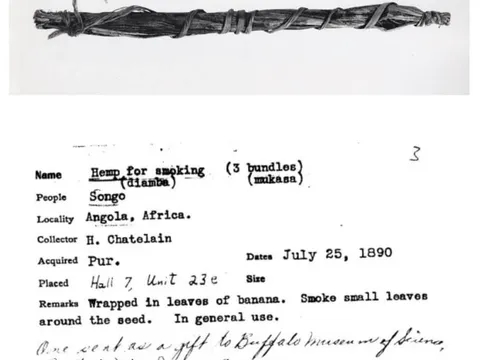
In Côte d'Ivoire cannabis is called diamba, part of a word patch running from Côte d'Ivoire to Senegal whose Central African origin Duvall reconstructs, commonly written with an initial j in French and Portuguese.[5] European listeners rendered the unfamiliar initial sound many ways — diamba, liamba, riamba — without a change in meaning.[5] The atlas traces the word in diamba, which also names the Kasai Bena Riamba movement, under a century of bans from the 1916 extension of French poison law to the 2022 drug law.[5][1]
Taking cannabis into or out of Côte d'Ivoire is a separate offence from possessing it, normally charged as smuggling or trafficking, with far heavier penalties. That holds almost everywhere, including between two places where cannabis is legal.
A prescription or medical card from another country is generally not recognised. Travellers who need a cannabis-based medicine should ask Côte d'Ivoire's embassy before travelling.[6]
General guidance that applies to almost every country, not a check of Côte d'Ivoire's customs rules.
Culture the atlas →
Datasets not part of the score
What other organisations publish about Côte d'Ivoire, and where it stands among the countries each one covers. Each dataset has a page of its own, with a world map and every country's figure.
Use
UNODC · 2017
Cannabis use
3.24%of people aged 15–64
ages 15–64 · survey 2017 · 600,000 people · UNODC 2026
Source Survey ages and years vary, and some surveys include children. Rates are not age-standardised; do not compare countries directly.WHO, Our World in Data · 2020
Alcohol drunk per person
2.85litres of pure alcohol a year
4.21 · 20004.21 · 20014.36 · 20024.35 · 20034.35 · 20044.26 · 20054.23 · 20064.19 · 20074.22 · 20083.53 · 20092.82 · 20102.12 · 20112.15 · 20122.26 · 20132.44 · 20142.57 · 20152.65 · 20162.71 · 20172.80 · 20182.80 · 20192.85 · 202020002020 Higher than 35% of 187 countriesLowestHighestper person aged 15 or over · 2020 · 4.21 in 2000 · 2.82 in 2010
Law
UNODC · 2021
Police contact for drug use or possession
8.4per 100,000 people
Higher than 23% of 101 countriesFewerMore2,757 people in 2021 · all drugs together
UNODC · 2024
Cannabis seized
10,760kg in 2024
4,020 · 20156,310 · 20163,050 · 20175,199 · 201827,888 · 201913,600 · 202020,214 · 202115,020 · 202213,267 · 202310,760 · 202420152024 Higher than 69% of 163 countriesLess seizedMore seized10,760 kg of herb · 4,020 kg in 2015 · 13,600 kg in 2020
Society
OpenAlex · 2025
Research on cannabis
0.0papers per million people
0.0 · 20100.0 · 20110.0 · 20130.1 · 20140.0 · 20160.0 · 20190.0 · 20200.1 · 20210.1 · 20220.1 · 20230.1 · 20240.0 · 202520102025 Higher than 3% of 176 countriesLowestHighest1 papers in 2025 · 1 in 2010
Cato and Fraser Institutes · 2023
Human Freedom Index
6.67of 10
6.32 · 20006.41 · 20016.25 · 20026.27 · 20036.30 · 20046.27 · 20056.30 · 20066.34 · 20076.22 · 20086.20 · 20096.04 · 20105.99 · 20116.14 · 20126.45 · 20136.49 · 20146.64 · 20156.75 · 20166.76 · 20176.79 · 20186.81 · 20196.51 · 20206.49 · 20216.61 · 20226.67 · 202320002023 Higher than 44% of 164 countriesLess freeFreerrank #92 of 165 · personal freedom 7.09 · economic freedom 6.08
V-Dem, Our World in Data · 2025
Civil liberties
0.70of 1 in 2025
0.15 · 19000.15 · 19010.15 · 19020.15 · 19030.15 · 19040.15 · 19050.15 · 19060.15 · 19070.15 · 19080.15 · 19090.15 · 19100.15 · 19110.15 · 19120.15 · 19130.15 · 19140.15 · 19150.15 · 19160.15 · 19170.15 · 19180.15 · 19190.15 · 19200.16 · 19210.16 · 19220.16 · 19230.16 · 19240.16 · 19250.16 · 19260.16 · 19270.16 · 19280.16 · 19290.16 · 19300.16 · 19310.16 · 19320.16 · 19330.18 · 19340.18 · 19350.18 · 19360.18 · 19370.18 · 19380.18 · 19390.18 · 19400.18 · 19410.18 · 19420.18 · 19430.19 · 19440.21 · 19450.25 · 19460.26 · 19470.26 · 19480.26 · 19490.26 · 19500.26 · 19510.27 · 19520.27 · 19530.27 · 19540.27 · 19550.27 · 19560.26 · 19570.26 · 19580.25 · 19590.48 · 19600.48 · 19610.47 · 19620.46 · 19630.46 · 19640.46 · 19650.46 · 19660.46 · 19670.46 · 19680.46 · 19690.47 · 19700.48 · 19710.48 · 19720.48 · 19730.48 · 19740.48 · 19750.48 · 19760.48 · 19770.48 · 19780.48 · 19790.48 · 19800.48 · 19810.48 · 19820.48 · 19830.48 · 19840.49 · 19850.48 · 19860.49 · 19870.49 · 19880.49 · 19890.65 · 19900.65 · 19910.64 · 19920.66 · 19930.69 · 19940.69 · 19950.71 · 19960.72 · 19970.71 · 19980.71 · 19990.72 · 20000.72 · 20010.73 · 20020.73 · 20030.72 · 20040.73 · 20050.73 · 20060.73 · 20070.73 · 20080.73 · 20090.71 · 20100.70 · 20110.74 · 20120.80 · 20130.80 · 20140.80 · 20150.80 · 20160.77 · 20170.77 · 20180.76 · 20190.71 · 20200.71 · 20210.72 · 20220.73 · 20230.71 · 20240.70 · 202519002025 Higher than 44% of 175 countriesFewer libertiesMore liberties0.16 in 1925 · 0.48 in 1961 · 0.65 in 1990
Our World in Data, World Bank · 2025
Population
32,711,547people in 2025
1,505,099 · 19001,588,890 · 19101,707,305 · 19201,969,853 · 19302,270,472 · 19402,735,187 · 19503,673,672 · 19605,411,573 · 19708,220,717 · 198012,189,780 · 199017,699,007 · 200022,488,068 · 201028,915,452 · 202032,711,547 · 202519002025 Higher than 74% of 196 countriesLowestHighest1,505,099 in 1900 · 2,735,187 in 1950 · 17,699,007 in 2000
CEPII
Former colonial rulers
Once ruled by France
World Bank · 2025
Government effectiveness
47of 100
57 · 199644 · 199825 · 200022 · 200222 · 200317 · 200419 · 200522 · 200622 · 200726 · 200829 · 200927 · 201027 · 201130 · 201233 · 201338 · 201440 · 201540 · 201640 · 201742 · 201843 · 201943 · 202042 · 202145 · 202245 · 202345 · 202447 · 202519962025 Higher than 37% of 195 countriesLowestHighestestimate -0.25 on a scale of −2.5 to 2.5 · 2025 · 25 in 2000 · 40 in 2015
Transparency International · 2024
Corruption Perceptions Index
45of 100
29 · 201227 · 201332 · 201432 · 201534 · 201636 · 201735 · 201835 · 201936 · 202036 · 202137 · 202240 · 202345 · 202420122024 Higher than 60% of 178 countriesLowestHighest0 highly corrupt, 100 very clean · 2024 · 32 in 2015 · 36 in 2020
Pew Research Center · 2020
Most common religion
Muslims
the largest group · 2020
World Bank · 2025
Income per person
$7,015per person
5,256 · 19905,053 · 19914,843 · 19924,646 · 19934,502 · 19944,639 · 19954,807 · 19965,073 · 19975,093 · 19984,987 · 19994,838 · 20004,609 · 20014,369 · 20024,060 · 20034,089 · 20044,032 · 20054,049 · 20064,000 · 20074,097 · 20084,151 · 20094,339 · 20104,017 · 20114,234 · 20124,597 · 20134,908 · 20145,111 · 20155,321 · 20165,556 · 20175,670 · 20185,895 · 20195,788 · 20206,045 · 20216,272 · 20226,521 · 20236,747 · 20247,015 · 202519902025 Higher than 26% of 187 countriesLowestHighestat purchasing power parity, 2021 dollars · 2025 · $5,256 in 1990 · $4,339 in 2010
World Bank · 2024
Development indicators
41.4%use the internet
0% · 19900% · 19950% · 19960% · 19970.1% · 19980.1% · 19990.2% · 20000.4% · 20010.5% · 20020.8% · 20030.8% · 20041% · 20051.5% · 20061.8% · 20071.9% · 20082% · 20092.7% · 20102.9% · 20114.4% · 20126.6% · 201310% · 201438.4% · 201541.2% · 201643.8% · 201737.5% · 201836.3% · 201936% · 202036% · 202138.4% · 202240.7% · 202341.4% · 202419902024 Higher than 21% of 195 countriesLowestHighest54% live in towns · 2.6% aged 65+ · life expectancy 62.1 · higher education 12.3% · 2024 · 0.2% in 2000 · 2.7% in 2010
GDELT · 2025
Cannabis in the news
0%of global news: cannabis articles from here
0% · 20170.0001% · 20180.0001% · 20190.0001% · 20200.0001% · 20210.0001% · 20220% · 20230% · 20240% · 202520172025 Higher than 0% of 147 countriesLowestHighest2025 average, 348 days · 0.0001% in 2018 · 0.0001% in 2021
Plant and market
GBIF · 1995
Records of the cannabis plant
11dated records
4 · 197010 · 197811 · 199519701995 Higher than 48% of 128 countriesLowestHighest0 more without a date · 1 in 1995
Enforcement 1 report · the Cannabis Enforcement Tracker →
How the law above is applied: raids, seizures, fields destroyed, arrests and sentences, as recorded by the Cannabis Enforcement Tracker, our companion site.
- SeizureIvorian customs stop 74 kg of cannabis at the entrance to Abidjan
A mobile customs unit stopped a ride-hailing car coming from Aboisso on the Moossou bridge and found 78 balls and 40 slabs of cannabis, 74 kg in all. The driver and two passengers were detained.
History 7 of 7 checked against a source
Score and entries per decade
11 today, from 100 before its first recorded change
This country's score Entries that moved the score Context only
Sources hover a number in the text to see its source
- Cited
- 6
- Websites
- 5
- 1
- Last reviewed
- History checked
- 7/7
Most cited
- data.unodc.org1
- incb.org1
- issup.net1
- koaci.com1
- loidici.biz1
All 6 sources
- Loi n° 2022-407 du 13 juin 2022 relative à la lutte contre le trafic et l'usage illicites des stupéfiants (Loidici.biz, chapter-by-chapter copy)archived
- ISSUP — Alternative à l'incarcération pour les usagers de drogues: cas de la Côte d'Ivoire (May 2024, PDF)archived
- Koaci — Côte d'Ivoire: les douanes saisissent 74 kg de cannabis sur l'axe Aboisso-Abidjan (15 October 2025)archived
- UNODC Data Portal — Drug seizures, reported seizures in kilogram equivalents (World Drug Report data)archived
- The African Roots of MarijuanaChris S. Duvall · Duke University Press · 2019 · ch. 4, printed p. 89 (diamba word patch from Côte d'Ivoire to Senegal, initial-j spellings, transcription variation); ch. 6, printed pp. 112–119 (Bena Riamba); read in the local PDF · ISBN 9781478004530
- International Narcotics Control Board — Travellers carrying medicines containing controlled substances