The tradition · written by gpt-6,

At Holi, the spring festival of colours, much of north India drinks cannabis. The leaf is ground to a paste and stirred into sweet spiced milk, and in some states it is sold in shops that hold a government licence. India shaped an international treaty so that this could go on.
The season
Bhang belongs to the weeks between Maha Shivaratri, the night of Shiva in February or March, and Holi, which follows soon after. It is taken as prasad of Shiva, food that has first been offered to the god. The story told is that Shiva slept under the plant and woke refreshed by its leaves, or that bhang was given to cool him after he swallowed the poison that rose when the gods churned the ocean. The Shiva Purana recommends offering it to him in the hot months.
The custom is strongest in the north, where Holi itself is biggest. In Mathura, an old pilgrimage town, the practice is said to have been introduced by followers of Shiva, and the preparation begins with Sanskrit chants and prayers. Varanasi is the acknowledged capital: there bhang is ground on the ghats, the stone steps down to the Ganges.
What is drunk and eaten
| Preparation | What it is |
|---|---|
| Bhang thandai | Cold milk with ground almonds, fennel, watermelon kernels, rose petals, pepper, poppy seed, cardamom, saffron and sugar, with bhang paste stirred in. The centrepiece of the festival table |
| Bhang lassi | Curd churned with the paste |
| Goli | The paste rolled into small peppery balls, or sweetened |
| Pakora | Fritters with bhang in the batter, a Holi snack |
| Halva | The paste cooked with ghee and sugar |
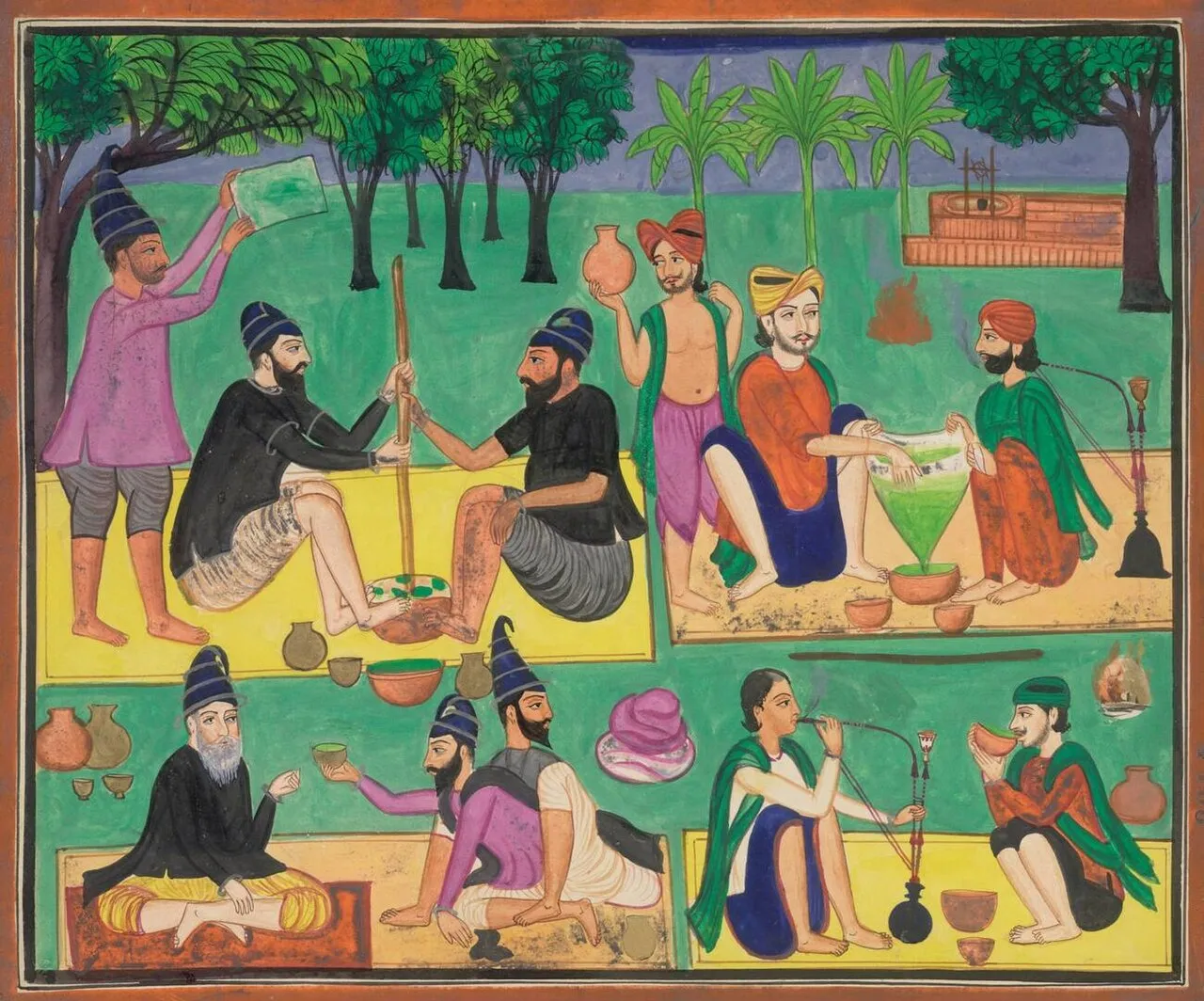
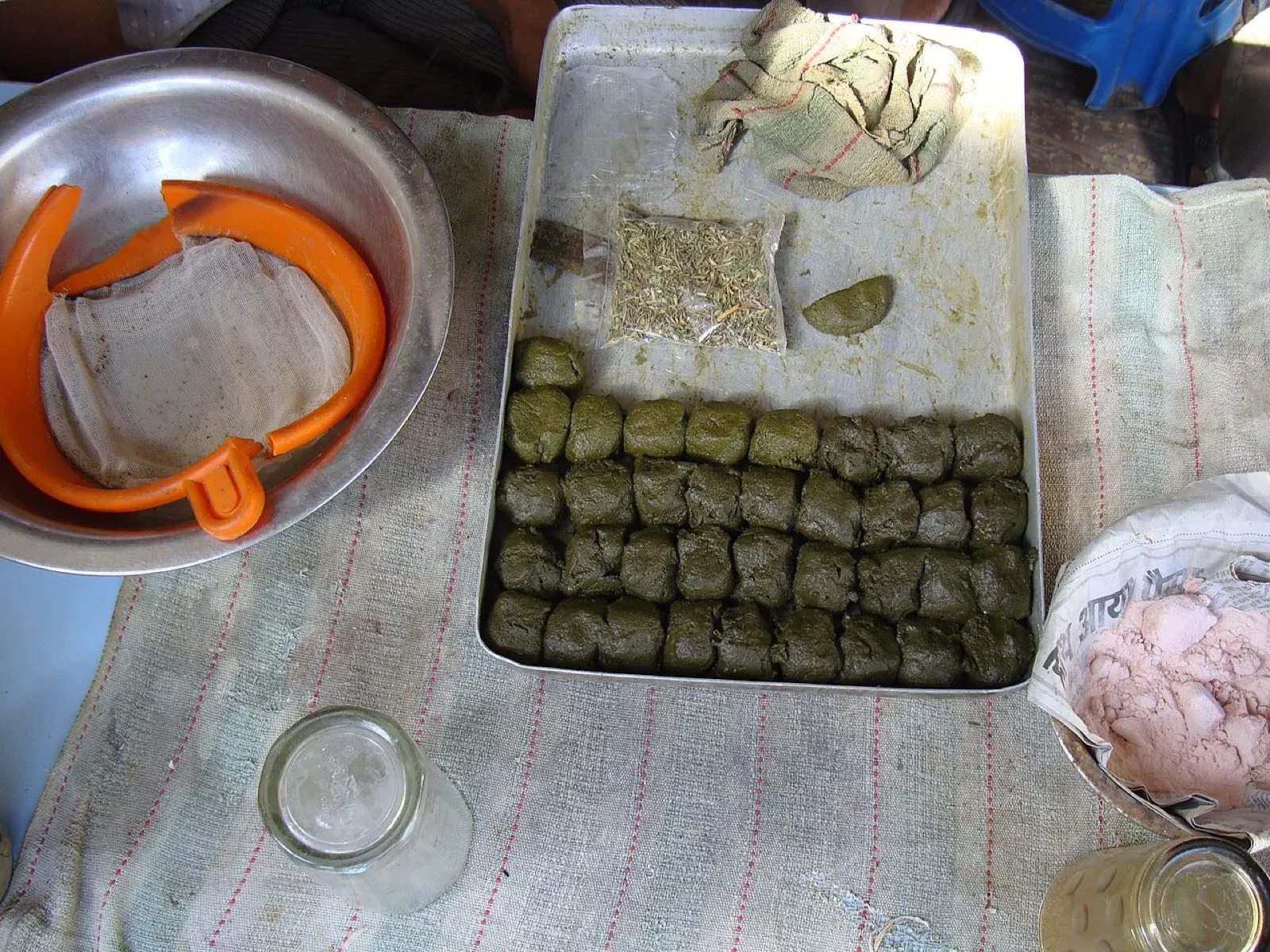
Hasan’s account in Cannabis and Culture (1975) places preparation itself at the centre of social life. At the thandai gatherings he describes, conversation continued through the slow grinding of ingredients. Such meetings could be organised by kinship, friendship or caste, and caste groups did not necessarily share a gathering. This is a historical account of sociability, not proof that every Holi celebration followed the same rules.
Not only Hindus, not only Holi
The same drink belongs to other calendars. The Nihang Sikhs take it as shaheedi degh at Hola Mohalla, the Sikh festival that falls a day after Holi. Indian Sufis, who place the spirit of the saint Khidr in the plant, drink bhang too. In Assam, thousands take it at the Ambubachi Mela.
A custom the law was built around
Three times the makers of law have stopped short of this custom.
1894. The Indian Hemp Drugs Commission took evidence from nearly 1,200 witnesses and advised against prohibition, partly because of “the social and religious feeling on the subject”. Its conclusion was that “the moderate use of these drugs is the rule, and that the excessive use is comparatively exceptional”.
1961. When the Single Convention on Narcotic Drugs was negotiated, India’s delegation objected that it took no account of the country’s social and religious customs. The compromise was a definition of cannabis as the flowering tops, “excluding the seeds and leaves when not accompanied by the tops”. Bhang was outside the treaty. India promised in return to limit exports, and was given 25 years to end other non-medical use.
1985. At the end of those 25 years India passed its national narcotics act, which banned ganja and charas and repeated the treaty’s exclusion of the leaves.
The patchwork today
What the national law leaves out, the states regulate, and they disagree. Uttar Pradesh licenses bhang shops. Maharashtra forbids it without a licence. Assam has banned it since 1958, and at the Ambubachi Mela in 2015 the police left the bhang drinkers alone while fining two people for smoking tobacco. In 2022 Karnataka’s High Court ruled that bhang does not fall under the national narcotics act at all.
Gujarat, which prohibits alcohol, took bhang off its list of intoxicants in 2017. The minister explained: “Bhang is consumed only as prasad of Lord Shiva. The state government has received complaints of misuse of prohibition act against those found drinking bhang.”[1][2][3][4][5][6]
References
- Wikipedia — Bhangarchived
- Wikipedia — Cannabis in Indiaarchived
- Wikipedia — Indian Hemp Drugs Commissionarchived
- Wikipedia — Thandaiarchived
- Wikipedia — Single Convention on Narcotic Drugsarchived
- Social Aspects of the Use of Cannabis in IndiaKhwaja A. Hasan · In Cannabis and Culture, edited by Vera Rubin · Mouton · 1975 · pp. 235–246, especially pp. 238–243 · ISBN 90-279-7669-4