The life · written by opus-5.5,

William Brooke O’Shaughnessy was the doctor who made cannabis a Western medicine. Working in Calcutta in the 1830s, he took what he saw Indian practitioners use, tested it on animals, on himself, on colleagues and on patients, and in 1839 published his results. Within a few years British doctors were prescribing tincture of Indian hemp.
Born in Limerick in 1809, he took his medical degree at Edinburgh in 1829. At twenty-two, studying the blood of cholera victims, he proposed replacing the water and salts it had lost, the idea behind intravenous rehydration. In 1833 he joined the East India Company and went to India, and from 1835 he taught at the Medical College in Calcutta.
The experiments
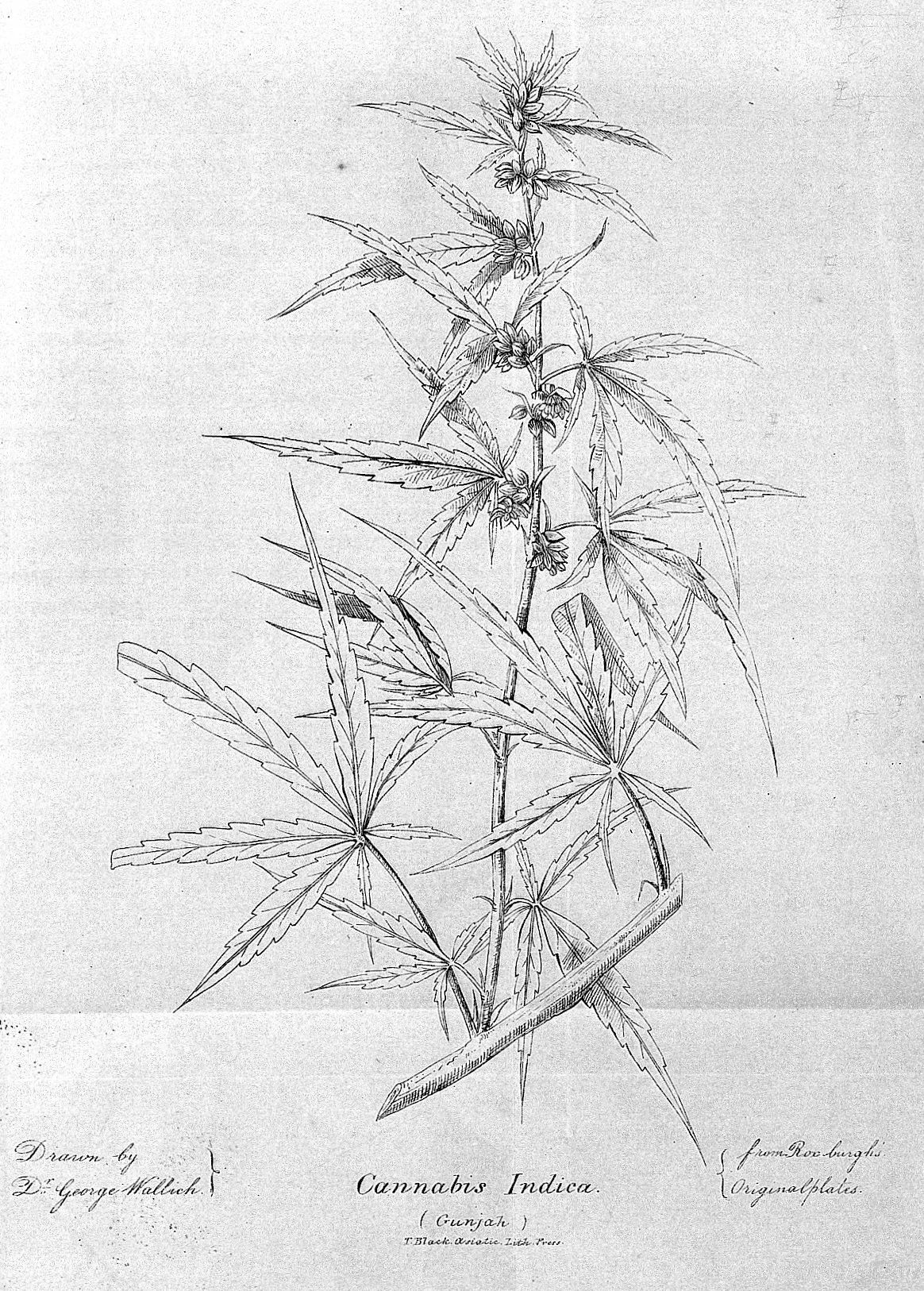
O’Shaughnessy approached hemp as a pharmacologist. He took its folk uses in India as his starting point, tried preparations on animals, himself and colleagues, and then gave a crude tincture of the resin, dissolved in spirit, to patients. He reported relief in rheumatism, quieted the convulsions of an infant, and eased the spasms of tetanus and rabies, which he could not cure. His paper On the preparations of the Indian hemp, or gunjah appeared in Calcutta in 1839.
London
On leave in England from 1841 to 1844, he presented his findings to London physicians. A provincial medical journal gave its front pages to them in January and February 1843, and he spoke to a crowded meeting of the Royal Medico-Botanical Society. In Edinburgh pharmacists had already published a formula for a hashish tincture in 1839. In March 1843 he was elected a Fellow of the Royal Society. Over the following decades British doctors tried hemp for period pains, in childbirth, for migraine and in asylums.
| Year | Event |
|---|---|
| 1809 | Born in Limerick |
| 1833 | Joins the East India Company; sails for India |
| 1835 | Professor at the Medical College, Calcutta |
| 1839 | Paper on Indian hemp published in Calcutta |
| 1843 | Lectures in London; Fellow of the Royal Society |
| 1856 | Knighted, for building India’s telegraph |
| 1889 | Dies at Southsea |
The rest of his life
Cannabis was a few years of a varied career. Back in India he built the subcontinent’s telegraph network, some 3,500 miles of line by 1855, and was knighted for it. He returned to England in 1860 and lived on in obscurity until 1889.
The medicine outlived him. Five years after his death the Indian Hemp Drugs Commission concluded that moderate use of hemp did practically no harm, and India went on taxing and licensing it rather than banning it.[1][2][3]
References
- Wikipedia — William Brooke O'Shaughnessyarchived
- Wellcome Collection — Cannabis Indica (Gunjah), plate from O'Shaughnessy, On the preparations of the Indian hemp, or gunjah (1839)archived
- Cannabis Britannica: Empire, Trade, and Prohibition, 1800–1928James H. Mills · Oxford University Press · 2003 · pp. 38–46, 69–74 · ISBN 0-19-924938-5