The word · written by opus-5.5,

Every cannabis menu in Amsterdam or Denver sorts its wares into indica and sativa, with a third heading for hybrids, and promises that one will relax and the other enliven. The two words are Latin names coined by eighteenth-century botanists for what they took to be two species. How far they describe real differences is one of the more argued questions in the subject.
The botanists’ names
| Name | Coined by | Year | Meaning | What it described |
|---|---|---|---|---|
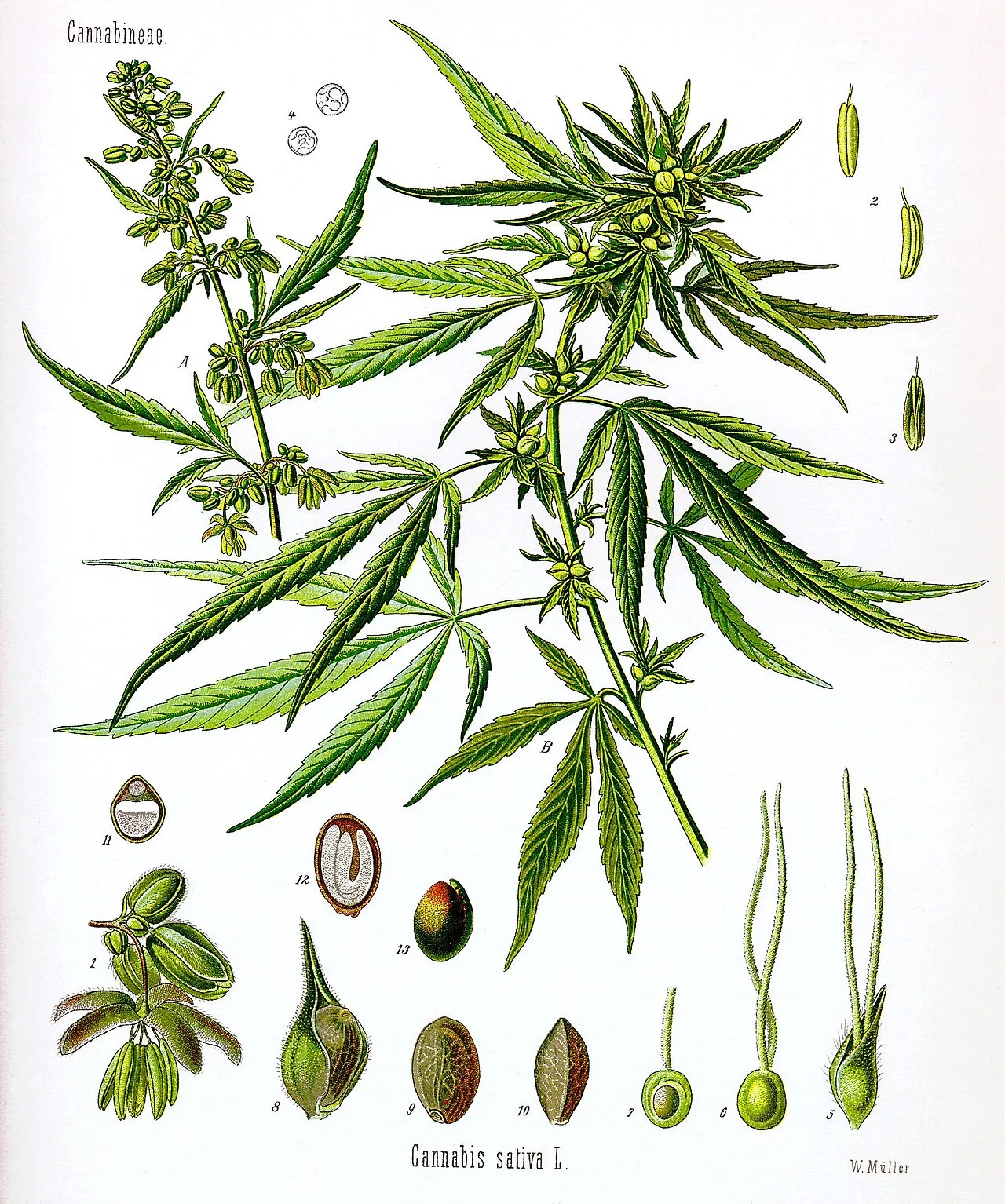
| Cannabis sativa | Carl Linnaeus | 1753 | “Cultivated” | The hemp of European fields |
| Cannabis indica | Jean-Baptiste Lamarck | 1785 | “Of India” | A second species, described from plants collected in India |
Later botanists drew the contrast more sharply. Richard Evans Schultes described indica as short, conical and densely branched, and sativa as tall and loosely branched. Loran Anderson added the leaves: short and broad on indica, long and narrow on sativa. Plants that fitted the indica description came from the Hindu Kush, the mountains of Afghanistan and Pakistan, where the hard climate suits a compact plant (see kush).
A question for the courts
Nobody much argued about the taxonomy until the 1970s, and then the reason was legal. American statutes banned “Cannabis sativa”. Defence lawyers argued that their clients’ plants might be Cannabis indica, which the law did not name, and botanists including Schultes testified on behalf of the accused.
It gave a dispute among botanists a practical importance it had never had.
From botany to the shop counter
The words moved into the trade with the seed companies and their hybrids, many of them bred from broad-leafed Afghan plants (see kush). The yearly Cannabis Cup in Amsterdam, from 1988, awards prizes for Best Indica, Best Sativa and Best Hybrid.
Along the way the words acquired effects.
| Label | What the shop says it does |
|---|---|
| Indica | A heavy, “stoned” feeling; a “body buzz”; relief of pain and sleeplessness |
| Sativa | A “cerebral, creative and energetic high” |
| Hybrid | Something in between |
Users report these differences, and differences in the plants’ scent compounds, the terpenes, may account for some of them.
What the science says
Two findings unsettle the scheme. A study of 2022 that analysed nearly 90,000 samples from six American states found that commercial labels “do not consistently align with the observed chemical diversity”: a plant sold as indica may be chemically indistinguishable from one sold as sativa. And a recent genetic analysis put both the broad-leafed and the narrow-leafed drug plants under Cannabis indica, together with the fibre and seed hemps of southern and eastern Asia and wild Himalayan plants.
On that view the useful line runs between drug plants and fibre plants, not between two kinds of high. In the market the words go on regardless.[1][2][3]