The tradition · written by gpt-6,

In divided Germany, hashish smoking meant opposite things on either side of the border. In West Germany around 1968, a pipe of Hasch, the everyday German shortening of Haschisch (hashish), was passed around communes and student circles as a sign of fellowship and refusal of bourgeois life. In the German Democratic Republic (GDR, DDR), the ruling party read the same habit as proof of capitalist decay, and hashish arrived mostly as cargo crossing its territory towards West Berlin.
Duden records the neuter das Hasch and Hascher, a masculine word for someone who smokes hashish. The words were shared across the border, but what people thought smoking meant was not.
Hasch and Hascher
The shortening makes a longer product name part of informal speech. Hascher shifts attention from the substance to the person using it. In a newspaper headline, that label could identify a whole social type rather than describe an individual act.
The dictionary establishes those meanings, not a first-use date. The dated newspaper examples examined here document circulation by 1970; they do not establish when German speakers first shortened the word or who invented it.
A pipe in the student movement
Historian Ned Richardson-Little describes the hashish pipe as a visible symbol among sections of West Germany’s extra-parliamentary opposition in 1968. Passing cannabis around could express sharing, fellowship and rejection of bourgeois conventions. Some commune participants understood intoxication as part of building a different kind of social life.
That interpretation was contested even on the Left. East Germany’s ruling Socialist Unity Party valued political discipline and rejected the claim that intoxication advanced socialism. In the historian’s account, the party’s press portrayed the drug scene as a diversion from organised political work.
These were competing political readings of consumption. They do not mean every student activist smoked or that every smoker belonged to a radical organisation.
Haschers and Marx
On October 27, 1970, Neues Deutschland published Günter Böhme’s article under a headline Richardson-Little translates as “Hashers don’t read Das Kapital.” It presented Western drug culture as a threat to political engagement, rather than a route towards emancipation.
The historian notes that the phrase originated in the West German magazine konkret. Its reuse illustrates how an argument could cross the ideological border even while the newspaper used it to condemn Western society. The original konkret item remains to be examined before assigning an exact first publication date.
As with the American vocabulary around reefer, the word’s visibility in an alarmist account is evidence about public language. It does not establish that the newspaper’s claims about consumers were accurate.
A border market rather than a mass domestic habit
Cannabis remained difficult to obtain within the German Democratic Republic. Richardson-Little emphasises restrictions on movement and the limited attraction of East German currency to international sellers.
The GDR’s roads and railways formed a transit corridor between West Germany and West Berlin, including a route for hashish. A classified Stasi report dated 17 October 1970 recorded approximately 125 kilograms of hashish detected by East German customs during its reporting period. It described attempted smuggling through border crossings, including a January case involving three kilograms bought in Afghanistan. These are the authorities’ recorded interceptions, not a measure of East German consumption.
Domestic cannabis use remained comparatively uncommon. Alcohol consumption was very high and alcoholism was a major social and health problem; Richardson-Little also documents recreational misuse of sedatives, including Faustan, sometimes combined with alcohol. Official portrayals of a Western drug threat should therefore be distinguished from the substances East Germans actually used and the limited availability of cannabis.
Cannabis in the socialist state’s law
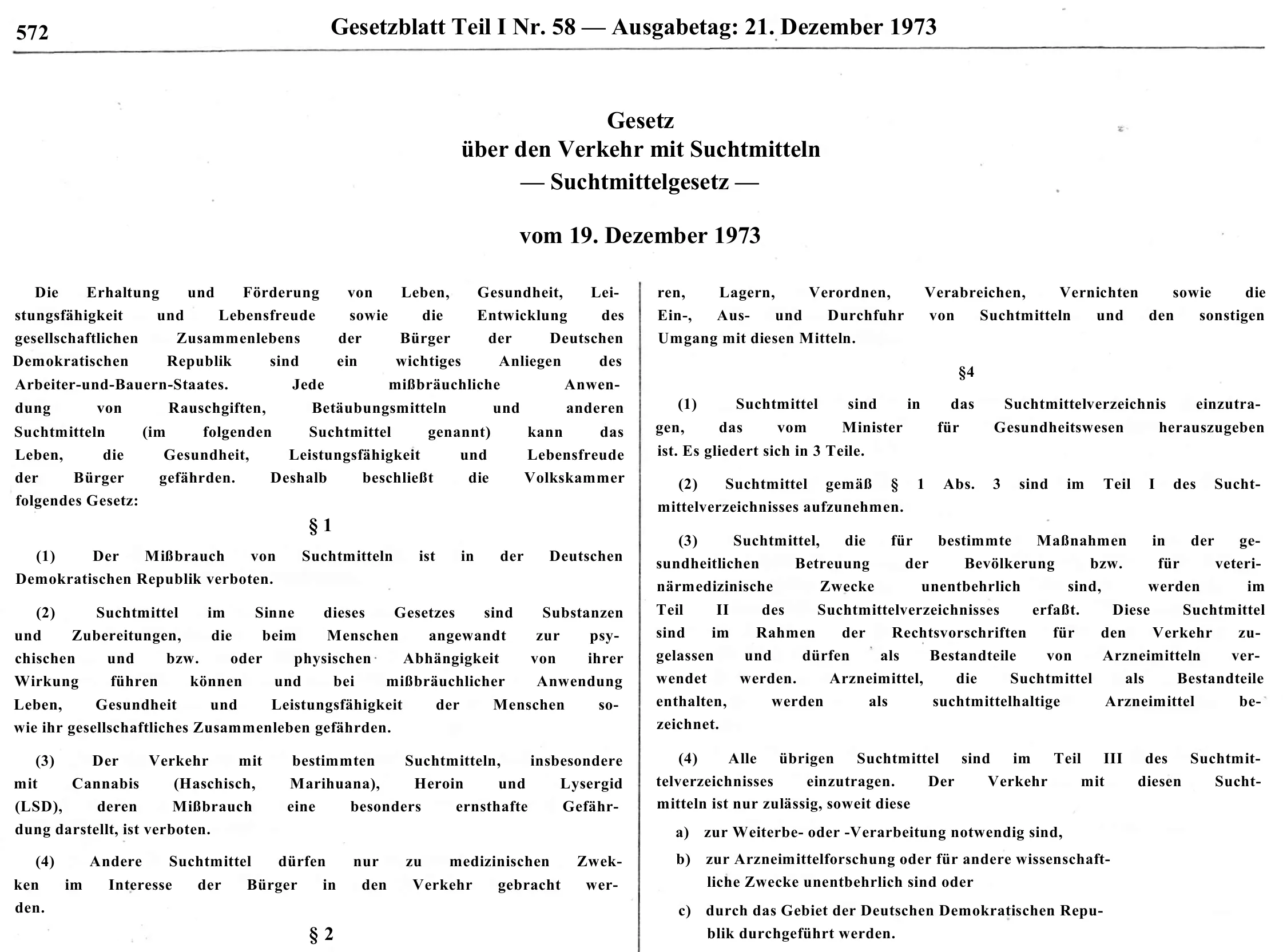
The 1973 Suchtmittelgesetz was dated 19 December 1973 and published in Gesetzblatt, Part I, no. 58, on 21 December. Section 1(3) explicitly prohibited circulation of “Cannabis (Haschisch, Marihuana)” alongside heroin and LSD. Section 3(2) defined circulation broadly, including production, acquisition, possession, import, export and transit. Under § 3(1), the health minister could authorise exceptions in individual cases.
The preamble framed drug misuse as a danger to health and social life, and § 2 required protection of socialist society. The law made cannabis an explicit object of state control; it was the GDR’s Suchtmittelgesetz, distinct from West Germany’s Betäubungsmittelgesetz. Its existence documents a restrictive policy, rather than proving widespread cannabis use among East German citizens.[1][2][3][4][5][6][7]
References
- Bundesarchiv — Berlin, Rauschgiftspürhund im Einsatz, Thomas Uhlemann (28 November 1989)Bild 183-1989-1128-012; original caption and licensing via Wikimedia Commonsarchived
- Gesetz über den Verkehr mit Suchtmitteln – SuchtmittelgesetzIn Gesetzblatt der Deutschen Demokratischen Republik, Teil I · Staatsverlag der Deutschen Demokratischen Republik, Berlin · 1973 · Nr. 58, p. 572; law dated 19 December, gazette issued 21 December 1973; § 1(3) and § 3(1)–(2)archived
- Störung und Missbrauch des Reise- und Güterverkehrs Berlin–BRDMinisterium für Staatssicherheit · Stasi-Unterlagen-Archiv, Bundesarchiv · 1970 · Information Nr. 1193/70, 17 October 1970; section 7, customs violations; BArch, MfS, ZAIG 1867, Bl. 1–18archived
- Duden — Hascharchived
- Duden — Hascher, a hashish smokerarchived
- “Hashers Don’t Read Das Kapital”: East Germany, Socialist Prohibition, and Global CannabisNed Richardson-Little · In Cannabis: Global Histories, edited by Lucas Richert, James H. Mills · MIT Press · 2021 · ch. 9, The Western Hashish Wave of the 1960s; Prohibitionist Impulses with Socialist Characteristics; Smuggling, Criminalization, and Medicalization (EPUB) · ISBN 9780262045209
- Neues Deutschland archive — Günter Böhme, Hascher lesen nicht mehr das Kapital, 27 October 1970 (heading and preview)archived