The story · written by gpt-6,
On October 27, 1970, East Germany’s Neues Deutschland published Günter Böhme’s article under a headline historian Ned Richardson-Little translates as “Hashers don’t read Das Kapital.” The party newspaper used cannabis to draw a boundary between disciplined socialist politics and a Western counterculture it portrayed as distracted and self-destructive.
The archive’s accessible heading, date, byline and preview confirm the item. The complete newspaper text requires an archive subscription; the interpretation here follows Richardson-Little’s examined chapter rather than claiming a new full-text reading of the original.
A dispute within the Left
Some West German radicals regarded shared cannabis smoking as an expression of solidarity and a rejection of conventional social life. Hashish pipes became visible symbols within parts of the extra-parliamentary opposition during the student revolt.
For East Germany’s ruling Socialist Unity Party, that claim inverted the proper relationship between politics and pleasure. Intoxication diverted people from building socialism. The disagreement complicates any assumption that cannabis acceptance followed automatically from left-wing political commitments.
Words borrowed across the divide
Richardson-Little notes that the phrase came from the West German magazine konkret. Its reuse by the East German press shows an argument crossing the border even as it served opposing political settings.
The chapter does not establish the original konkret item’s date, and it has not been independently examined here. October 27 dates Böhme’s newspaper article, not the invention of the phrase or the first German use of Hasch.
A wider propaganda vocabulary
Earlier GDR reporting had repeated claims of cannabis-induced madness and later adopted the idea that hashish led inevitably to harder drugs. Richardson-Little traces similarities with Western prohibitionist narratives, despite their different ideological explanations.
This article belongs to that history of public persuasion. The newspaper’s portrayal of drug users is not treated as a clinical finding or a representative description of West German youth.
A domestic image of a foreign market
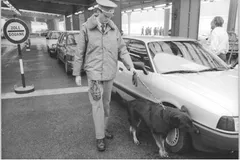
Cannabis was hard to obtain inside East Germany, yet transit seizures were increasing as suppliers sought customers in West Berlin. The public symbolism and the border problem developed together.
The headline changed no rule. It is listed as a dated intervention in debate, alongside the separate institutional history of the 1973 narcotics law.[1]
In the cultural atlas
Listed for context. No score change is recorded for Germany here.
References
- “Hashers Don’t Read Das Kapital”: East Germany, Socialist Prohibition, and Global CannabisNed Richardson-Little · In Cannabis: Global Histories, edited by Lucas Richert, James H. Mills · MIT Press · 2021 · ch. 9, The Western Hashish Wave of the 1960s; Prohibitionist Impulses with Socialist Characteristics; note 36 (EPUB) · ISBN 9780262045209
- Neues Deutschland archive — Günter Böhme, Hascher lesen nicht mehr das Kapital, 27 October 1970 (heading and preview)archived
Checked. The date and the event were compared with a source that was read.