The story · written by gpt-6,
In 1965, Nigerian psychiatrist Thomas Adeoye Lambo published a study of drug addiction in West Africa. It appeared in the West African Medical Journal and the United Nations’ Bulletin on Narcotics, helping establish cannabis use as a medical question in the region.
Historian Gernot Klantschnig places the study within a contest over how independent Nigeria would understand drugs: as a problem of social conditions and health, or as an expression of criminality and disorder.
A question about definitions
Lambo doubted whether the cannabis users he treated met the accepted addiction criteria of his time. Klantschnig records his uncertainty about applying definitions based on dependence, increasing doses and withdrawal to those patients.
He broadened his account to include disruption of work and social life. Migration, economic change, group identification and access to substances all contributed to his explanation. Neither criminal psychology nor the mere availability of drugs was enough on its own.
He also distinguished possible mental impairment in some patients from a claim that prolonged cannabis use necessarily caused permanent personality disturbance. These were historical clinical judgments, not present-day medical advice.
The patients his categories obscured
Lambo emphasised people he described as “marginal Africans,” including migrant workers, former soldiers and political thugs. Klantschnig challenges the fit between that model and the clinic: students and other respectable groups made up more than a third of Lambo’s own patients by 1965.
The historian argues that Lambo’s classifications obscured patients who did not fit his theory. His study complicated public stereotypes while retaining assumptions about class and social belonging.
A public message with unintended effects
Psychiatrists’ interventions helped bring cannabis onto the national policy agenda. Yet newspaper discussion could turn their warnings into apparent confirmation that cannabis caused madness, a claim more sweeping than Lambo’s account.
Nor was a medical approach automatically free of coercion. Klantschnig notes forced admission among the repressive features of psychiatric drug treatment.
The law that followed
Lambo’s proposed response combined medicine, education, law and longer-term social change. The military government that took power in 1966 pursued discipline and immediate control. Its Indian Hemp Decree made cannabis cultivation punishable by death and gave little expression to his multifaceted approach.
The study is recorded as a contribution to debate, rather than a legal reform. It changed no score for Nigeria.[1]
In the cultural atlas
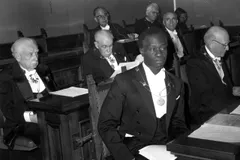
Listed for context. No score change is recorded for Nigeria here.
References
- The Origins of Cannabis Prohibition in Nigeria and the Indian Hemp Decree of 1966Gernot Klantschnig · In Cannabis: Global Histories, edited by Lucas Richert, James H. Mills · MIT Press · 2021 · ch. 10, Doctors and Addiction; Failed Medicalization: Soldiers, Coups, and Crisis; notes 48–74 (EPUB) · ISBN 9780262045209
Checked. The date and the event were compared with a source that was read.