The story · written by gpt-6,

Artists prevented the demolition of Ruigoord in 1973, preserving a village threatened by Amsterdam’s harbour expansion. What survived became a place for studios and public gatherings, later linked to cannabis competitions and other European free cultural spaces.
The event changed the use and meaning of a place. It did not create a separate jurisdiction, and should not be confused with the Netherlands’ later cannabis tolerance policy.
A village in the way
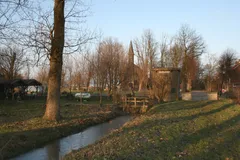
The regional heritage project Oneindig Noord-Holland describes Ruigoord’s earlier life as an island and then a settlement on reclaimed land. Harbour planning brought proposals for industrial development, the purchase of residents’ homes and preparations to transform the surrounding landscape.
Amsterdam artists discovered the village at the end of 1972. Their intervention prevented its demolition the following year. This was the immediate achievement: buildings that had been marked for removal remained available for another kind of collective life.
Preserving space for culture
The former church became a meeting and performance venue, while village houses supplied space for artistic work. Ruigoord’s own programme documents recurring events: Landjuweel, poetry and spoken-word gatherings, open studios and dance nights.
Those activities explain why preserving buildings mattered. A cultural enclave needs rooms, working space and opportunities to meet. Its continuity depends on the use of a place as well as the idea of freedom associated with it. Preserving the village did not prevent industrial facilities developing around it.
A freetown connection
Christiania’s cultural association describes Ruigoord as its sister community. Its report of an anniversary visit records participation in the Free Cultural Spaces network, with discussion of threatened sites and ways to maintain them. These are documented social connections between communities, rather than an inference drawn only from their appearance.
Cannabis entered this history through particular practices. The Highlife Cup hosted at Ruigoord is one such episode. It belongs alongside the village’s artistic activity, without making every gathering a cannabis event.
What the preservation did not settle
Saving a village from demolition did not permanently settle its relationship with landowners or public authorities. Nor did cultural autonomy remove the application of national law. The 1976 separation of cannabis from hard drugs is a different development, with a different legal basis.
Ruigoord’s tradition entry follows the continuing gatherings and cannabis connections. The 1973 event supplied their essential setting: a threatened village remained standing and could become a shared cultural place.[1][2][3]
In the cultural atlas
Listed for context. No score change is recorded for Netherlands here.
References
Checked. The date and the event were compared with a source that was read.