The story · written by gpt-6,
A report dated July 3, 2017 attributed an unexpected ranking to the head of Iran’s Drug Control Headquarters: gol, cannabis flower, had become the country’s second most commonly consumed drug after opium. Maziyar Ghiabi and colleagues cited the report in their 2018 study of cannabis, religious interpretation and possible policy reform in Iran.
The statement brought an increasingly visible urban practice into official discussion. It did not announce a change in cannabis law.
A familiar plant with a different name
Gol means flower in Persian. In the cannabis market, it referred to herbal material promoted as potent marijuana, alongside the resin traditionally known as bang or hashish.
Ghiabi’s later ethnographic chapter traces its marketing in Tehran around 2000 and its popularity among university students and participants in the capital’s arts scenes during the 2010s. It carried an international image, associated by some consumers with North American cannabis culture.
Calling it a flower also helped users distance themselves from the stigma attached to other drugs. Interviewees described it as an herbal product and contrasted themselves with hashish smokers. These statements reveal social distinctions and beliefs about risk; they do not establish that flower was chemically pure or harmless.
What the ranking establishes
The 2018 paper cites ADNA’s July 3 report for the drug chief’s statement. The passage does not provide a survey sample, prevalence table or definition of the period over which consumption was measured. The ranking is therefore recorded here as an attributed official claim, rather than an independently reconstructed national statistic.
The same caution applies to the relationship between gol and older products. Ghiabi describes flower gaining currency in particular urban settings, but his research also documents continuing hashish use. A changing market did not mean one preparation had disappeared or that every social group used the same vocabulary.
Visibility under prohibition
Cannabis had been brought under Iran’s prohibition in 1959. By the mid-2010s, researchers and policy figures were discussing possible regulation, while consumers occupied private and informal social spaces.
Official concern about gol formed part of that debate. Neither the July 2017 statement nor the cultural visibility described by researchers created a lawful market. The event records a change in public recognition of cannabis flower, with no change to the country’s legal score attributed to the announcement.[1]
In the cultural atlas
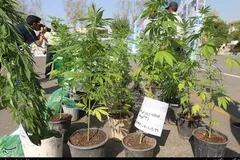
Listed for context. No score change is recorded for Iran here.
References
- “We Smoke Flowers”: On “Being High” in Postrevolutionary IranMaziyar Ghiabi · In Cannabis: Global Histories, edited by Lucas Richert, James H. Mills · MIT Press · 2021 · ch. 12, introductory discussion; Hashish Versus Marijuana: Class(ist), Gender(ed) Environments of Consumption (EPUB) · ISBN 9780262045209
- Ghiabi, Maarefvand, Bahari & Alavi — Islam and cannabis, legalisation and religious debate in Iran, International Journal of Drug Policy 56 (2018)archived
Checked. The date and the event were compared with a source that was read.