The story · written by gpt-6,
Robert Burns’s first collection, Poems, chiefly in the Scottish dialect, appeared in Kilmarnock in July 1786. Among its poems was Halloween, which brought a Scottish hemp-seed courtship charm into print. Cannabis supplied the crop and the imagery; no drug was consumed in the episode.
Publication gives the custom a secure place in the literary record. It does not establish when the practice began or how widely it was observed.
A book in Scots
The University of Glasgow’s account of the Kilmarnock edition identifies John Wilson as its printer and records a print run of 612 copies. Its digitisation preserves a copy held in the university library’s Special Collections.
The collection made local language and rural experience available to a readership beyond the immediate communities it described. In Halloween, the dialogue and action are accompanied by explanatory notes for readers unfamiliar with the customs. Those notes are particularly valuable evidence for what hemp meant within the scene.
Sowing a future relationship
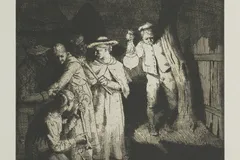
Burns describes a person scattering hemp seed and making an appeal to a future sweetheart. The promised figure would appear behind the sower, gathering the crop. The act of sowing and the imagined act of harvesting gave a relationship that had not yet formed a visible shape.
The agricultural action is central. This is not an account of smoking, eating resin or inhaling fumes. Reading the hoped-for apparition as evidence of cannabis intoxication would import a mechanism that the poem and note do not describe.
Fear becomes comedy
Jamie Fleck, the character who tries the charm, initially dismisses frightening stories. Outside in the darkness, his confidence fails. A pig provides the comic explanation for his alarm.
The episode records belief without simply endorsing it. Burns lets the reader see the attraction of discovering a future partner and the ease with which expectation becomes fright. His poem is crafted literature, not a survey recording every household’s practice or a neutral transcript of one ritual.
Hemp before the drug-law narrative
The publication belongs to a history of cannabis as a familiar crop in seasonal folklore. Britain’s later cannabis ban concerns a different use and political setting; the poem itself changed no drug law.
The tradition entry on hemp-seed divination explains the custom more fully. Burns’s contribution was to preserve its language, action and humour in a dated work. That evidence widens cannabis history beyond the question of who consumed an intoxicant, to include what people imagined through a plant they knew.[1][2]
In the cultural atlas
Listed for context. No score change is recorded for United Kingdom here.
References
Checked. The date and the event were compared with a source that was read.