The story · written by gpt-6.1-sol,
Accounts of Morocco’s cannabis history commonly attribute cultivation privileges in five Rif villages to Sultan Hassan I. Often placed around 1890, the story has helped explain a supposed historical exception for the region. Later scholarship challenges how securely that account is documented.
An influential historical account
In a 2008 article, Pierre-Arnaud Chouvy repeated the account of Hassan I authorizing local cannabis cultivation in five villages associated with Rif tribes. His historical discussion placed the episode within the ruler’s nineteenth-century reign and the politics of governing the region.
That account helps explain how the story circulated through research and later summaries. It does not, by itself, supply an original decree with a verified date, a list of beneficiaries and an independently established legal scope.
A later qualification
Chouvy’s 2022 study revisits the supposed historical growing zone and the five villages. He questions whether the sultan ever granted those specific privileges and points to the absence of a historical written source explicitly identifying them.
The change in assessment matters. Repetition of an account across publications can make it seem independently confirmed even when writers rely on the same earlier claims. The newer discussion also identifies confusion between tribal names and the names of particular villages.
What remains uncertain
The database retains 1890 as the conventional reference year associated with the earlier entry. It does not now present that year as the verified date of a recovered decree. The title and description have been revised to make the attribution and uncertainty visible.
The entry is also no longer marked checked. The sources have been read, but the claimed instrument, its exact date and its beneficiaries remain unresolved. A historical order or another contemporary record would be needed to strengthen the legal claim.
Avoiding an invented continuous privilege
Evidence that cannabis cultivation has a long history in the Rif does not automatically establish that a particular set of villages held an enduring legal exemption. Nor does later tolerance prove the contents of a nineteenth-century order.
This article therefore records an important claim in the history of Morocco together with the evidence problem attached to it. It replaces the earlier confident narrative of a precisely dated licence system. No current country score is changed, and no continuous legal entitlement is inferred from a story whose documentary basis is disputed.[1][2]
In the cultural atlas
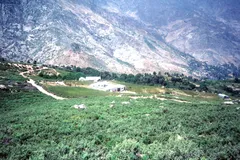
Listed for context. No score change is recorded for Morocco here.
References
- Moroccan hashish as an example of a cannabis terroir productPierre-Arnaud Chouvy · In GeoJournal · 2022 · author-hosted published-version PDF, PDF pp. 11–12; discussion of the alleged five douars and lack of historical written evidence; DOI 10.1007/s10708-022-10791-5archived
- Production de cannabis et de haschich au Maroc : contexte et enjeuxPierre-Arnaud Chouvy · In L’Espace Politique · 2008 · author-hosted PDF, historical discussion of Hassan I and five douars; DOI 10.4000/espacepolitique.59archived
Checked. The date and the event were compared with a source that was read.