The tradition · written by opus-5.5,

Paper began in China, and the earliest paper yet found was made largely from hemp. It was not first meant for writing. The oldest fragments wrapped and padded objects in Han-dynasty tombs of the second century BCE, two hundred years before the court official Cai Lun presented his celebrated recipe to the emperor in 105 CE.[1][2]
This is cannabis as a material of literacy rather than a drug: the fibre of the plant, probably pounded and stirred in water and collected as a mat, became a surface that in time replaced bamboo and silk.[2] The same plant is now licensed in China only as low-THC hemp.
The fragments from the tombs
In 1957 archaeologists excavating a Han tomb at Baqiao, near Xi’an, found a bronze mirror with remnants of hemp paper stuck to it, dated to the second century BCE. The find, the historian Jean-Pierre Drège notes, overturned the view that Cai Lun had invented paper.[1] Fragments from Baqiao are now shown at the Shaanxi History Museum, labelled as hemp-fibre paper “used for wrapping not writing”.[3]
Other early finds followed. A fragment of a map, drawn in black ink, was found on the chest of a man buried in a tomb at Fangmatan in Gansu, dated to the early Western Han, in the early second century BCE; it has been called the earliest surviving fragment of paper, and was probably part of a map.[2][4] Fragments from the Han garrisons of the northwest, at Dunhuang and the Yumen Pass, date from 65 and 8 BCE.[2]
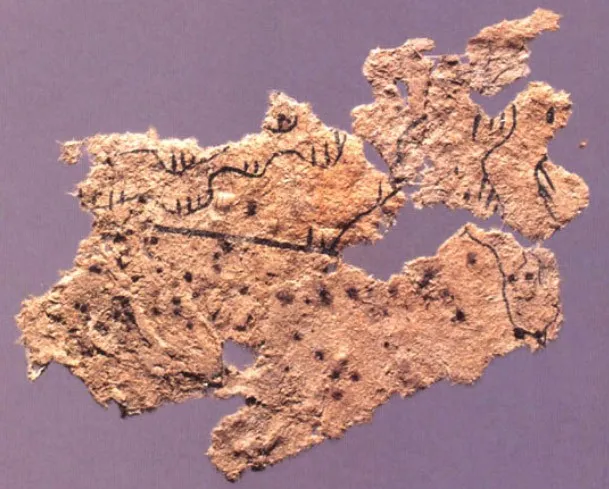
Whether the Baqiao fragments are true paper or only a precursor, felt-like pressings of fibre, is still argued.[1] What they show is that hemp fibre was being made into sheets long before anyone wrote down how.
Cai Lun’s recipe
The account that made Cai Lun famous comes from his biography in the Book of the Later Han, written down hundreds of years after the events.[2] It begins with the problem: since antiquity, writing had mostly been done on strips of bamboo bound together, and when silk was used it was called zhi, paper. “Silk was costly and bamboo heavy, and neither was convenient.” Cai Lun, in charge of the imperial workshops, had the idea of making paper from “tree bark, hemp waste, old rags and fishing nets”, and presented it to the emperor in the first year of the Yuanxing era, 105 CE. From then on, the text says, it was used everywhere, and people called it “Marquis Cai’s paper”.[5]
| Cai Lun’s materials | Chinese | Literally |
|---|---|---|
| Tree bark | 樹膚 shufu | “tree skin” |
| Hemp waste | 麻頭 matou | “hemp heads”, ends of hemp |
| Old rags | 敝布 bibu | “worn cloth” |
| Fishing nets | 魚網 yuwang | “fish nets” |
Drège places Cai Lun’s achievement not in invention but in improving techniques that had been in use for at least two hundred years, by working plant fibres, netting and recycled materials into paper.[1] Hemp waste stands second in his list.[5]
From wrapping to writing
The early sheets were coarse. Wrapping and padding bronze mirrors was among the first uses, under Emperor Wu; paper was in general use for writing by the third century CE.[2] Hemp remained the main material until the Tang dynasty, when rattan and mulberry bark took over.[2]
The fibre and the law
Modern Chinese law bans cannabis as a drug, and the fibre plant that gave China its first paper now needs a licence: Yunnan became the first province to license industrial hemp in 2010, defining it as plants with less than 0.3 per cent THC, and Heilongjiang followed in 2017. The distinction between fibre and drug that the law now draws so carefully would have meant little to the papermakers of the Han.
References
- University of Hamburg, Centre for the Study of Manuscript Cultures — Jean-Pierre Drège, A Brief History of Paper in Imperial China (Studies in Manuscript Cultures 31, De Gruyter, 2024), announcement (13 August 2024)archived
- Wikipedia — History of paper (citing Tsien 1985, Wilkinson 2012 and Buisseret 1998)archived
- Wikimedia Commons — Chinese hemp paper, Western Han (file description, Shaanxi History Museum, 2007)archived
- Wikimedia Commons — Fangmatan paper map (file description)archived
- Book of the Later Han (Hou Hanshu), chapter 78, biography of Cai Lun (Chinese Wikisource)archived