The story
A set of scorched wooden braziers from western China contains some of the earliest directly dated chemical evidence that people selected and burned cannabis for its psychoactive effect.
A cemetery in the Pamirs
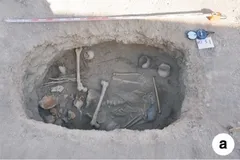
The Jirzankal cemetery lies more than 3,000 metres above sea level in the eastern Pamir Mountains of today’s Xinjiang. It was used about 2,500 years ago, around 500 BCE. Archaeologists excavated ten wooden braziers containing heat-marked stones from eight tombs.
The cemetery’s black-and-white stone strips and burial forms connect it with wider Central Asian practices. Objects found there also point to movement and exchange across the mountains long before formal Silk Road administration.
Strontium analysis found that ten of 34 sampled people were not local. Glass beads, silk and a harp likewise place the cemetery within a landscape of long-distance cultural contact.
What the chemistry found
Researchers extracted organic material from ten brazier fragments and four burned stones, then analysed it with gas chromatography and mass spectrometry. Cannabis biomarkers appeared in nearly all of the burned residue samples. Control samples from the vessels’ exteriors contained no cannabinoids.
The principal marker was cannabinol, a product formed when THC degrades. The absence of the pattern expected from cannabidiol led the researchers to conclude that the burned plants had higher THC levels than typical wild cannabis.
That does not prove deliberate plant breeding. The paper offers several possibilities: people may have selected naturally stronger plants, high-altitude stress may have increased cannabinoid production, or hybridisation may have played a role.
A funerary setting
The braziers came from tombs, so the authors interpret the burning as part of mortuary ritual. Heated stones inside wooden vessels may have released smoke into an enclosed space. The evidence demonstrates burning and likely inhalation, though it cannot reconstruct exactly what participants believed or experienced.
This distinction matters. East Asian communities had cultivated cannabis for seed and fibre for millennia, but direct evidence of psychoactive use in antiquity is scarce and often disputed.
Why the index did not move
The study was published in 2019, but its subject is ancient cultural practice, not a modern law. It adds deep historical context to China without changing any of the country’s six freedom scores.[1][2]
In the cultural atlas
Listed for context. No score change is recorded for China here.
References
Checked. The date and the event were compared with a source that was read.